


Syllabus: GS2/IR/GS3/Economy
Context
- The US recently articulated its vision for reforming the World Trade Organization (WTO).
Major Highlights of the US Suggested Reforms
- Decision-Making (Plurilateralism): The US argues consensus among 166 members is unrealistic for new trade rules.
- It supports plurilateral agreements among willing members as the future of WTO rule-making.
- Plurilateral describes agreements, or initiatives involving a limited group of countries that share specific interests, often focusing on particular sectors or issues, offering a flexible way to advance cooperation.
- Special & Differential Treatment (S&DT): The US wants S&DT largely restricted to least developed countries.
- It advocates uniform rules for all other members regardless of development gaps.
- It demands strict justification for any deviation from common obligations.
- Level Playing Field: US highlights trade distortions from non-market policies and practices.
- Links erosion of trust in WTO to overcapacity and state intervention.
- It proposes transparency and stricter notification compliance as key remedies.
- Most-Favoured-Nation (MFN) Principle: US questions MFN’s relevance in an era of divergent economic systems. It argues MFN enforces one-size-fits-all liberalisation.
- It supports wider departures to allow differentiated trade relationships.
- MFN principle requires member countries to treat all trade partners equally by extending the same trade benefits (e.g., reduced tariffs or market access) to all signatories.
- Role of WTO Secretariat: The US strongly criticises the role of the WTO Secretariat, which it views as fundamentally administrative rather than substantive.
- It accuses the Secretariat of overstepping its mandate by expanding its monitoring and commentary on members’ trade measures, and undertaking research projects not authorised by members.
Concerns with Reforms
- MFN Principle: India should strongly oppose dilution of MFN principle.
- MFN ensures predictability and protects weaker trading nations.
- Its erosion would entrench power-based trade relations.
- Trade Imbalances: The concern of Trade imbalances requires attention but it should not dominate trade policy. Structural and macroeconomic factors must be acknowledged.
- WTO should not be reduced to a balance-of-trade enforcement forum.
- Economic Security: Economic security concerns should be addressed multilaterally within the WTO.
- Safeguards Agreement could be expanded to include strategic vulnerabilities.
- S&DT Reform: Limiting S&DT only to LDCs is excessively rigid. A differentiation approach based on income levels offers a balanced approach.
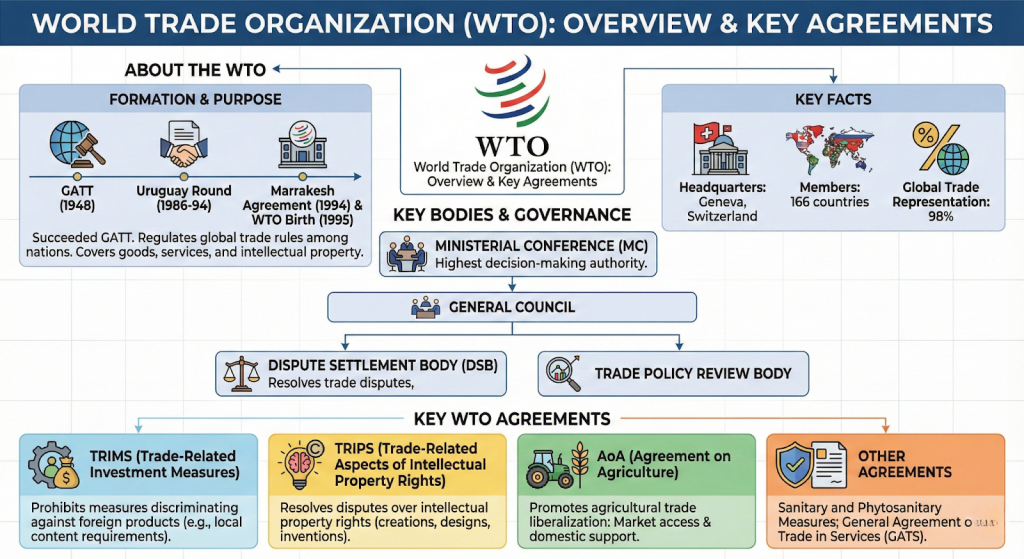
Source: BL
Previous article
Water Guardians: A Local Fight Against Desertification
