


Syllabus: GS3/Economy
Context
- In an era of global economic uncertainty and rising protectionism, like the recent U.S. hike on Indian steel and chemical products, India’s tourism sector stands out as a resilient, inclusive, and tariff-proof engine of growth.
About Tourism Sector in India
- Current Statistics (2023–24): India’s tourism sector has rebounded strongly post-pandemic, with both domestic and international travel showing impressive growth:
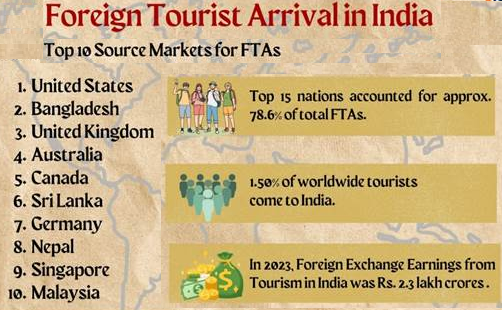
- Foreign Tourist Arrivals (FTAs): 9.52 million (2023), up 47.89% from 2022;
- Non-Resident Indian (NRI) Arrivals: 9.38 million (2023), up 18.9% from 2022;
- Domestic Tourist Visits (DTVs): Domestic visitor spending ₹14.64 trillion (2023), up 15% from 2019;
- Foreign Exchange Earnings (FEEs): ₹2.3 lakh crore (2023), up 31.5% from 2022;
- GDP Contribution: About 5% to India’s GDP (Global average of 10%); Countries like Spain and the UAE earn around 12% of GDP from tourism;
- Global Ranking: India ranks 39th in the Travel & Tourism Development Index (World Economic Forum) 2024; Strong performance in:
- Price Competitiveness: 18th;
- Air Transport Infrastructure: 26th;
- Ground & Port Infrastructure: 25th;
Tourism’s Transformative Potential
- Tourism Vision @2047: 100 million foreign tourists by 2047; Focus on adventure, wellness, heritage, and niche tourism segments;
- Raising tourism’s share of GDP from 5% to 10% over the next decade could:
- Add $516 billion annually to the economy;
- Create 40 million new jobs;
- Boost foreign exchange earnings to $130–140 billion;
- India currently has 1,80,000 branded hotel rooms and 1.5 million unbranded ones. Both categories need to triple to meet demand and keep prices competitive.
Why Is Tourism Tariff-Proof?
- Contrast with Tariff-Vulnerable Sectors: Key sectors like steel, chemicals, telecom equipment, and medical devices are vulnerable to tariffs that can reduce competitiveness, shrink export volumes, and lead to job losses.
- However, tourism, by contrast, is insulated from these risks.
- No Border Duties: When a foreign tourist visits India, they spend money on hotels, food, transport, and experiences—all within India.
- There are no import/export tariffs involved, making tourism immune to global trade wars or protectionist policies.
- Direct Foreign Exchange Earnings: In 2024, India earned $28 billion (₹2.45 lakh crore) in foreign exchange from inbound tourism.
- It is not subject to customs duties, unlike goods exports which can be taxed or restricted by other countries.
- Economic & Strategic Value: Tourism supports millions of jobs across urban and rural India.
- It has one of the highest economic multipliers—every rupee spent by a tourist flows through multiple sectors like transport, crafts, and hospitality.
Related Efforts & Initiatives
- Budgetary Provision: ₹2,541 crore for tourism development (FY 2025–26) for infrastructure, skill development, travel facilitation, and heritage conservation.
- Swadesh Darshan Scheme: Integrated development of theme-based tourist circuits, like Buddhist Circuit, Coastal Circuit, Desert Circuit.
- Financial assistance to states/UTs for infrastructure and amenities.
- Pilgrimage Rejuvenation and Spiritual, Heritage Augmentation Drive (PRASHAD) Scheme: Development of pilgrimage sites and spiritual destinations.
- To enhance religious tourism and visitor experience.
- E-Visa Expansion: It is available under 7 sub-categories including e-Tourist Visa; e-Medical Visa; and e-Ayush Visa.
- It has 5-year multiple entry, 1-year multiple entry, 1-month double entry options.
- Incredible India Tourist Facilitator Certification: Online training platform to create a pool of certified tourist guides.
- Capacity Building for Service Providers (CBSP): Training programs for hospitality and tourism workers. It aims to improve service standards and employability.
- MUDRA Loans for Homestays: Financial support for individuals to start or upgrade homestay businesses.
- Performance-Linked Incentives to States: Rewards for effective destination management, cleanliness, and marketing.
- Heal in India Initiative: It promotes India as a global medical tourism hub. It includes visa facilitation, private sector collaboration, and upgraded healthcare infrastructure.
Strategic Pathways for Growth
- Develop World-Class Destinations: The Union Budget’s plan to develop 50 destinations in partnership with states is a strong start.
- Each state needs at least one world-class hub combining infrastructure, sustainability, and branding.
- Streamline Travel Facilitation: Simplified e-visas, shorter immigration queues, and seamless arrivals are essential.
- With Indian airlines expanding by 1,000 aircraft, connectivity can be leveraged to attract more visitors.
- Leverage Digital Storytelling: The future lies in content-led promotion. By partnering with influencers and global platforms, India can amplify its presence through AI-enabled curation and digital campaigns.
- Unlock Private Investment: Including tourism infrastructure in the Harmonised Master List can catalyse PPP investments in hotels, ropeways, wayside amenities, and convention centres.
- Strengthen Domestic Tourism: The Dekho Apna Desh campaign can be scaled into a national movement.
- With 86% of revenues already from domestic tourism, making interstate travel more affordable will enhance cultural exchange and economic redistribution.
| Daily Mains Practice Question [Q] Discuss how tourism in India functions as a tariff-proof sector and evaluate its potential to drive inclusive economic growth in the face of global trade uncertainties. |
Previous article
What Does the New Online Gaming Act Outline?
