


Syllabus: GS3/Renewable Energy; Environment
Context
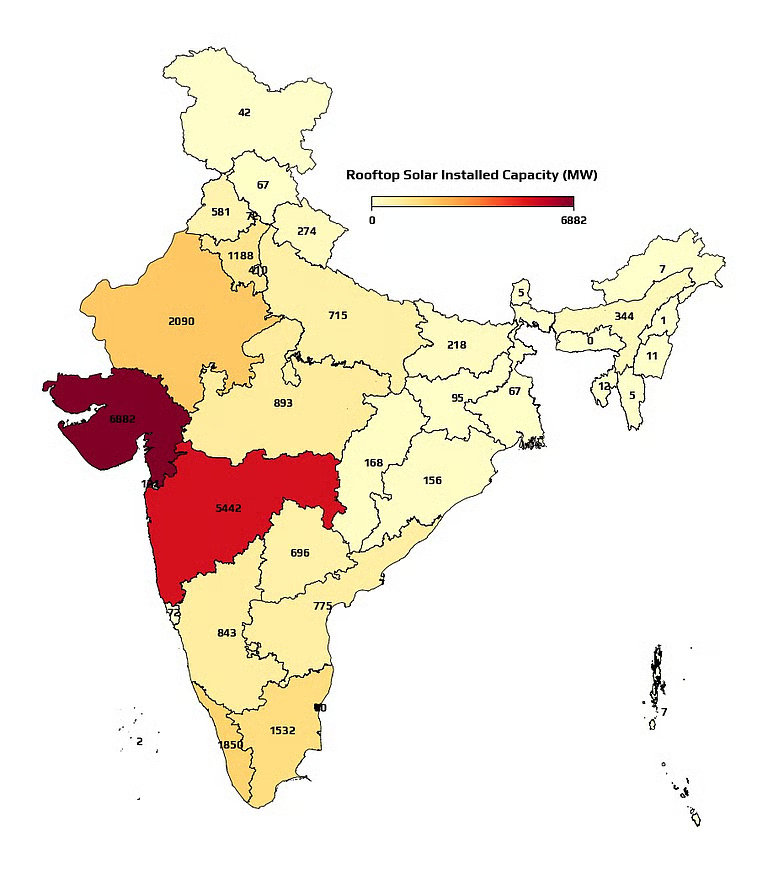
- Recent analysis by Climate Compatible Futures (CCF) and data from MNRE highlights significant regional disparities in adoption in rooftop solar.
India’s Rooftop Solar Landscape
- India’s total rooftop solar capacity reached 25.7 GW, with 2.7 GW added in Q1 of 2026 alone, marking a 125% year-on-year growth.
- Gujarat and Maharashtra now carry more rooftop solar than the rest of the country put together, while West Bengal, Odisha and much of the east have barely started.
Reason Behind Rooftop Solar Boom
- PM Surya Ghar: Muft Bijli Yojana (2024): It aims to cover 1 crore households and to provide subsidies up to ₹78,000 for residential rooftop systems.
- It aims to promote decentralised clean energy generation and to reduce household electricity expenditure.
- Residential consumers contributed nearly 82% of new rooftop additions in early 2026.
- Strong Ecosystem in Leading States: Major solar rooftop states have developed related infrastructure, easier access to credit, efficient DISCOM and faster net-metering approvals.
Regional Distribution of Rooftop Solar
- Western and Southern Leadership: The top ten states constitute almost 86% of India’s rooftop solar power installations.
- Important factors include timely government policies, well-developed solar market, better performing DISCOMS, and presence of vendors and financial institutions.
- Eastern Region of India: Eastern states are still struggling due to sufficient sunshine in the region.
- Main barriers are stressed DISCOMS, insufficient number of installers, lack of credit access, poor awareness among consumers, and delayed approval of net metering systems.
- North-Eastern Region: Deployment of rooftop solar is still low despite increased government support centrally.
- Important barriers include shortage of vendors, poor utility capabilities, delayed approvals, lack of financing options, and poor public awareness.
Key Issues Hindering Expansion
- Institutional Challenges: Unhealthy financial condition of DISCOMs, delay in getting approvals for net metering, and poor coordination among different state departments.
- Economic Challenges: Lack of access to finance and high initial cost even after subsidy.
- Market Challenges: Insufficient presence of installer in backward areas, and absence of network of after-sales services.
- Social Challenges: Poor knowledge of subsidies and cost savings, and poor consumer confidence.
India’s Renewable Energy: Recent Trends & Future Projection
- India stands at 3rd position for solar power, 4th position for wind power, and 4th position for total renewable energy installed capacity worldwide. (IRENA Renewable Energy Statistics 2025)
- Total solar power has surpassed 150 GW, including the projects which are under implementation and pipeline.
- India has outpaced its NDC target for the year 2030, and it can attain 500 GW of non-fossil fuel power by 2030.
- Solar capacity may touch 1,500 GW by 2050 on account of Current Policy Scenario, and about 2,400 GW by 2050 on account of Net Zero Scenario. (NITI Aayog)
- Hence, solar power is important for India’s Net Zero target by 2070.
India’s Climate Pledges
- The third nationally determined contribution (NDC 3.0) by India was approved in March 2026 for submission to the UNFCCC, which pledged to:
- 47% emission intensity reduction of GDP.
- 60% non-fossil installed power capacity by 2035.
Path Ahead
- Empowering DISCOMs: State governments must modernize utilities and motivate them to consider rooftop solar installations as their assets.
- Expanding the Installer Base: Motivating the private sector installers to move to underserved eastern and northeastern states.
- Improving Financial Access: Creating new financial arrangements including low-interest loans, pay-as-you-go schemes, and micro-finance.
- Consumer Awareness Campaigns: Huge efforts by the state are required in this regard through Panchayats, municipal corporations, and DISCOMs.
- Timely Approvals for Installations: Single window approach and digital means can help in that.
Previous article
Twin Climate and Energy Crises: A Call for Clean Energy Transition
Next article
News In Short 25-06-2026
