


Syllabus: GS3/ Defence and Security / Science and Technology / Economy
Context
- The Defence Minister of India emphasised that nations capable of manufacturing their own weapons shape their own destiny during the inauguration of NIBE Group’s Defence Manufacturing Complex at Shirdi in Maharashtra.
About the Event
- Defence Manufacturing Complex: The facility will manufacture advanced artillery systems, missile and space technologies, rocket systems, energetic materials, and autonomous defence platforms.
- Suryastra Rocket System:
- India’s first 300-km Universal Rocket Launching System, named “Suryastra,” was flagged off during the event.
- The foundation stone for a dedicated missile complex related to the system was also laid.
- Indigenous Technologies Unveiled:
- Indigenous TNT Plant Technology was unveiled during the ceremony.
- Indigenous RDX Plant Technology was also introduced.
- A Renewable Bio-Energy Compressed Biogas Plant was unveiled as part of the initiative.
- An MoU was exchanged between NIBE Group and Black Sky for cooperation in satellite assembly.
Defence Production in India
- Sectoral Contribution: In FY 2024-25, defence public sector undertakings (DPSUs) accounted for 57.50% of the total defence production, while Indian ordnance factories contributed 14.49%, and non-defence PSUs 5.4%.
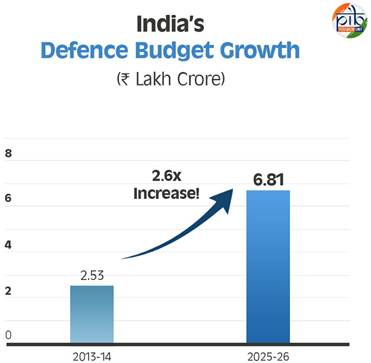
- Defence Budget Growth: Increased from ₹2.53 lakh crore in 2013-14 to ₹6.81 lakh crore in 2025-26.
- In 2024-25, India achieved its highest-ever defence production of ₹1.50 lakh crore, more than three times the ₹46,429 crore recorded in 2014-15.
- Surge in Indigenous Defence Production: 65% of defence equipment is now manufactured domestically, a significant shift from the earlier 65-70% import dependency.
- India targets ₹3 lakh crore in defence production by 2029, reinforcing its position as a global defence manufacturing hub.
Significance of Defence Self-Reliance
- Strategic Autonomy: Eliminates reliance on foreign powers for critical military hardware, preserving a nation’s sovereign foreign policy and freedom of action without facing geopolitical pressure or sanctions.
- Operational Security: Protects sensitive military infrastructure and command systems from foreign-controlled technology (e.g., GPS or foreign software dependencies), ensuring uninterrupted, secure operations.
- Tailored Defence: Allows militaries to design and procure platforms (such as artillery and missiles) specifically customized to their unique terrain, strategic threats, and combat doctrines.
- Economic Growth: Drives heavy domestic manufacturing, reduces costly import bills, and builds a robust ecosystem that creates high-tech jobs while generating revenue through future defence exports.
Government Measures to Promote Defence Manufacturing
- Defence Industrial Corridors & Indigenous Production Push: Two defence industrial corridors have been established in Tamil Nadu and Uttar Pradesh to bolster its defence manufacturing ecosystem and promote domestic defence production.
- Government schemes such as iDEX (Innovations for Defence Excellence) and DTIS (Defence Testing Infrastructure Scheme) to enable innovation within the Defence & Aerospace ecosystem.
- Self-Reliant Initiatives through Joint Action (SRIJAN): Launched by the Department of Defence Production (DDP) in 2020 to promote indigenisation under Atmanirbhar Bharat.
- Serves as a common platform for Defence Public Sector Undertakings (DPSUs) and the Armed Forces (SHQs) to list imported items for domestic manufacturing.
- Ease of Doing Business (EoDB):
- In 2019, the Defence Product List was streamlined to reduce the number of items requiring a manufacturing licence.
- The validity of defence licences under the Industries (Development and Regulation) Act, 1951, has been extended from three years to 15 years, with a further extension option of up to 18 years.
- Defence Acquisition Procedure (DAP) 2020: It promotes indigenous design, development & manufacturing, prioritises “Make in India” categories.
What are the Challenges?
- India continues to depend on imports for several advanced defence technologies and critical components.
- Research and development expenditure in the defence sector remains comparatively limited.
- Technological gaps exist in areas such as jet engines, semiconductors, cyber warfare, and advanced sensors.
- Private sector participation still faces regulatory and procurement-related challenges.
- Achieving global competitiveness in defence exports requires sustained investment and quality assurance mechanisms.
Way Ahead
- India should strengthen indigenous research and development capabilities in emerging defence technologies.
- Greater collaboration between DRDO, private industries, startups, and academic institutions is required.
- Defence industrial corridors and manufacturing clusters should be expanded further.
- Specialised skill development and training programmes should be launched to create a skilled workforce for emerging defence technologies.
Source: TH
Previous article
US-India Strategic Alliance, Global Influence: Rubio
