


Vande Mataram and the Right to Conscience
Syllabus: GS2/ Polity and Governance
Context
- The Supreme Court observed that the government can determine the scope and length of the National Song, but it cannot violate religious freedom or impose penal consequences on conscientious objectors who decline to sing it.
Constitutional and Legal Status
- The Constituent Assembly recognised Vande Mataram the status of the national song, with equal honour to the national anthem, but not identical legal treatment.
- Prevention of Insults to National Honour (Amendment) Act, 2026: It seeks to amend the Prevention of Insults to National Honour Act, 1971.
- The amendment makes it an offence to intentionally prevent the singing of the National Song or to cause a disturbance to an assembly engaged in its singing.
Constitutional Provisions
- Article 51A(a) Fundamental Duties: Mandates every citizen to abide by the Constitution and respect its ideals and institutions, the National Flag and the National Anthem.
- Absence of Explicit Constitutional Protection: Unlike the national anthem, Vande Mataram is not explicitly protected by any constitutional provision.
- Its status flows from Constituent Assembly resolutions, not from enforceable constitutional text.
- Articles 19(1)(a) and Article 25 become relevant where compulsory participation conflicts with freedom of expression, conscience or religious belief.
Bijoe Emmanuel Judgment, 1986
- In Bijoe Emmanuel v. State of Kerala (1986), the Supreme Court held that respectful non-participation in the National Anthem on grounds of genuine religious belief, is protected under Articles 19(1)(a) and 25.
- The Court held that non-participation, by itself, does not constitute disrespect to the National Anthem.
Vande Mataram
- Vande Mataram was composed by Bankim Chandra Chatterjee in Sanskrit.
- It was first published in the literary journal Bangadarshan on 7th November 1875. It was later included in the novel Anandamath, published in 1882.
- Anandamath is set against the backdrop of the 1769–73 Bengal famine and the Sanyasi Rebellion.
- First sung by Rabindranath Tagore at the 1896 Indian National Congress session in Calcutta.
- During the Swadeshi Movement of 1905, Vande Mataram emerged as the anthem of civil resistance.
- Vande Mataram, as a political slogan, was used on 7 August 1905.
- National Song: On 24 January 1950, the first two stanzas were adopted as India’s National Song.
Source: TH
World Rhino Day
Syllabus: GS3/Species in News
In News
- World Rhino Day is celebrated globally on September 22 every year to raise awareness on the conservation of rhinoceros species.
About
- The day was first proposed by WWF-South Africa in 2010 and observed internationally since 2011, and now coordinated largely by the International Rhino Foundation (IRF).
- This year’s theme is “Keep the Five Alive”.
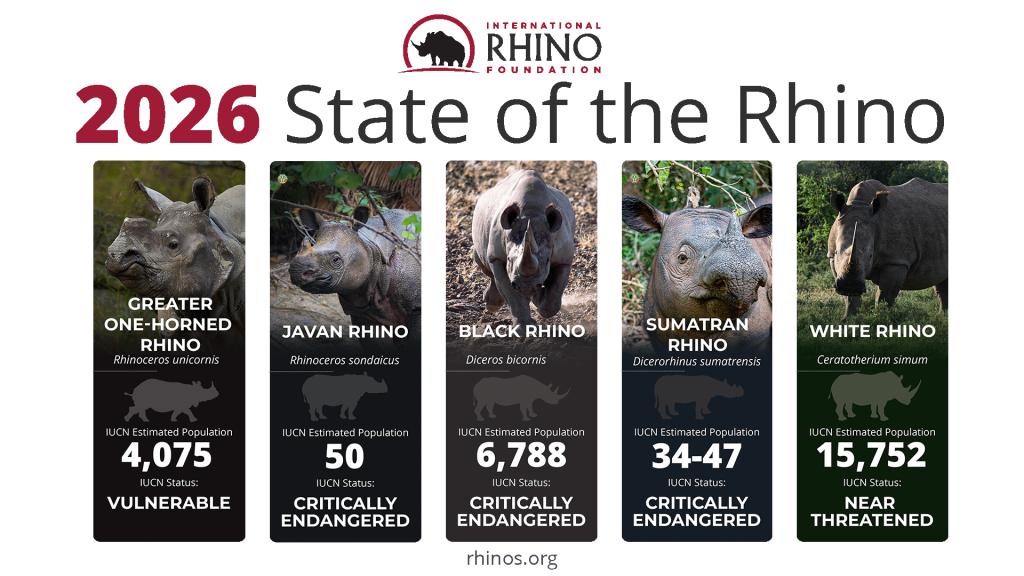
- According to the IRF’s 2026 report, the global rhino population across all five species stands at roughly 26,700, and four of the five species remain threatened with extinction.
- The four (Black, White, Sumatran, and Javan) are found only in Africa and Southeast Asia.
India’s Rhino Story
- Of the five living rhino species in the world, only the Greater One-Horned Rhinoceros (Rhinoceros unicornis) is found in India.
- India Rhino is a single-horned rhino (unlike African rhinos, which have two), with thick, folded skin that gives it an almost armour-plated look.
- It’s the largest of the Asian rhino species, and unlike its Javan and Sumatran.
- IUCN Status is vulnerable & under Schedule I of Wildlife Protection Act.
- It nearly went extinct in the early 1900s due to habitat loss, hunting, and human-rhino conflicts.
- Assam (Kaziranga, Manas, Pobitora, Orang) is home to 3,260 one-horned rhinoceroses, which account for around 80% of its global population.
- Kaziranga became a National Park in 1974 later Tiger Reserve (2006) and a UNESCO World Heritage Site (1985) giving it much stronger legal protection.
- Indian Rhino Vision 2020 (IRV 2020) was launched in 2005 to increase Assam’s rhino population to 3,000 and spread them across at least seven protected areas.
- IRV 2.0, 2021 was launched as a follow-up initiative to conserve 4,500–5,000 rhinos across protected areas by 2030.
Source: PIB
US–Denmark–Greenland Agreement and Arctic Security
Syllabus: GS2/ IR
Context
- The United States, Denmark and Greenland have signed an agreement to strengthen Arctic and North Atlantic security, including plans for an expanded U.S. military presence in Greenland.
About Greenland
- It is semi-autonomous and part of the Kingdom of Denmark, with strong defense ties to NATO.
- Location: Situated between the Arctic and North Atlantic Oceans, northeast of Canada.
- Greenland is the world’s largest non-continental island, and roughly 80% of its surface is covered by a massive ice sheet.
Strategic Importance of Greenland
- Military significance: Greenland is significant for missile warning, missile defence and satellite monitoring, in particular because of its position between North America, Europe and the Arctic.
- Russia and China: Greater access to the Arctic has heightened geopolitical competition between Russia, China and NATO members.
- Emerging shipping routes: The melting of Arctic sea ice is creating new marine routes, making the region more geologically and commercially important.
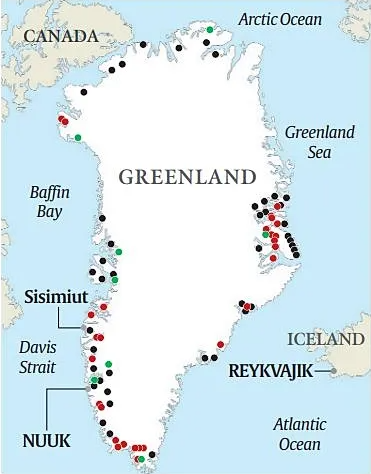
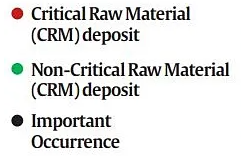
- Critical minerals: Greenland has large mineral resources, which gives it an economic aspect to its strategic importance.
U.S. Military Presence in Greenland
- The U.S. has maintained a military presence in Greenland for decades.
- The Pituffik Space Base in northwestern Greenland currently hosts U.S. personnel and supports missile warning, missile defence and space surveillance operations for the U.S. and NATO.
Source: BBC
International Mobile Equipment Identity (IMEI) Number
Syllabus: GS2/Governance/GS3/Science and Tech
In News
- The expanding digital ecosystem brings concern of misuse of the International Mobile Equipment Identity (IMEI) number.
International Mobile Equipment Identity (IMEI) number.
- The IMEI is a unique 15-digit number that identifies a mobile device on a telecom network.
- The first eight digits of an IMEI form the Type Allocation Code (TAC), which identifies the device model or type.
- The Global System for Mobile Communications Association (GSMA) oversees the global allocation of TAC to manufacturers and brand owners. Manufacturers then assign unique IMEIs to individual devices.
- A dual-SIM phone generally has two IMEI numbers, one for each SIM slot.
Tampering issues
- Unlawful IMEI tampering refers to intentionally removing, erasing, changing or altering a mobile device’s unique IMEI number.
- It also includes knowingly using, producing, selling/trafficking, controlling, or possessing hardware or software configured to alter or manipulate an IMEI.
- Such practices can hinder device identification, complicate law enforcement and weaken telecom network security.
Legal Protection Against IMEI Tampering
- India has a robust legal framework to defend the sanctity of the telecommunication eco-system.
- The Telecommunications Act, 2023 allows for strict action against manipulation of telecommunication identifiers like IMEI number of mobile smartphones and other telecommunication devices.
Suggested Measures
- Manufacturers and importers need to register and assure genuine and unique IMEIs through the Device Setu–ICDR portal and vendors need to validate IMEIs and refrain from dealing in altered devices.
- Consumers must buy from licensed merchants, safeguard devices, utilise authorised repair centers and validate IMEIs. In case of loss or theft, they should report the police, get a replacement SIM and ban the device through Sanchar Saathi/CEIR to assist prevent fraud and boost telecom security.
Source: PIB
Community of Latin American and Caribbean States (CELAC)
Syllabus: GS2/IR
Context
- The External Affairs Minister called for greater solidarity among Global South countries at the India – Community of Latin American and Caribbean States (CELAC) Foreign Ministers’ Meeting.
About
- The Community of Latin American and Caribbean States (CELAC) is a regional bloc of 33 Latin American and Caribbean states.
- It was formed at the Unity Summit, which consisted of the 21st Summit of the Rio Group and the 2nd Latin American and Caribbean Summit on Integration and Development (CALC) in 2010.
- Aim: To unite all of the Latin American and Caribbean states in order to strengthen the political, social and cultural integration of the region.
- It is a successor of the Rio Group and the 2nd Latin American and Caribbean Summit on Integration and Development (CALC).
- India–CELAC bilateral trade reached $50 billion in 2025–26.
- India reaffirmed its commitment to deepening its partnership with CELAC countries across a broad range of areas.
- The meeting reflected India’s growing engagement in the Latin America & Caribbean region and the mutual desire to take the partnership to greater heights.
Source: MEA
National Single Window System
Syllabus:GS2/Governance
In News
- Recently, the National Single Window System completed 5 Years.
National Single Window System (NSWS)
- It was launched in 2021 and is implemented by the Department for Promotion of Industry and Internal Trade (DPIIT), Ministry of Commerce & Industry.
- It consolidates approvals granted by Central Ministries, State Governments and regulatory authorities on a uniform digital platform.
- It provides a single window to the investors to identify, apply and track approvals.
- It has major features like Know Your Approvals, Common Registration Form, Applicant Dashboard, Document Repository and E-Communication Module.
Importance
- It streamlines approvals, lowers duplication and compliance load and shortens approval times by enabling one-time submission, online processing and real-time tracking, and improves transparency and coordination.
- It is harnessing its increased integration of Central Ministries, States and regulatory authorities to enhance India’s Ease of Doing Business and create a more seamless investment ecosystem.
Source :PIB
India’s First Blue Bond Set For Launch
Syllabus: GS3/Economy
Context
- Sagarmala Finance Corporation plans to raise ₹6 billion through India’s first blue bond.
What are Blue bonds?
- A blue bond is a debt instrument that national governments, development banks and corporations issue to raise finance for marine and ocean-based projects that have long-term sustainability objectives and benefits.
- Blue bonds work like conventional bonds wherein an investor lends capital to the bond issuer who pays back the initial investment plus an interest rate every year until the end of the bond’s term.
- Seychelles issued the world’s first sovereign blue bond, through World Bank’s SWIOFish3 project, to safeguard its ocean economy.
Sagarmala Finance Corporation Limited (SMFCL)
- It was incorporated in 2016 under the Companies Act, 2013, by the Ministry of Shipping.
- Formerly known as Sagarmala Development Company Limited (SDCL), SMFCL received a Non-Banking Financial Company (NBFC) licence in 2025, becoming India’s first NBFC in the maritime sector.
Source: BS
Exercise Tarang Shakti
Syllabus: GS3/Defence
Context
- The second edition of the Indian Air Force’s multinational air exercise TARANG SHAKTI 2026 is going to conduct at Air Force Station, Jodhpur, and adjoining air bases.
About
- The exercise aims to expose all participants to planning and execution of multinational joint combat operations in a realistic contemporary battlespace and derive tactically viable solutions.
- Eight friendly foreign countries such as Australia, Bangladesh, France, Germany, Greece, Sri Lanka, UAE and USA will participate with air assets, while 32 nations will be attending as observers.
- The first edition was held in 2024 and was conducted in two phases at Sulur in Tamil Nadu and Jodhpur in Rajasthan.
Source: AIR
Khair Tree
Syllabus: GS1/Species in News
Context
- In the forests of Western Odisha, the khair tree has become a part of an alleged Rs 120 crore interstate smuggling network.
About
- The Khair tree belongs to the Fabaceae family, which includes several nitrogen-fixing species known for improving soil fertility.
- The Khair tree (Acacia catechu) is one of the most important native tree species found across the Indian subcontinent.
- Khair has long been valued for its durability, medicinal properties, and its role in traditional industries.
- Katha, the catechu extract made from the heartwood of the Khair tree, is commonly used in paan and is a staple of paan shops across India.
Source: IE
Previous article
Women’s Growing Role in Agriculture
