


Syllabus: GS1/ Geography, GS3/Environment; Disaster Management
Context
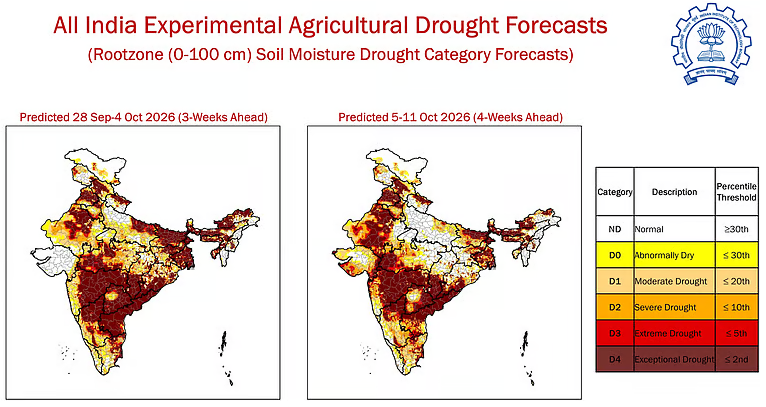
- As the southwest monsoon begins withdrawing, drought conditions have spread across over half of India, with persistent soil-moisture stress raising concerns for kharif yields, rabi sowing and water security.
About Drought in India
- Drought is a prolonged period of abnormally low rainfall leading to water shortage, with impacts varying across meteorological, agricultural and hydrological systems.
- In India, drought assessment increasingly combines rainfall, soil moisture, vegetation health, reservoir storage and groundwater conditions.
- India is particularly vulnerable because 55–60% of its net sown area is rainfed.
- The National Disaster Management Authority (NDMA) and the Ministry of Agriculture emphasise drought monitoring, early warning, contingency crop planning and efficient water management.
India’s Emerging Drought Stress
- Monsoon Variability: The key concern is not merely seasonal rainfall deficiency but its uneven temporal and spatial distribution.
- Repeated alternation between wet and dry spells has produced prolonged periods of soil drying.
- Thus, short rainfall episodes have not necessarily translated into drought recovery where antecedent soil-moisture deficits remain.
- Extent and Spread of Drought: According to the IIT Gandhinagar India Drought Monitor, around 52.5% of India’s area was under dry or drought conditions by September 16, up from 38.9% about a month earlier. Regional stress was particularly high in:
- Western India: 79% of the area under dry/drought conditions;
- Southern India: 67%;
- Northeast: 62%;
- Northwest: 47%;
- East: 42%;
- North: 41%;
- Central India: 40%
- Rainfall Deficit and Spatial Variability: Between June 1 and September 22, 2026, India received 706.9 mm rainfall against a normal 832.4 mm, a 15% deficit.
- About 41% of the country experienced deficient seasonal rainfall.
- Regional deficits included Rayalaseema (43%), Coastal Andhra Pradesh (37%), Marathwada (36%), Karnataka interiors (32% each) and Kerala (28%).
- El Niño and Monsoon Uncertainty: A strengthening El Niño adds uncertainty to rainfall and temperature patterns.
- Its interaction with other ocean-atmosphere phenomena can influence monsoon variability.
- Recent research highlights the role of ENSO in modifying drought characteristics and agricultural productivity.
Implications for Agriculture & Overall Economy
- The stress is already visible in kharif sowing.
- By September 11, kharif acreage stood at 1,096.49 lakh hectares, compared with 1,112.54 lakh hectares a year earlier.
- Paddy acreage declined by nearly 17 lakh hectares.
- Persistent soil-moisture deficits can reduce crop yields, livestock productivity and farm incomes, while raising demand for irrigation and government support.
- Lower reservoir and groundwater recharge may constrain rabi sowing, affecting food prices, rural employment and agricultural GDP.
- The vulnerability is significant because the Agriculture Ministry and ICAR had identified 315 districts as potentially vulnerable to El Niño-related farm distress, including 111 high-priority districts with irrigation coverage below 25%.
Way Forward
- Strengthen district-level drought early-warning systems integrating rainfall, soil moisture, groundwater and satellite data.
- Promote millets, pulses and drought-tolerant crop varieties through climate-resilient agriculture.
- Expand micro-irrigation, watershed development and rainwater harvesting.
- Adopt contingency crop planning based on real-time monsoon conditions.
- Improve reservoir operation and groundwater recharge for rabi resilience.
- Strengthen crop insurance, weather advisories and targeted livelihood support in vulnerable districts.
- Shift from rainfall-deficit assessment alone towards impact-based drought monitoring.
About Indian Summer Monsoon
- It is a seasonal reversal of winds that brings the bulk of India’s annual rainfall. It is central to agriculture, water resources and the economy.
- Southwest Monsoon: Normally begins over Kerala around 1 June and advances northwards, covering most of India by July. It generally accounts for about 75% of India’s annual rainfall.
- Two Branches:
- Arabian Sea Branch: It brings rainfall to the west coast and northern/northwestern India.
- Bay of Bengal Branch: It moves towards Northeast India and then westward along the Himalayan foothills and the Ganga plains.
- Monsoon Variability: Rainfall is highly uneven spatially and temporally, with active and break phases. Factors such as El Niño–Southern Oscillation (ENSO), Indian Ocean Dipole (IOD), Himalayan–Tibetan conditions and intra-seasonal atmospheric circulation influence its performance.
- Withdrawal: The southwest monsoon normally begins withdrawing from northwestern India in September, progressing southwards and generally retreating from the country by October.
- The Northeast Monsoon subsequently becomes important, particularly for Tamil Nadu, coastal Andhra Pradesh and adjoining southeastern peninsular India, mainly during October–December.
Previous article
News In Short 23-09-2026
