


Syllabus: GS3/ Science and Technology
Context
- Over the last decade, India has transformed from a large digital market into an emerging global technology power, through Digital Public Infrastructure (DPI), indigenous innovation, startup ecosystems, and emerging technology capabilities.
Digital India Programme as the Backbone of Emerging Capabilities
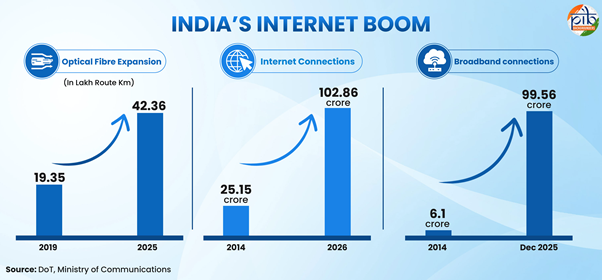
- Digital India Programme, launched in 2015, laid the foundation for India’s emerging technology ecosystem by strengthening digital infrastructure across the country.
- Lower internet costs expanded access to telemedicine, online education, digital payments, e-commerce, and e-governance services.
Developing Capabilities for Future Readiness
- Under the National Supercomputing Mission (NSM), launched in 2015 with an outlay of ₹4,500 crore, India has deployed 38 supercomputers with a combined computing power of 47 petaflops across leading institutions.
- A major achievement is the development of the indigenous PARAM Rudra series, built with Indian-designed hardware and software.
- The Semicon India Programme launched in 2021 with an outlay of ₹76,000 crore promoted semiconductor manufacturing, display fabrication, chip design, packaging, testing, talent development, and research collaborations.
- Building on this momentum, the Union Budget 2026–27 further announced India Semiconductor Mission (ISM) 2.0, with an initial outlay of ₹1,000 crore for FY 2026–27.
- The National Quantum Mission launched in 2023 with an outlay of ₹6,003.65 crore focuses on four key areas: Quantum Computing, Quantum Communication, Quantum Sensing and Metrology, and Quantum Materials and Devices.
- The mission seeks to develop indigenous quantum technologies, strengthen research infrastructure, build skilled talent, support startups, and foster industry-academia collaboration.
- The IndiaAI Mission approved in 2024 with an outlay of over ₹10,300 crore focuses on building indigenous AI computing infrastructure and expanding access to high-end GPU facilities.
- The AI Kosh platform hosts 12,115 datasets and 306 AI models across 20 sectors, enabling innovation and research at scale.
- Cloud Computing: India’s indigenous cloud ecosystem began with the launch of MeghRaj in 2014 by the MeitY, serving as the Government’s national cloud platform.
- further, MeghRaj 2.0 strengthened this ecosystem through hybrid cloud architecture, and stronger cybersecurity.
- Blockchain Technology: The government initiated the National Blockchain Framework (NBF) in 2021 with an outlay of ₹64.76 crore,.
- It aims to create a secure, scalable, and interoperable blockchain ecosystem for citizen-centric governance and digital trust.
- India’s blockchain ecosystem has expanded through indigenous platforms such as the Vishvasya Blockchain Stack, NBFLite sandbox, Praamaanik app verification system, and the National Blockchain Portal.
- The Reserve Bank of India (RBI) launched Digital Rupee (e₹) pilots, while the Telecom Regulatory Authority of India (TRAI) adopted blockchain-based Distributed Ledger Technology (DLT) to curb spam.
- Data Centers: India’s data centre sector has witnessed rapid expansion, with capacity growing from about 375 MW in 2020 to nearly 1,500 MW by 2025.
- Building India’s Semiconductor Talent Pipeline: The Chips to Start-up (C2S) Programme launched in 2022, supports startup incubation, patent generation, technology transfer, and advanced research in Very Large-Scale Integration (VLSI), Application-Specific Integrated Circuits (ASICs), System-on-Chip (SoC) design, and embedded systems.
Biotechnology: Next Phase of Innovation-Led Growth
- India’s biotechnology sector crossed the USD 150 billion milestone in 2023 and reached USD 190 billion in June 2026.
- Key initiatives for Biotechnology include the National Biopharma Mission (NBM), approved in 2017 with an outlay of ₹1,500 crore, the BioE3 Policy launched in 2023, BioNEST incubators, and innovation schemes such as Intensifying the Impact of Industrial Innovation (i4) and Promoting Academic Research Conversion to Enterprise (PACE).
Advancing Artificial Intelligence Capacity
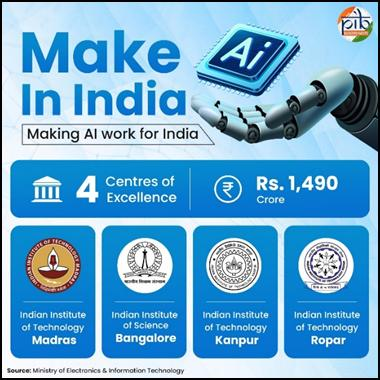
- Under the vision of “Make AI in India and Make AI Work for India,” the Government established four Centres of Excellence (CoEs) in Artificial Intelligence with a total allocation of ₹1,490 crore. These centres focus on Education, Healthcare, Sustainable Cities, and Agriculture.
Global Innovation Index Rise
- India rose to 38th in the Global Innovation Index 2025 from 81st in 2015. This reflects India’s rapid growth as a global innovation hub.
- Initiatives like Start-Up India, Digital India, and Atal Innovation Mission boosted entrepreneurship, digital infrastructure, research, and technology development.
The Bharat 6G Alliance (B6GA)
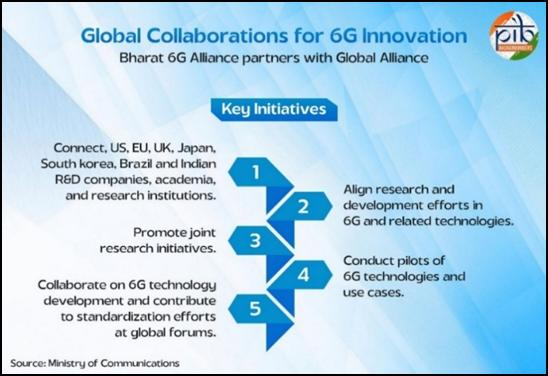
- B6GA, formed in 2023, is an industry-led, government-facilitated initiative bringing together telecom service providers, academia, research institutions, and standards organizations.
- It drives indigenous 6G R&D to build a self-reliant, globally competitive advanced communications ecosystem.
What are the Challenges?
- Digital Divide: Despite rapid digital expansion, disparities in internet access, digital literacy, and device affordability persist, particularly in rural and remote regions.
- Dependence on Imports: India continues to rely heavily on imported semiconductor equipment, advanced chips, critical minerals, and high-end technology components.
- Low R&D Expenditure: India’s expenditure on Research and Development remains relatively low compared to leading technology powers, limiting breakthrough innovation.
- Data Privacy Concerns: The rapid growth of digital platforms and AI applications raises concerns regarding data protection, privacy, algorithmic bias, and ethical use of technology.
Concluding remarks
- India’s digital transformation over the past decade has laid a strong foundation for Viksit Bharat 2047.
- By combining inclusive digital infrastructure, indigenous innovation, and trusted governance, India is evolving from a technology adopter to a technology leader, shaping a future that is innovative, secure, and people-centric.
Source: PIB
Previous article
India’s Net Foreign Direct Investment (FDI) Surges to $6.6 Billion
Next article
Western Ghats & Ecologically Sensitive Areas (ESAs)
