


Syllabus: GS1/ Climatology
Context
- A powerful Western Disturbance has arrived and impacted northern India, bringing widespread rainfall, heavy snowfall, and thunderstorms to the region.
What is a Western Disturbance?
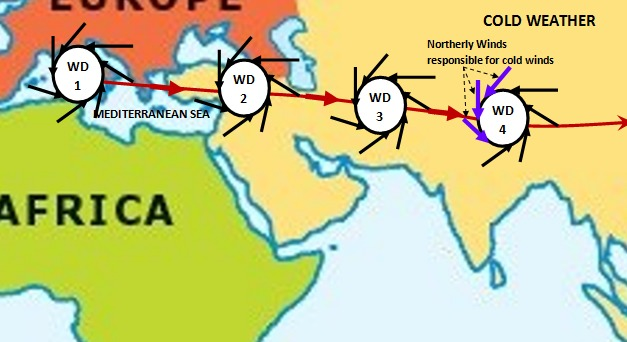
- A Western Disturbance (WD) is an extra-tropical weather system that originates outside India and moves from west to east, bringing rain, snowfall, and storms to northern parts of the Indian subcontinent, especially during winter and early spring.
- Origin and Formation:
- Western disturbances originate over the Mediterranean region, Black Sea, or Caspian Sea.
- They form when cold polar air interacts with warmer, moist air, creating low-pressure systems.
- These systems are carried eastward by westerly winds in the upper atmosphere, particularly the subtropical westerly jet stream.
- Regions Affected in India: Jammu & Kashmir, Himachal Pradesh, Uttarakhand, Punjab, Haryana, Delhi, Rajasthan and Western Uttar Pradesh.
How Western Disturbances Cause Rain and Snow?
- While travelling, western disturbances accumulate moisture from surrounding seas.
- When this moist air encounters the Himalayan mountains, or is forced upward due to temperature contrasts, it rises and cools.
- Cooling leads to condensation, forming clouds that result in rainfall in plains and snowfall in higher altitudes.
Significance of Western Disturbances
- 30% of annual precipitation over the North West Indian region (J & K, Ladakh, Himachal Pradesh &Uttarakhand) is received during winter and it is mostly associated with Western Disturbances.
- Precipitation associated with Western Disturbances (WDs) influences Himalayan climate, glaciers, snow-water storage, flora, fauna, agricultural crops and human inhabitants etc.
- Winter rainfall from western disturbances is vital for rabi crops, especially wheat, Mustard, Barley. Adequate rainfall improves soil moisture, crop yield, and food security.
Associated Hazards
- Intense precipitation in the form of snow, rain or hail leading to landslides, avalanches and damage of agriculture and manmade structures.
- Dense to very dense fog events leading to interruption in aviation / rail / road transport services.
- Cold Wave and Severe Cold Day conditions after the passage of western disturbances.
Concluding remarks
- Western disturbances remain a vital component of North India’s winter climate system, providing much-needed rainfall and snowfall.
- However, their increasing intensity due to a warmer atmosphere is raising the risk of extreme rainfall, crop damage, urban flooding, and avalanches, making better forecasting and preparedness increasingly important.
Source: IT
