


Syllabus: GS1/ Social Issue
In News
- Allahabad High Court categorically held that live-in relationships are not illegal and that consenting adults have the constitutional right to live together with dignity and safety, irrespective of marital status.
Key Observations of the Allahabad High Court
- Live-in relationship is not an offence: Living together without marriage does not violate any law in India if both partners are adults and give free consent.
- Right to life and personal liberty: The Court emphasized that Article 21 of the Constitution guarantees the right to life, dignity, and personal freedom to all individuals, including those in live-in relationships.
- State’s duty to protect: Once adults choose to live together, the State is duty-bound to ensure their safety, even against threats from family or society.
- Social Morality vs Constitutional Morality: The Court clearly prioritised constitutional morality over social morality.
- Evidentiary Presumption of Marriage: The Court referred to Section 114 of the Indian Evidence Act, 1872, and Section 119(1) of the Bharatiya Sakshya Adhiniyam, 2023.
- These provisions state that if a man and woman cohabit for a significant period in the nature of husband and wife, the law may presume them to be married.
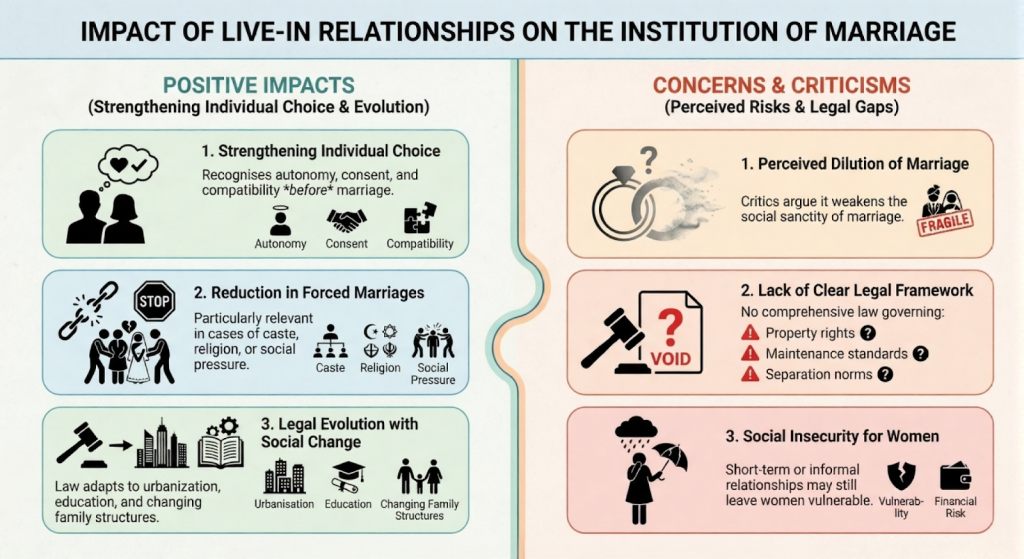
Key Supreme Court Judgments on Live-in Relationships
- Tulsa v. Durghatiya (2008): Children born from prolonged live-in relationships cannot be treated as illegitimate.
- Ensures inheritance and dignity of children.
- D. Velusamy v. D. Patchaiammal (2010): The Court clarified the concept of “relationship in the nature of marriage” under the Domestic Violence Act.
- Conditions laid down like a couple must hold themselves out as husband and wife, must be of legal age & must be otherwise qualified to marry.
- Indra Sarma v. V.K.V. Sarma (2013): Recognised that live-in relationships may be morally debated, but courts must deal with social realities.
- Shafin Jahan v. Asokan K.M. (2018): The Court held that the right to marry a person of one’s choice is an integral part of Article 21.
Source: TOI
Previous article
News In Short 19-12-2025
