


Draft Content Syndication Policy, 2025
Syllabus: GS2/ Governance
Context
- Prasar Bharati has prepared a draft Content Syndication Policy, 2025 to promote cultural outreach and monetize content.
About
- The policy aims to monetize content being produced by Doordarshan and Akashvani, archived national and regional content, and live coverages (Government events, festivals, sports, etc.).
- It also takes into consideration digital-first content published on Prasar Bharati’s OTT platform.
- It also proposes monetization of commissioned, co-produced, licensed, and other content owned by Prasar Bharati.
- The draft Policy envisages fostering strategic collaborations with domestic and international platforms to expand the reach of Prasar Bharati’s content and strengthen India’s cultural presence globally.
- It provides for flexible licensing models such as flat fee, revenue share, minimum guarantee with revenue share.
Source: AIR
900 Million People will Have Diabetes by 2050
Syllabus: GS2/ Health
Context
- The 11th edition of the International Diabetes Federation (IDF) Diabetes Atlas, projects a sharp global rise in diabetes prevalence by 2050.
Scale of the Global Burden
- The number of people living with diabetes (20–79 years) is projected to rise from around 580 million adults in 2024 to over 850–900 million by 2050.
- Diabetes prevalence is estimated to increase from 11.11% of the global adult population in 2024 to 12.96% by 2050.
- The projections cover 210 countries and five territories, making it the most comprehensive global assessment to date.
- In 2024:
- China ranks first with about 148 million people with diabetes.
- India is second with nearly 90 million.
- The United States ranks third, followed by Pakistan.
- By 2050, China and India are projected to retain the top two positions.
What is Diabetes?
- Diabetes is a chronic medical condition where the body has trouble regulating blood sugar (glucose) levels.
- It occurs when the body either doesn’t produce enough insulin (a hormone that helps regulate blood sugar) or doesn’t effectively use the insulin it produces.
Types of diabetes
- Type 1 Diabetes: The body doesn’t produce insulin at all, and it typically develops in childhood or adolescence.
- Type 1 diabetes is usually diagnosed in children and young adults, although it can appear at any age.
- People with type 1 diabetes need to take insulin every day to stay alive.
- Type 2 Diabetes: The body doesn’t use insulin properly (insulin resistance), often due to lifestyle factors, and usually develops in adults.
- One can develop type 2 diabetes at any age, even during childhood. However, this type of diabetes occurs most often in middle-aged and older people.
- Type 2 is the most common type of diabetes.
- Managing Diabetes:
- If not managed, diabetes can lead to serious health issues such as heart disease, kidney problems, and nerve damage.
- Managing diabetes typically involves a combination of diet, exercise, medication, and regular blood sugar monitoring.
Source: TH
New Logo for Regional Rural Banks (RRBs)
Syllabus: GS3/ Economy
In News
- The Government of India, in collaboration with NABARD, has unveiled a common logo for all Regional Rural Banks (RRBs) under the “One RRB, One Logo” initiative, marking a significant step towards unifying the identity of RRBs across the country.
What is the “One RRB, One Logo” Initiative?
- A reform measure to introduce a single, uniform visual identity for all 43 Regional Rural Banks operating in India.
- Implemented jointly by Department of Financial Services (DFS), Ministry of Finance & National Bank for Agriculture and Rural Development (NABARD)
- Applies across all RRB branches, digital platforms, passbooks, ATMs, stationery and customer interfaces.
Objectives of the Initiative
- Unified Identity: Present RRBs as part of a single national banking system, rather than fragmented regional entities.
- Customer Trust: Improve public confidence by ensuring easy recognition and credibility.
- Operational Integration: Support recent amalgamation and consolidation of RRBs.
- Digital Readiness: Align RRB branding with modern banking and digital financial services.
About RRBs
- RRBs were created under the Regional Rural Banks Act, 1976 to expand institutional credit in rural areas & serve small farmers, SHGs, artisans and MSMEs.
- RRBs have a tripartite ownership pattern:
- Government of India – 50%
- Concerned State Government – 15%
- Sponsor Bank – 35%.
Source: TH
Andhra’s Rare Earth Corridor
Syllabus: GS3/ Science & Technology
In News
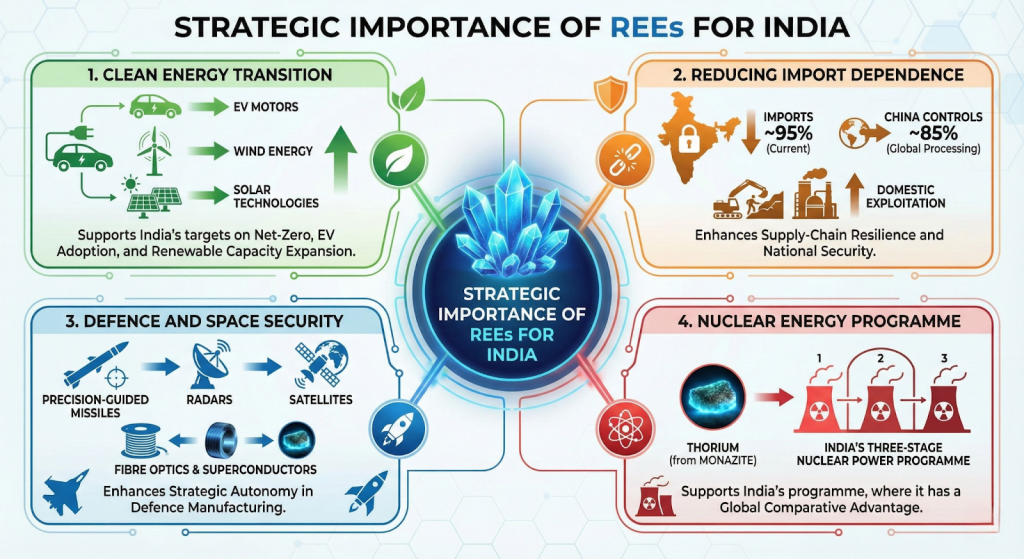
- Andhra Pradesh’s 974-km-long coastline has gained strategic importance due to large reserves of rare earth elements (REEs) embedded in beach sand minerals.
What is Andhra’s Rare Earth Corridor?
- A continuous mineral-rich belt along Andhra Pradesh’s coast from Srikakulam (north) to Nellore (south).
- Rich in beach sand minerals such as:
- Monazite (primary source of REEs and thorium)
- Ilmenite, rutile, zircon, garnet and sillimanite
- Andhra Pradesh holds 30–35% of India’s total monazite reserves, out of 12–15 million tonnes nationally, making it one of India’s most underutilised critical mineral zones.
What are Rare Earth Elements (REEs)?
- They are a group of 17 elements, 15 lanthanides + scandium + yttrium.
- Though geologically abundant, they are termed “rare” because:
- They occur in low concentrations, and
- Their extraction and processing are complex, capital- and technology-intensive.
- REEs are classified into:
- Light REEs (LREEs): lanthanum, cerium, neodymium, praseodymium, samarium, etc.
- Heavy REEs (HREEs): dysprosium, terbium, yttrium, etc.
Source: TOI
Ratle Project
Syllabus: GS3/Infrastructure
In News
- Recently, the Jammu and Kashmir Police informed Megha Engineering and Infrastructure Limited (MEIL) that 29 workers employed at the under-construction 850 MW Ratle Hydro Electric Project in Kishtwar had alleged militant links or criminal backgrounds.
The Ratle Hydroelectric Project (850 MW)
- Location: On the Chenab River near Drabshalla in Kishtwar district, Union Territory of Jammu and Kashmir.
- Type and capacity: Run-of-the-river scheme with a total installed capacity of 850 MW and a 133 m high concrete gravity dam and associated underground power houses.
- Ownership structure: Implemented by Ratle Hydroelectric Power Corporation Ltd, a JV of NHPC (51% equity) and JKSPDC (49% equity).
Source :IE
RESPOND Basket 2025
Syllabus: GS3/Space
In News
- Recently, Indian Space Research Organisation (ISRO) launched the RESPOND Basket 2025.
RESPOND Basket 2025
- It invites submission of research proposals from various premier universities, and other recognised academic and R&D institutions in areas relevant to ISRO’s upcoming missions and national priorities.
- It supports ISRO’s upcoming projects, including Bharatiya Antariksh Station, Chandrayaan-4, Gaganyaan missions, Venus orbiter, and a human Moon landing.
Source :TH
Previous article
Select Committee Report on IBC Amendment Bill 2025
