


Suez Canal offers 15% Discount to Cargo Ships
Syllabus: GS1/ Geography
Context
- In response to the Red Sea security crisis that severely disrupted maritime trade, the Suez Canal Authority (SCA) has announced a 15% discount on transit fees for large container ships from May 15, 2025.
Security Crisis in the Red Sea
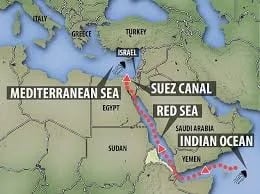
- The crisis began in 2023 when Iran-backed Houthi rebels in Yemen started targeting commercial ships linked to Israel or its allies, in retaliation to the conflict in Gaza.
- In response, major shipping lines avoided the Red Sea and rerouted ships via the Cape of Good Hope, significantly increasing Voyage duration by 10–14 days, Fuel consumption and Freight rates.
About Suez Canal
- The Suez Canal is a 193-km artificial waterway that connects the Mediterranean Sea to the Red Sea, making it the shortest maritime route between Europe and Asia.
- It was officially opened to ships in 1869.
- The Canal does not have locks and it is essentially a sea-level waterway.
- This characteristic allows for a smoother, more efficient passage of vessels, thus supporting a high volume of maritime traffic.
- It is one of the busiest waterways in the world through which 12–15% of global commerce passes.
Importance of Suez Canal
- Reduced Transit Time: The Suez Canal reduces the maritime distance between Europe and Asia by approximately 7,000 kilometers.
- World trade: It’s a major factor in the world’s economy, with roughly 12% of global trade, 7% of the world’s oil, and 30% of daily container traffic passing through it.
- Revenue Generation: The Suez Canal is one of Egypt’s primary sources of revenue.
Source: IE
United States Birthright Citizenship
Syllabus: GS2/ Polity and Governance
Context
- The US Supreme Court heard arguments in a case concerning an executive order issued by the US President, denying birthright citizenship to children born in the US to parents who are in the country illegally or temporarily.
What is Birthright Citizenship?
- Birthright citizenship is the legal principle that a person acquires citizenship automatically at birth, based on the place of birth or the nationality of parents.
- Jus soli (right of the soil): Citizenship is granted to anyone born within the territory of the country, regardless of parental citizenship. It is followed by the United States.
- Jus sanguinis (right of blood): Citizenship is granted based on parental nationality, not place of birth. It is followed by India.
14th Amendment of the US Constitution
- The 14th Amendment to the US Constitution was ratified in 1868.
- The Citizenship Clause says, All persons born or naturalized in the United States, and subject to the jurisdiction thereof, are citizens of the United States.
- This has been interpreted to guarantee citizenship to anyone born on US soil, irrespective of parental immigration status.
Source: IE
e-Zero FIR Initiative
Syllabus: GS2/Polity and Governance
Context
- Indian Cybercrime Coordination Centre (I4C) has introduced the new e-Zero FIR initiative to nab any criminal with unprecedented speed.
About
- Seamless FIR Registration: High-value cyber financial crimes (above ₹10 lakh) reported via National Cybercrime Reporting Portal (NCRP) or helpline 1930 will now be automatically converted into Zero FIRs, ensuring quicker initiation of investigations.
- Integrated Digital Framework: It brings together systems from the Indian Cybercrime Coordination Centre (I4C), Delhi Police’s e-FIR, and National Crime Record Bureau’s (NCRB’s) Crime and Criminal Tracking Network & Systems (CCTNS.
- Territory-Neutral Action: Complaints can be filed and processed irrespective of the complainant’s location, removing delays due to jurisdictional constraints.
- Easy Escalation: Victims can get their Zero FIR converted into a regular FIR by visiting the relevant cybercrime police station within 3 days.
- Initially launched as a pilot in Delhi, the system will soon be extended to other States and Union Territories across India.
Significance
- Legal Backing from BNSS: The process is aligned with Sections 173(1) and 1(ii) of the Bhartiya Nagrik Suraksha Sanhita (BNSS), reinforcing the role of new criminal laws in modernizing policing.
- Enhanced FIR Conversion Rate: The system is expected to significantly improve the conversion rate of complaints into FIRs, enabling faster recovery of lost funds and stronger enforcement.
- Strengthened Cybercrime Response: This tech-driven approach bolsters India’s overall capability to tackle cybercrime, builds public confidence, and strengthens the digital financial ecosystem.
Source: PIB
Follow OROP Principle for All Retired HC Judges: SC
Syllabus: GS2/Polity and Governance
Context
- The Supreme Court held that retired high court judges will be entitled to uniform pension and other terminal benefits.
About
- It establishes a long-overdue parity in judicial service benefits.
- Flat pension of ₹13.5 lakh per annum for all retired High Court judges and ₹15 lakh per annum for retired Chief Justices.
- The court has removed inconsistencies rooted in entry points, tenure duration, and service breaks.
- Reiterating the One Rank One Pension (OROP) principle, the court emphasized that all judges, regardless of whether they came from the district judiciary or the bar, are entitled to equal post-retirement benefits — a position grounded firmly in the constitutional guarantee of equality (Article 14).
- This decision ends decades of ambiguity and discrimination in judicial pensions and reinforces the dignity and uniformity of the judiciary — not just in office, but in retirement too.
Source: TH
Futures & Options
Syllabus: GS3/Economy
Context
- The former SEBI Chairman has raised concern over the rising risks associated with F&Os [futures and options] as most of the individuals who invested in them are losing money.
What is a derivative?
- A derivative is a financial contract whose value depends on the price of an underlying asset.
- An underlying asset is the primary asset based on which a derivative’s value is derived at.
- They can be stocks, stock indices or commodities such as crude oil, natural gas, gold, silver, copper etc.
- Derivatives are a helpful tool for those informed traders who use them as a hedging strategy (to mitigate losses).
- Futures: Futures are derivative contracts in which both the buyers and the sellers have an obligation to buy or sell an underlying asset at a predetermined price on a future date, decided today.
- If a trader thinks the price of natural gas will increase in the next three months, he can buy a natural gas futures contract today.
- If his prediction is right, he can gain considerable profit. But if his prediction fails, he would incur an unlimited loss.
- Options: In an options contract, buyers have the right, but not an obligation, to buy an underlying asset via the call option, or have the right to sell an underlying asset via the put option at a specified price before a certain date. It’s because of this flexibility, investors think options are safer.
- Though options have more options, they are highly risky, to the extent that your capital would erode to zero.
Source: TH
Alternative Investment Funds
Syllabus: GS3/Economy
In News
- RBI has proposed revised guidelines to ease restrictions on investments by regulated entities (REs) in Alternative Investment Funds (AIFs).
Alternative Investment Fund (AIF)
- Alternative Investment Fund or AIF means any fund established or incorporated in India which is a privately pooled investment vehicle which collects funds from sophisticated investors, whether Indian or foreign, for investing it in accordance with a defined investment policy for the benefit of its investors.
- AIF does not include funds covered under the SEBI (Mutual Funds) Regulations, 1996, SEBI (Collective Investment Schemes) Regulations, 1999 or any other regulations of the Board to regulate fund management activities.
- AIFs in India are classified into three categories based on their investment strategy, risk profile, and use of leverage.
- Category I AIFs invest in sectors that are considered socially or economically desirable by the government or regulators, such as start-ups, small and medium enterprises (SMEs), infrastructure, and social ventures.
- Category II AIFs comprise funds that do not fall under Category I or III and typically include private equity funds, real estate funds, and distressed asset funds.
- Category III AIFs are designed for high-risk, high-return strategies and are permitted to employ leverage and complex trading strategies, including in listed or unlisted derivatives.
Source :IE
Workings of an Atomiser
Syllabus: GS 3/Science
In News
- Now, Atomisers are used widely in industries like agriculture, medicine and even in everyday household products.
Atomiser
- It is a device that turns liquid into a spray, which is a collection of tiny droplets dispersed in air.
- It is widely used because liquids are easy to store, while sprays offer better coverage.
- It varies by design depending on the spray’s purpose—differing in drop size, spray pattern, and angle of application.
- Drop size can be measured in several ways, including the Relative Span Factor (RSF), which indicates how uniformly sized the drops are.
- Laser-based methods are often used to assess droplet size.
Working
- Atomisers work by forcing liquid through narrow channels, breaking it into droplets via pressure or motion.
- Designs include flat-fan sprays, pressure-swirl systems, and advanced types like ultrasonic nebulisers or air-assisted atomisers, which create fine mists or aerosols.
Applications
- Atomisers are used in diverse sectors—fuel injection in engines, agricultural spraying, cooling machinery, firefighting, and medicine (e.g., nasal sprays and antiseptics).
- They are also common in everyday household items like cooking oil sprays, perfumes, and deodorants.
Source :TH
New Generation Barcodes to Go Live From 2027
Syllabus :GS 3/Economy
In News
- GS1 (the global standards organization) is planning to introduce next-generation QR codes by 2027 to enhance transparency, traceability, and consumer protection.
| Do you know? – Bharat QR is the world’s first interoperable QR code payment solution. – It has been developed by National Payments Corporation of India (NPCI), Master card and Visa to support India’s move toward a less-cash economy. – It was devised based on the direction set by the Reserve Bank of India (RBI) in September 2016 and its Payments Vision 2018, which outlines innovation, interoperability, and security as the three pillars to facilitate India’s transition to a less – cash society. |
New generation barcodes
- These QR codes, currently being tested in countries like Australia, will be introduced in India based on how ready manufacturers are.
- Initially, both traditional barcodes and QR codes will appear on product packaging to support retailers still upgrading their systems.
- Full transition to QR codes will depend on retailers’ readiness in each country.
Significance
- The initiative aligns with GS1’s Vision 2030, which focuses on digital transformation, supply chain resilience, sustainability, and consumer and patient safety
- GS1 leaders emphasized India’s growing importance, both economically and digitally, and are hosting their General Assembly in India for the first time, highlighting the country’s strategic role in this global shift.
Source :TH
Operation Olivia
Syllabus: GS3/Environment
Context
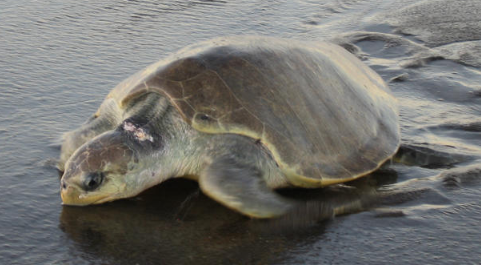
- Operation Olivia helped protect a record of over 6.98 lakh Olive Ridley turtles nested at the Rushikulya river mouth in Odisha.
About
- Operation Olivia is an annual mission of the Indian Coast Guard’s (ICG) conducted from November to May.
- It is aimed at ensuring safe nesting grounds for Olive Ridley turtles particularly at Gahirmatha Beach and surrounding coastal areas of Odisha, which see the arrival of over eight lakh turtles each year.
About Olive Ridley Turtles
- The olive ridley gets its name from the olive green color of its heart-shaped shell.
- These are carnivores and feed mainly on jellyfish, shrimp etc.
- Distribution: Olive ridleys are found throughout the world primarily in the tropical regions of the Pacific, Indian, and Atlantic oceans.
- Major nesting sites in India: Rushikulya rookery coast (Odisha), Gahirmatha beach (Bhitarkanika National park) and the mouth of the Debi River.
- Features: They are known for their unique mass nesting called Arribada, where thousands of females come together on the same beach to lay eggs.
- Conservation Status:
- IUCN Red List: Vulnerable
- CITES Appendix I
- Schedule I of the Indian Wildlife (Protection) Act, 1972.
Source: PIB
