


Syllabus: GS3/ Environment
Context
- A recent study has cautioned that peatlands are severely underprotected, and their ongoing destruction could jeopardise climate change goals.
What are Peatlands?
- Peatlands are unique wetland ecosystems composed of partially decayed organic matter accumulated over thousands of years.
- In cool climates, peatland vegetation is mostly made up of Sphagnum mosses, sedges and shrubs and are the primary builder of peat, whereas in warmer climates graminoids and woody vegetation provide most of the organic matter.
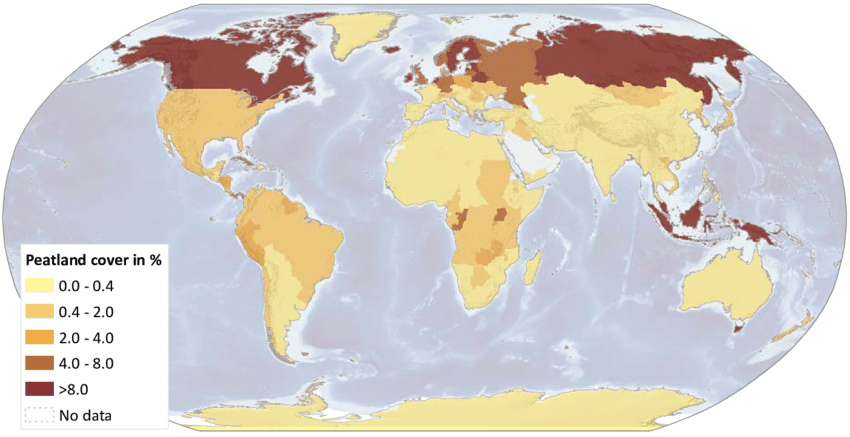
Distribution of Peatlands
- Peatlands occur in every climatic zone and continent and cover 4.23 million km2, which corresponds to 2.84% of the Earth’s terrestrial surface.
- Countries with the most peatlands include Canada, Russia, Indonesia, the United States, Brazil, the Democratic Republic of the Congo, China, Peru, Finland and the Republic of the Congo.
- The first five contain 70 percent of global peatlands.
- Peatlands on the Earth’s surface, hold 600 billion tonnes of carbon — surpassing the carbon stored in all the world’s forest biomass combined.
- However, merely 17 percent of peatlands are safeguarded worldwide.
- Specifically, only 11 percent of boreal peatlands are protected, compared to 27 percent of temperate and tropical peatlands.
Threats to Peatlands
- Agriculture and Forestry: Large-scale commercial agriculture and logging operations drain peatlands, causing carbon release into the atmosphere.
- Mining: Peat extraction for fuel and horticulture, along with infrastructure projects, leads to the destruction of peat ecosystems.
- Climate Change: Rising temperatures and changing precipitation patterns exacerbate peatland degradation, increasing the risk of wildfires and carbon release.
Conservation Efforts
- Role of Indigenous Communities: Around 27% of global peatlands lie within indigenous territories, where traditional practices have contributed to their conservation.
- The Brazzaville Declaration on Peatlands is an agreement adopted in 2018 in Brazzaville, Republic of the Congo.
- It aimed at protecting and sustainably managing peatlands in the Congo Basin, which contains the world’s largest tropical peatland complex.
- The Global Peatlands Initiative (GPI), led by United Nations Environment Programme (UNEP), aims to protect and conserve peatlands.
- Ramsar sites, comprises roughly a fifth of protected peatlands globally and nearly two-fifths of protected peatlands in the tropics.
Way Ahead
- Strengthening Legal Protections: Countries should integrate peatland conservation into domestic environmental laws and ensure the enforcement of Ramsar site protections.
- Nationally Determined Contributions (NDCs) under the Paris Agreement and action plans under the Kunming-Montreal Global Biodiversity Framework should incorporate peatland conservation.
- Indigenous Stewardship Support: Recognizing and supporting indigenous-led conservation efforts can significantly enhance peatland protection.
Concluding remarks
- Peatlands are invaluable carbon reservoirs essential for climate stability. Despite their ecological significance, they remain critically underprotected.
- Strengthening conservation efforts through legal frameworks, global commitments, and sustainable management is imperative for preserving these vital ecosystems.
Source: DTE
Previous article
Chhatrapati Shivaji Maharaj Jayanti
Next article
Global Sea Ice Cover Has Dipped to Record Low
