


Syllabus: GS2/Governance
Context
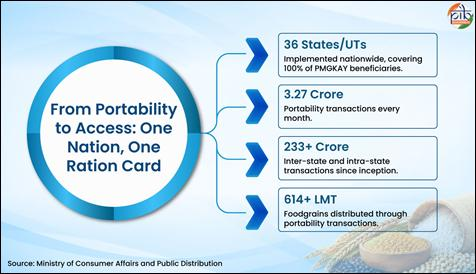
- The One Nation One Ration Card (ONORC) scheme has been implemented across all 36 States and Union Territories, covering 100% of beneficiaries under the Pradhan Mantri Garib Kalyan Anna Yojana (PMGKAY).
About
- The ONORC scheme was launched in 2019 by the Department of Food & Public Distribution.
- It is a major reform of the Public Distribution System (PDS), enabling nationwide portability of ration cards and beneficiaries covered under the National Food Security Act (NFSA).
National Food Security Act (NFSA), 2013
- NFSA aims to supplement the food requirements of up to 75% of the rural and up to 50% of the urban population at Census 2011 comes to 81.35 crore persons.
- It aims to ensure food and nutritional security by providing affordable foodgrains through the Targeted Public Distribution System (TPDS).
- Eligible households receive subsidized foodgrains based on:
- Antyodaya Anna Yojana (AAY) households: These households constitute the poorest of the poor. AAY households are entitled to 35kg of food grains per household per month.
- Priority Households (PHH): These households are entitled to 5kg of food grains per person per month.
- Under this, Central issue prices are highly subsidized (Rs 3/kg for rice, Rs 2/kg for wheat, and Rs 1/kg for coarse grains).
- Also, pregnant and lactating women are entitled to a cash maternity benefit of not less than Rs. 6,000.
Who are the Beneficiaries?
- Antyodaya Anna Yojana (AAY) Households: Chosen by States/UTs based on Central Government criteria, covering the poorest of the poor. The Eligible Categories are:
- Households headed by widows, terminally ill persons, disabled persons, or elderly persons (60+) with no assured means of subsistence or societal support.
- Widows or terminally ill persons or disabled persons or persons aged 60 years or more or single women or single men with no family or societal support or assured means of subsistence.
- All primitive tribal households.
- Landless agricultural labourers, marginal farmers, rural artisans/craftsmen, slum dwellers, and people earning a daily livelihood in the informal sector and other similar categories in both rural and urban areas.
- All eligible Below Poverty Line (BPL) families of HIV-positive persons.
- Priority Households: Selected by State Governments/Union Territory Administrations as per their own criteria.
Merger With PMGKAY
- During the COVID-19 pandemic in 2020, the government launched the Pradhan Mantri Garib Kalyan Anna Yojana (PMGKAY), under which additional foodgrains were provided free of cost.
- From January 2023, the government merged PMGKAY with NFSA and made the regular NFSA entitlement itself free of cost.
- In 2023, this free foodgrain scheme was extended for five years (January 2024 to December 2028).
India’s Food Security Framework
- National Food Security Act (NFSA), 2013: Provides legal entitlements to subsidised foodgrains for up to 75% of the rural population and 50% of the urban population, covering approximately 81 crore people.
- Pradhan Mantri Garib Kalyan Anna Yojana (PMGKAY): Free foodgrains have been provided to eligible beneficiaries since 2024, with the arrangement extended until 2028.
- Targeted Public Distribution System (TPDS): Supports the distribution of foodgrains to eligible beneficiaries.
- Digitisation: Digitised ration cards and Aadhaar seeding help improve the identification of beneficiaries and reduce leakages.
- One Nation One Ration Card (ONORC): Enables eligible beneficiaries, particularly migrant workers, to access their foodgrain entitlements from ration shops across the country.
- Mid Day Meal Programme: The Programme aims to boost enrolment, retention, and attendance while improving the nutritional status of children in government, local body, and government-aided schools.
- Food Fortification: The government promotes fortified rice, wheat flour, and edible oils as part of the public distribution system.
- Poshan Tracker: The Ministry of Women and Child Development developed the Poshan Tracker ICT application as a key governance tool.
- It uses WHO’s expanded tables with day-based z-scores to dynamically assess stunting, wasting, underweight, and obesity in children based on height, weight, gender, and age.
- SakshamAnganwadi and Poshan 2.0 includes key schemes such as the POSHAN Abhiyaan, Anganwadi Services and Scheme for Adolescent Girls as direct targeted interventions to address the problem of malnutrition in the country.
Strengthening Transparency and Delivery Under PDS
- 100% Digitisation: Ration card and beneficiary databases are 100% digitised across all States/UTs as of October 2026, covering around 78.65 crore beneficiaries, and are accessible on public transparency portals of States/UTs.
- In 2026, e-KYC was done in respect of 71.52 crore beneficiaries i.e., 91% of total beneficiaries.
- Transparent Grievance Redressal: Transparency portals, online grievance systems and toll-free helplines operate across all States/UTs.
- Computerised Supply Chain: Online foodgrain allocation is implemented nationwide, while supply chains are computerised in 31 States/UTs.
- Rightful Targeting & De-duplication: Advanced Aadhaar and PDS data analytics flagged 5.95 crore suspicious records, leading to the deletion of 2.58 crore duplicate or ineligible entries for Rightful Targeting.
- Scheme for Modernisation and Reforms through Technology in Public Distribution System (SMART-PDS): Under the SARTHAK-PDS, SMART-PDS digitally integrates ration cards, distribution, supply chains and grievance redressal, while addressing State/UT-level technology gaps through an integrated central system.
Source: DD
Previous article
News In Brief 12-11-2026
