


Syllabus: GS3/Economy
Context
- NITI Aayog released the report titled “Impact Assessment of PLI Schemes”, evaluating the performance of Production Linked Incentive (PLI) schemes across 14 sectors.
About Production Linked Incentive (PLI) Scheme
- The Production Linked Incentive (PLI) scheme is a government initiative launched in 2020.
- The primary aim was strengthening India’s manufacturing capabilities by offering financial incentives to eligible companies based on their incremental sales.
- The scheme initially targeted three sectors, and over time, it has expanded to include 14 sectors.
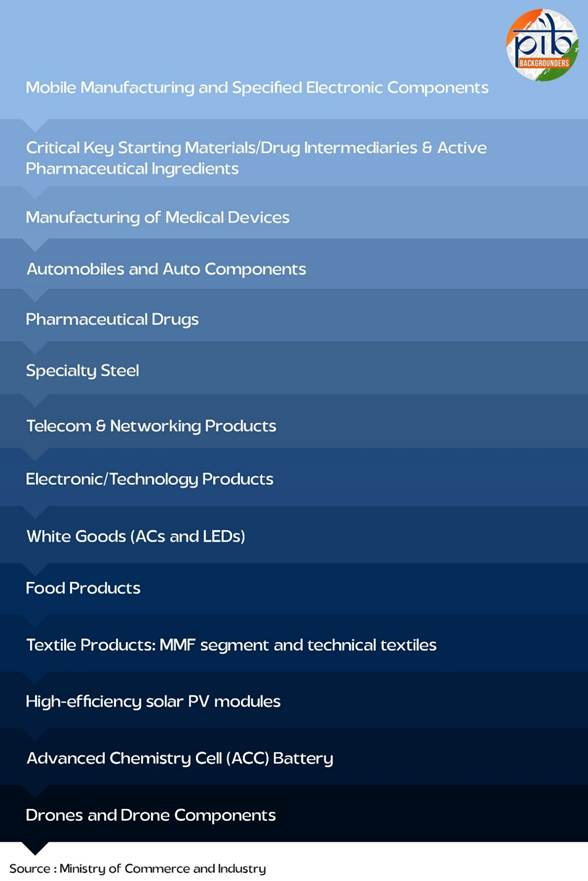
Findings of the NITI Aayog Report
- Investment: PLI schemes attracted investments of ₹2.4 lakh crore, achieving 76% of the combined target.
- Production and Sales: Generated ₹22.66 lakh crore in cumulative production and sales, achieving 64% of the target.
- Employment: Generated employment for 8.49 lakh people by March 2026, achieving only 28% of the target of 30.18 lakh jobs.
- Implementation period: The schemes had completed 58% of their combined implementation period, with 42% remaining.
- Sectoral progress: Nearly 70% of the targeted segments were broadly on track.
Significance of PLI Schemes
- The domestic value addition under the White Goods PLI scheme grew from 20% to 55%, indicating greater localisation of components and knowledge transfer.
- The Medical Devices PLI scheme generated ₹14,945 crore in sales by March 2026, supporting domestic production of medical devices.
- Reducing import dependence: India’s local renewable energy production ecosystem has been strengthened by raising solar PV manufacturing capacity from roughly 8 GW to nearly 116 GW.
- Pharmaceutical self-reliance: The Bulk Drugs PLI scheme has aided in local production of critical starting materials, drug intermediates and active pharmaceutical ingredients (APIs).
- Developing emerging industries: The Drones PLI scheme has encouraged the growth of India’s domestic drone manufacturing ecosystem.
Challenges in PLI Implementation
- Employment creation has reached only 28% of the target, considerably lower than investment and production achievements.
- High capital intensity and automation in several sectors limit employment generation relative to investment.
- High investment and turnover eligibility thresholds have restricted the participation of smaller enterprises, particularly in the textile sector.
- Higher production does not necessarily translate into deeper domestic manufacturing if critical components and raw materials continue to be imported.
- Outcomes vary across sectors due to differences in technology, market maturity and investment cycles.
- Investments in manufacturing facilities take time to translate into commercial production and employment, particularly in emerging technology sectors.
Way Ahead
- Create common data-reporting systems across implementing ministries and regularly monitor investment, production, exports and employment at the firm level.
- Encourage public procurement of domestically manufactured products, strengthen domestic markets and develop export opportunities.
- Improve access to finance, technology, infrastructure and quality certification. Rationalise eligibility conditions wherever necessary to facilitate greater MSME participation.
Source: PIB
Next article
2026 Global Carbon Budget
