



In News
- Recently, the Union Cabinet restored the Members of Parliament Local Area Development Scheme (MPLADS) that was suspended in April 2020.
Latest developments
- Suspension:
- The scheme was suspended for two financial years (2020-21 and 2021-22).
- The funds for the scheme were subsumed in the Consolidated Fund of India.
- The government diverted ?8,000 crore to be spent under the scheme for fighting the COVID-19 pandemic.
- Reason for Restoration:
- Citing economic recovery, the Government announced a partial rollback.
- The MPs will get ?2 crore instead of the annual approved ?5 crore.
Arguments Against MPLAD Scheme
- Separation of Powers:
- The scheme violates one of the cardinal principles, which though not specifically written down in the Constitution, actually permeates the entire Constitution: separation of powers.
- Simply put, this scheme, in effect, gives an executive function to legislators (read legislature).
- No Accountability:
- No accountability for the expenditure in terms of the quality and quantities executed against specifications;
- Delays in issuing work orders ranging from 5 to 387 days in 57% of the works against the requirement of issuing the work order within 45 days of the receipt of recommendation by the MP;
- Proper SoP Not followed:
- Extensions of time granted to contractors without following the correct procedure;
- Register of assets created, as required under the scheme, not maintained, therefore location and existence of assets could not be verified;
- The implementation of the scheme was marked by various shortcomings and lapses.
- These were indicative of the failure of internal control mechanisms in the department in terms of non-maintenance of records”.
- Appeasement of kins or alike:
- Money under MPLADS being used to appease or oblige two sets of people:
- opinion-makers or opinion-influencers, and
- favourite contractors.
- An often-heard tale is that of the contractor being a relative, close friend, or a confidant of the MP, and the contractor and the MP being financially linked with each other.
- Money under MPLADS being used to appease or oblige two sets of people:
- Gaps in Utilisation:
- Reports of underutilisation and misutilisation of MPLADS funds continue to surface at regular intervals but there seems to have been no serious attempt to do anything about it till now.
- Also, there are wide variations in the utilisation of the MPLAD amount in various constituencies.
- CAG’s Observations:
- Implementation of the scheme has always left much to be desired.
- Utilisation of funds:
- Expenditure incurred by the executing agencies being less than the amount booked. Utilisation of funds between 49 to 90% of the booked amount;
- Work on existing assets:
- Though the scheme envisages that works under the scheme should be limited to asset creation, 549 of the 707 works test-checked (78%) of the works recommended were for improvement of existing assets;
- Variation in quantities:
- Wide variations in quantities executed against the quantities specified in the BOQ (Bills of Quantity) in 137 of the 707 works test-checked.
- Variations ranged from 16 to 2312%. (“2312%” is the figure actually mentioned in the audit report);
- Use of lesser quantities of material than specified by contractors resulting in excess payments and sub-standard works.
- Various Recommendations: The National Commission to Review the Working of the Constitution (2000) and the Second Administrative Reforms Commission (2007), recommended discontinuation of the scheme.
Arguments in Favour of MPLAD Scheme
- Good number of projects completed:
- Since the inception of the scheme, a total of 19,86,206 works/projects have been completed with the financial implication of ?54,171.09 crore.
- People centric MPs:
- It engaged MPs, catered to the aspirations of local people and ironed out regional imbalances.
- Third-party evaluators appointed by the government reported that the creation of good quality assets had a “positive impact on the local economy, social fabric and feasible environment”.
- Addresses day-to-day Problems:
- The responsibility of an MP does not end with the supervision of administration and legislation.
- The MPLAD Scheme has enabled MPs to play a leadership role in the developmental process of his constituency and sort out its day-to-day problems.
- The suspension of the MPLADS for 2020-21 and 2021-22 in the wake of the pandemic has done away with this vital role of MPs.
- Antidote to favouritism:
- The pork barrel policy of State and Union Governments often leads to skewed development and regional imbalance.
- The elected opposition legislators of those constituencies fall victim to this pork-barrel politics.
- MPLADS has been an antidote to this favouritism as it provided opposition MPs some chance to cater to the developmental needs of their constituency.
- Aspirations of the marginalised
- Of the MPLADS corpus, 15% has been earmarked for the development of Scheduled Castes and 7.5% for the Scheduled Tribes.
- Around ?20 lakh of the MPLADS fund per annum has been allotted for the welfare of differently-abled people.
- Suspension of the MPLADS undermines the developmental aspirations of these marginalised segments.
- Proper Audit:
- The Scheme undergoes impartial and meticulous auditing.
- The second instalment of funds is released only when the first instalment is fully utilised with no audit objections. This procedure leaves no place for corruption.
- Suspension Affected States:
- The Centre, by way of suspending the MPLAD Scheme, withheld funds for the States during the peak of the pandemic when they were battling with financial strain themselves.
Way Ahead
- To avoid inadequate allocation of funds for individual works, the asset intended to be created may be described in more detail so that it’s cost implication is clear.
- The MP may consider the allocation of funds only after the cost estimate is prepared and the detailed work plan and coordination mechanism is made available to him.
|
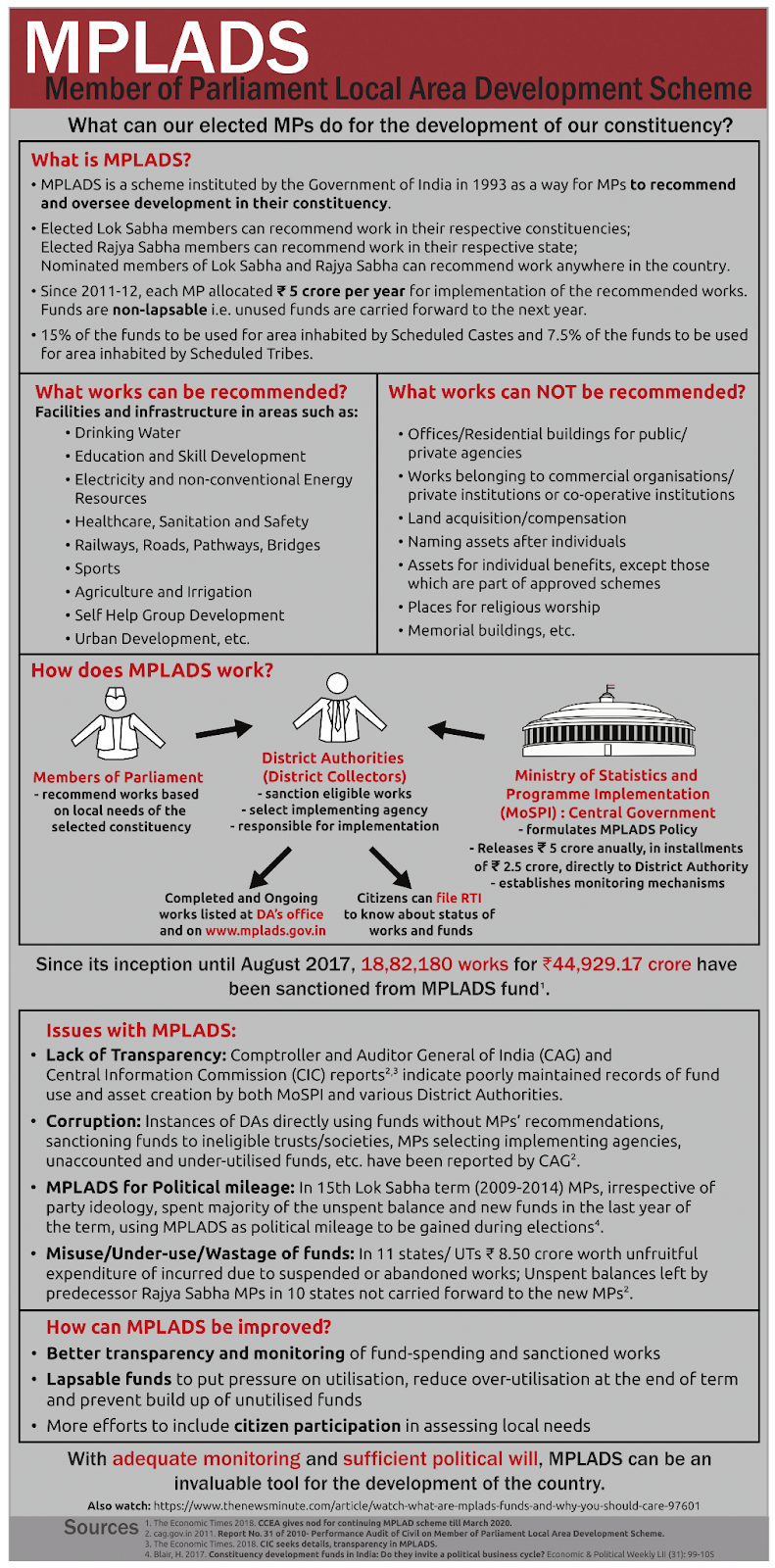
Member of Parliament Local Area Development Scheme (MPLADS)
Image Courtesy: wiki
|
Source: TH
Previous article
General consent to CBI
