


Syllabus: GS3/Environment
Context
- A recent UN Special Report, Challenges related to sea-level rise and ways and approaches to address it, highlighted escalating threats to infrastructure, human rights, livelihoods, culture and statehood.
Scale and Drivers of the Crisis
- Rising seas are primarily driven by warming ocean waters and melting glaciers and ice sheets.
- In 2024, the annual global sea-level rise reached 5.9 mm, the highest level ever recorded.
- Around 770 million people, or nearly 10% of the global population, live in coastal areas less than five metres above the high-tide line and face significant risks.
- Up to 1.2 billion people could be displaced by 2050 without urgent adaptation.
Unequal Regional Impacts
- Coastal Cities: Cities such as Miami, New York and Guangzhou face enormous financial exposure. Coastal assets at risk are estimated at $2–3.5 trillion.
- South Asian Deltas: In low-lying South Asian deltas, the principal concern is human displacement. More than 14 million people in Kolkata, Mumbai and Dhaka are at immediate risk of losing their homes to permanent inundation.
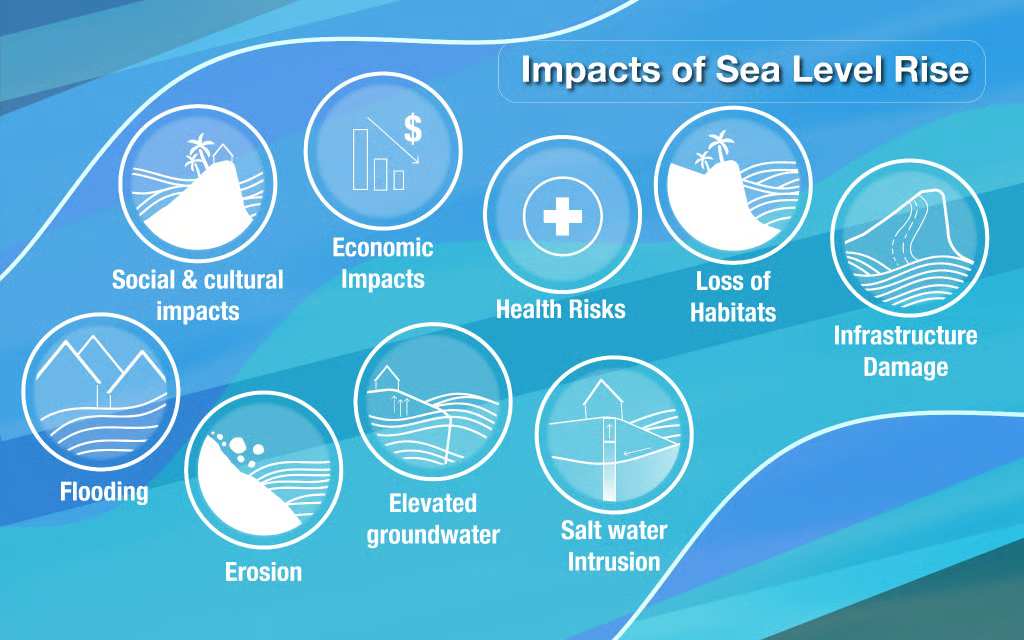
- Human Rights and Cultural Identity: Sea-level rise threatens fundamental rights, including access to adequate housing, safe drinking water, sanitation, food, healthcare and education.
- Flooding and coastal erosion can destroy homes, schools, hospitals and agricultural land.
- Saltwater intrusion contaminates freshwater resources and soils, while damaged sanitation systems increase exposure to water-borne diseases.
- Small Island Developing States (SIDS), Indigenous Peoples and low-lying coastal communities are particularly vulnerable.
- For Indigenous Peoples, the loss of ancestral lands can sever cultural identity, spiritual connections and intergenerational transmission of traditional knowledge.
- Thus, climate-induced displacement is not merely an economic issue but a human-rights and cultural-identity challenge.
Economic and Legal Challenges
- Coastal infrastructure damage is already estimated at more than $1.8 trillion. Without adequate adaptation, annual global losses could reach $1.2–4 trillion by the end of the century.
- Sea-level rise creates unprecedented legal questions concerning statehood, sovereignty, nationality and maritime boundaries, especially for island states facing permanent territorial loss.
Rise of Sea Level in India
- Current Trend: India’s sea level is rising gradually due to climate change, mainly because of ocean warming (thermal expansion) and melting glaciers/ice sheets.
- Long-term observations indicate an average rise along the Indian coast of roughly 3.3 mm/year, though rates vary regionally.
- Relative sea-level rise can be higher locally because of land subsidence, groundwater extraction and sediment compaction.
- Most Vulnerable Regions: Mumbai, Kolkata, Chennai and other coastal cities face increasing risks from flooding and storm surges.
- Sundarbans and Ganga-Brahmaputra-Meghna delta are particularly vulnerable because of their low elevation.
- Small islands, including parts of the Andaman & Nicobar and Lakshadweep, face heightened exposure.
Government/Policy Response
- National Centre for Coastal Research (NCCR) monitors shoreline changes and coastal vulnerability.
- INCOIS provides ocean information, forecasts and early-warning services.
- Coastal Regulation Zone (CRZ) framework seeks to regulate environmentally sensitive coastal development.
- National Disaster Management Authority (NDMA) and state agencies focus on cyclone preparedness, evacuation and resilient infrastructure.
- Mangrove restoration and nature-based solutions can provide protection against storm surges and erosion.
Way Forward
- Effective adaptation requires:
- Early action and reliable scientific assessments;
- Early-warning systems and resilient infrastructure;
- Faster greenhouse-gas emission reductions;
- Greater and predictable climate-adaptation finance;
- Technology transfer and stronger international cooperation; and
- People-centred and human-rights-based planning.
- Developing countries face a severe financing gap: annual adaptation needs are estimated at $310–365 billion, against only $26 billion in adaptation finance in 2023.
- For India, coastal planning needs to integrate disaster resilience, sustainable urbanisation, ecosystem-based adaptation and protection of vulnerable communities.
Previous article
Western Dedicated Freight Corridor (WDFC)
Next article
News In Short 09-09-2026
