


Syllabus: GS3/Economy; Agriculture
Context
- India is the world’s largest producer of raw jute and accounts for about 75% of estimated global jute goods production.
About Jute (aka ‘Golden Fibre’)
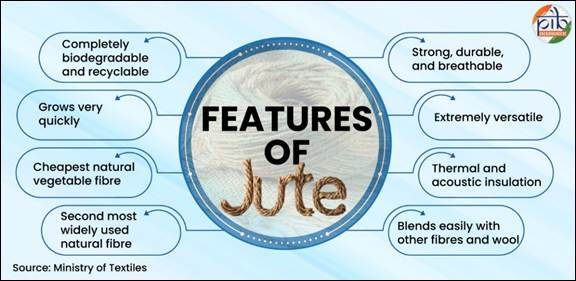
- Jute is a biodegradable and recyclable natural fibre characterised by its rapid growth, cost-effectiveness, and wide availability.
- It is strong, durable, breathable, and highly versatile, with applications spanning packaging, construction, agriculture, and industrial textiles.
- It possesses favourable functional attributes, including thermal and acoustic insulation, high moisture absorption, and low static generation.
Agro-Climatic Profile
- Jute is generally sown in March-April and harvested within 100–110 days.
- It requires hot, humid conditions and 700–1,500 mm rainfall.
- It is predominantly rainfed and cultivated by small and marginal farmers.
Historical Evolution
- Jute use dates to the 3rd century BC, but it became a commercial commodity under British rule, when mills emerged in Bengal.
- Partition in 1947 separated nearly 80% of jute-growing areas into East Pakistan, while most mills remained in India, causing raw-material shortages.
- The ‘Grow More Jute’ campaign (September 1949) boosted production from 6.7 lakh tonnes (1951-52) to 14.56 lakh tonnes (1961-62).
- The Jute Packaging Act, 1987 created a stable market.
Present Status
- India accounts for about 75% of estimated global jute-goods production.
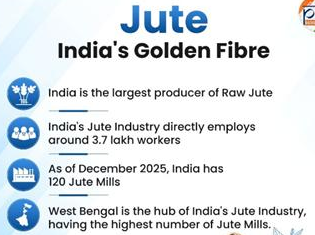
- Production of jute and mesta rose from 88.02 lakh bales (2024-25) to 94.03 lakh bales (2025-26).
Sustainable and Diversified Applications
- Jute is strong, durable, breathable and versatile, with applications in packaging, construction, agriculture and industrial textiles.
- It offers thermal/acoustic insulation, high moisture absorption and low static generation and blends with natural and synthetic fibres.
- Jute leaves are consumed in Africa, the Middle East, Southeast Asia and Japan and contain vitamins, carotenoids, calcium, potassium and dietary fibre.
- Technologies have been developed for antioxidant herbal drinks and healthcare products.
- The National Jute Board provides technical support on design, procurement, testing and installation.
- Jute Geotextile (JGT): It is a technical textile used for soil stabilisation, erosion control, road construction, river-bank protection and ecological restoration.
- It is fully biodegradable, improves soil structure and fertility, lowers soil temperature and supports seed germination.
Related Concerns & Issues
- Declining acreage & production: Farmers are shifting to higher-return crops like maize and paddy. Area fell to 5.56 lakh ha in 2025 (vs normal 6.60 lakh ha).
- Low & uneven yields + poor fibre quality: Most Indian jute is lower grade (TD-3 to TD-5), suited mainly for sacking, not premium products. Water scarcity for retting is a major constraint.
- Small & marginal farmers: Predominant dependence of the crop on smallholders creates challenges of technology access, economies of scale and market access.
- Climate vulnerability & retting constraints: Erratic monsoon, floods (Assam), and drought-like conditions reduce both quantity and quality. Traditional water retting is hampered by scarce clean water sources (unlike Bangladesh’s riverine advantage).
- Heavy dependence on government packaging mandate: Over 75% of output goes into compulsory jute bags for foodgrains/sugar under the 1987 Act.
- Technology & mechanisation gap: Continued intervention is required in farm operations, fibre processing and modern manufacturing.
- Market expansion: Despite India’s global leadership, sustained efforts are needed to strengthen domestic and export markets for diversified jute products.
- Competitiveness: Jute must remain price-competitive against synthetic materials while maintaining quality and sustainability.
- Supply-chain complexity: Transporters, traders, importers and mills require greater integration and digitalisation, which JUTE-SMART is addressing.
- Need for innovation: Wider commercialisation of products such as jute geotextiles, blended apparel and health/food products is essential for long-term sectoral growth.
- Infrastructure challenges: Expanding JGT applications requires greater technical awareness, standardised specifications, testing and installation capabilities.
Government Interventions
- MSP For Raw Jute: It is ₹5,925/quintal for FY 2026-27, providing a 61.8% return over the all-India weighted average cost of production, about 147% higher than ₹2,400 in FY 2014-15.
- MSP payments rose from ₹441 crore (FY 2004-05–2013-14) to ₹1,342 crore (FY 2014-15–2025-26).
- Jute Packaging Materials Act: It mandates 100% food grains and 20% sugar packaging in jute bags.
- Jute Corporation of India (JCI) is the only nodal agency for MSP procurement, with around 110 Departmental Purchase Centres across West Bengal, Assam, Bihar, Andhra Pradesh, Odisha and Tripura.
- National Jute Development Programme (NJDP): It is implemented by National Jute Board (NJB) with an outlay of ₹485.58 crore (FY 2021-22–2025-26), focuses on productivity, farmer incomes and diversification through JUTE-ICARE and Jute Diversification Scheme.
- JUTE-ICARE, launched in FY 2015-16, promotes scientific cultivation, mechanisation, certified seeds, demonstrations and improved retting, with CRIJAF and JCI; retting ponds are supported through convergence with PMKSY and RKVY.
- Jute Mark India Logo: It assures authenticity, quality, sustainability, standards and jute content in blended products. Over 57 regional jute fairs were organised in FY 2025-26, including IITF, Surajkund Mela and Bharat Tex.
- JUTE-SMART: It digitises procurement and supply of food-grain jute bags.
- Till August 2026, 303 lakh bales of B.Twill bags (500 bags/bale), worth approximately ₹1,00,000 crore, were procured through the portal by more than 20 State Procurement Agencies, including FCI.
- Jute Crop Information System (ISRO-National Remote Sensing Centre, NRSC): It uses remote sensing and field data through BHUVAN JUMP and Prospective Assessment of Jute Using Mobile App-Based Field Observations (PATSAN) for near-real-time monitoring and analytics.
- The Market Development & Promotion Scheme supports domestic/export promotion, while the Workers’ Welfare/Scholarship Scheme supports girls of jute-mill/JDP-MSME workers passing Secondary and Higher Secondary examinations.
- Diversification measures include Jute Raw Material Banks, 30% capital subsidy for plant and machinery, Jute Resource-cum-Production Centres, and Jute Retail Outlets offering 25% sales assistance up to ₹9 lakh/unit.
- Exporters receive Production Linked Incentives for Jute Diversified Products (JDPs).
Way Forward
- Innovation, technical textiles, sustainable apparel, digital agriculture, branding and export-oriented diversification can transform jute from a packaging-dependent crop into a green, inclusive and globally competitive value chain, strengthening rural livelihoods while supporting India’s transition away from plastics.
Previous article
Sustainable Cooling of Data Centres in India
Next article
The International Day of Clean Air for Blue Skies
