


Syllabus: GS3/Economy; Infrastructure
Context
- Recently, the Chief Economic Advisor (CEA) has highlighted the growing role of inland waterways as a resilient and strategic component of India’s logistics framework.
About Inland Waterways
- Inland Water Transport (IWT) refers to the movement of goods and passengers through rivers, canals, backwaters, and creeks.
- These are cost-effective, energy-efficient, and environmentally sustainable, making them ideal for bulk cargo transport.
- India has over 14,500 km of navigable waterways, with 111 National Waterways declared under the National Waterways Act, 2016.
- Key projects such as the Jal Marg Vikas Project (NW-1: Ganga-Bhagirathi-Hooghly river system) supported by the World Bank.
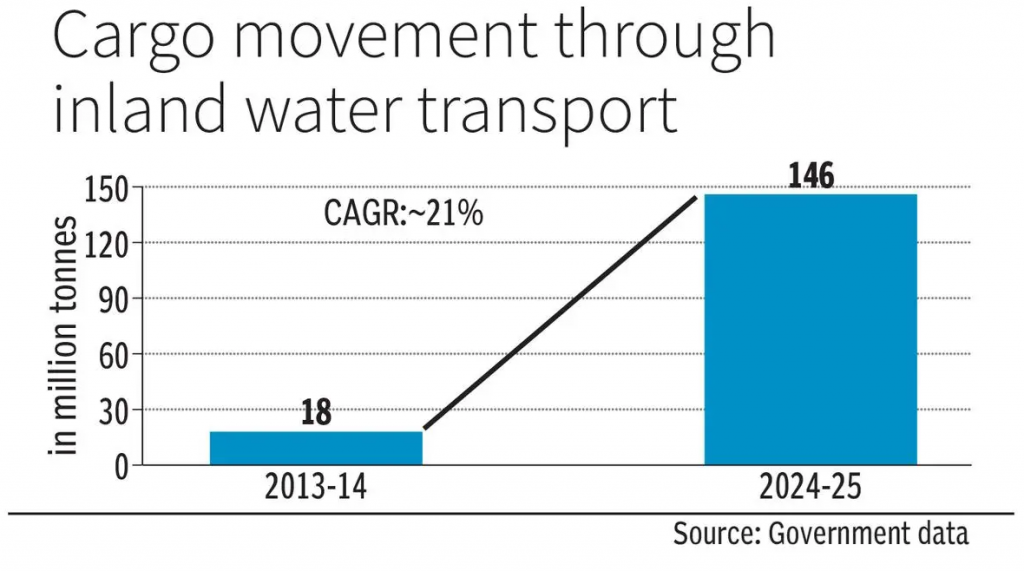
- Cargo movement increased to about 146 million tonnes (from 18 million tonnes in 2013–14), registering a CAGR of almost 21%.
Drivers of Growth in Inland Waterways
- Policy Push and Institutional Support: These initiatives have improved navigability, terminal infrastructure, and cargo handling capacity.
- Inland Waterways Authority of India (IWAI) for regulation and development
- Jal Marg Vikas Project (JMVP) on National Waterway-1 (Ganga)
- Sagarmala Programme and PM Gati Shakti for multimodal integration
- Multimodal Logistics Integration: Inland waterways enhance intermodal connectivity, linking ports, railways, and highways, and reduce transit time and logistics costs.
- The expansion of inland waterways is part of a broader logistics transformation i.e. integration with rail freight corridors and ports, development of multimodal logistics parks, and reduction in supply bottlenecks.
Inland Waterways as a Resilient Logistics Mode
- Insulation from Global Disruptions: Inland waterways provide a domestic, stable transport alternative, unlike maritime shipping routes affected by geopolitical tensions.
- Reducing Logistics Costs: India’s logistics costs remain relatively high (~13–14% of GDP).
- IWT offers lower fuel consumption and higher load capacity.
- Decongestion of Road and Rail: Diverts bulk cargo (coal, cement, food grains); and reduces pressure on overburdened rail and road networks.
- Climate and Environmental Benefits: Lower carbon emissions per tonne-km; and supports India’s climate commitments and green logistics goals.
Strategic Importance in India’s Economy
- Enhancing Supply Chain Resilience: Logistics disruptions (e.g., geopolitical conflicts, pandemics) expose vulnerabilities.
- It includes rising freight and insurance costs, supply chain disruptions, and energy price volatility (crude oil, LPG, natural gas).
- Inland waterways provide redundancy and diversification, key elements of resilient supply chains.
- Regional Development and Inclusion: Promotes economic activity in hinterland and riverine regions; and facilitates trade corridors in Indo-Gangetic plains.
- Supporting Economic Growth: Efficient logistics systems are crucial for sustaining high growth.
- IWT contributes by reducing bottlenecks and improving competitiveness.
Challenges in Inland Water Transport
- Seasonal variability in river flow;
- Limited depth (draft issues) and dredging requirements;
- Underdeveloped terminal infrastructure;
- Environmental concerns (e.g., biodiversity impact on Ganga dolphins)
- Low private sector participation;
Way Forward
- Infrastructure and Technology: River training, dredging, and modern terminals and use of digital navigation systems and river information services.
- Policy and Institutional Reforms: Strengthening National Logistics Policy (2022) and incentivizing private investment and PPP models.
- Sustainable Development Approach: Environmental safeguards; and community participation in river-based economies.
- Integrated Multimodal Vision: Align IWT with rail, road, and port networks under Gati Shaktil; and develop logistics hubs and economic corridors.
Conclusion
- The growing role of inland waterways marks a paradigm shift in India’s logistics strategy, from cost-centric to resilience-oriented planning.
- Inland waterways are poised to become a cornerstone of India’s economic and infrastructure development by offering a sustainable, efficient, and shock-resistant transport mode.
Previous article
News In Short 02-05-2026
Next article
Medical and Wellness Tourism in India
