
ISRO’s LVM3 Rocket Launches GSAT-7R

Syllabus: GS3/ Science and Technology

Context

  • The Indian Space Research Organisation (ISRO) successfully launched the Indian Navy’s advanced communication satellite GSAT-7R (CMS-03) from the Satish Dhawan S Satish Dhawanpace Centre in Sriharikota.

About the GSAT-7R Satellite

  • Gsat-7R an indigenously developed satellite, weighing approximately 4,400 kg, is India’s heaviest communication satellite to be launched from the country to date.
    • It is designed to replace Gsat-7 (Rukmini), which was launched in 2013 and is primarily dedicated to the Indian Navy.
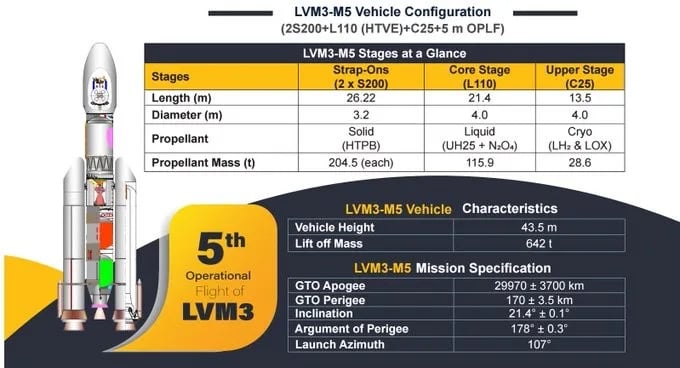
  • ISRO launched the rocket aboard its most powerful launch vehicle, the LVM3, on its M5 mission.
    • The satellite had been successfully inserted into a geosynchronous transfer orbit (GTO).
Geosynchronous Transfer Orbit
– The GTO allows satellites to be positioned into geostationary orbits, where they can maintain a fixed position relative to the Earth’s surface. 
– This is crucial for communication and weather satellites that need to monitor specific areas continuously.
  • The satellite carries advanced payloads in multiple frequency bands, UHF, S-band, C-band and Ku-band, and includes several indigenous technologies such as a 1,200-litre propulsion tank and collapsible antenna systems. 
  • Its payload includes transponders capable of supporting voice, data, and video links over multiple communication bands.
  • Significance: With state-of-the-art indigenous components, the GSAT-7R will provide robust and secure telecommunication coverage across the Indian Ocean Region

Reasons for Heavy Mass of Communication Satellites

  • Wide Coverage and Multi-band Capability: To serve the entire Indian mainland, communication satellites require broad-area coverage and support for multiple frequency bands.
    • This multi-band design demands large deployable antennas, high-power amplifiers, waveguides, and digital processors, all of which contribute to greater mass.
  • High Power Demand and Large Solar Arrays:  Modern communication satellites are high-power platforms, consuming several kilowatts of electricity.
    • To sustain this for 12–15 years, satellites carry large solar panels and batteries to provide continuous energy during Earth’s shadow (eclipse) periods.
  • Redundancy for Long Service Life: To ensure reliability, satellites include redundant systems, duplicate computers, radios, power units, and control systems.
    • This redundancy allows continued operation even if primary systems fail.
    • While critical for mission longevity, redundancy significantly increases the overall launch mass.
ISRO’s LVM3 Rocket Launches GSAT-7R

Source: TH


Other News of the Day

Syllabus: GS2/Polity and Governance Context ‘Enshittification’ is a term increasingly being used to describe how your digital experiences, services, and transactions have become worse over time. What is Enshittification? In 2022, the Canada-born author and activist Cory Doctorow coined the term “enshittification.”  It refers to the systematic decline in quality and fairness of digital platforms...
Read More

Syllabus: GS2/Health In News Investing in healthcare boosts resilience and productivity, helping India achieve affordable universal care and a Viksit Bharat by 2047. Universal Health Coverage (UHC) Universal health coverage (UHC) means that all people have access to the full range of quality health services they need, when and where they need them, without financial...
Read More

Syllabus: GS3/Economy Context Around the world, leading maritime hubs are transforming into “blue cities”.  What are Blue Cities? Blue Cities refer to coastal or port cities that integrate ocean-based economic activities with sustainable urban development.  The concept is rooted in the idea of a “Blue Economy” — using ocean resources for economic growth while preserving...
Read More

Syllabus: GS3/Economy Context Rupee-backed stablecoins regulated by the Reserve Bank of India (RBI) could revolutionize payments, remittances, and cross-border transactions, if the regulatory framework aligns with innovation. What Are Rupee Stablecoins? Stablecoins are cryptocurrencies designed to maintain a fixed value by being tied to a reserve asset — typically fiat currencies like the US dollar...
Read More

Syllabus: GS3/Economy  In News India’s honey sector is undergoing a structured transformation as the National Beekeeping and Honey Mission (NBHM) continues to scale scientific beekeeping across the country. National Beekeeping and Honey Mission (NBHM) It is a Central Sector Scheme launched by the Government of India for the overall promotion and development of scientific beekeeping...
Read More

Syllabus: GS3/ Science and Technology Context PM Modi launched the ₹1 Lakh Crore Research, Development and Innovation (RDI) Scheme Fund while inaugurating the Emerging Science, Technology and Innovation Conclave (ESTIC) 2025 in New Delhi.  About the scheme The scheme has an outlay of Rs 1 lakh crore over 6 years, with Rs 20,000 crore allocated...
Read More

Lucknow Designated a UNESCO Creative City of Gastronomy Syllabus: Miscellaneous In News UNESCO designated Lucknow as a Creative City of Gastronomy, recognizing its rich and diverse culinary heritage, particularly its famed Awadhi cuisine. This makes Lucknow the second Indian city after Hyderabad (2019) to earn this honor in the gastronomy category of the UNESCO Creative...
Read More
scroll to top