


Syllabus: GS3/Sustainable Development/Science and Technology
Context
- Different technological approaches under the Namami Gange’s approach to wastewater treatment combines infrastructure, diverse technologies, decentralised solutions, rehabilitation and long-term operation.
Namami Gange Programme (NGP)
- The Namami Gange Programme (NGP) was launched in 2014.
- It is an Integrated Conservation Mission with the twin objectives of effective abatement of pollution, conservation and rejuvenation of the National River Ganga.
- Main pillars of the Namami Gange Programme are Sewerage Treatment Infrastructure, River-Front Development, River-Surface Cleaning, Biodiversity, Afforestation, Public Awareness, Industrial Effluent Monitoring and Ganga Gram.
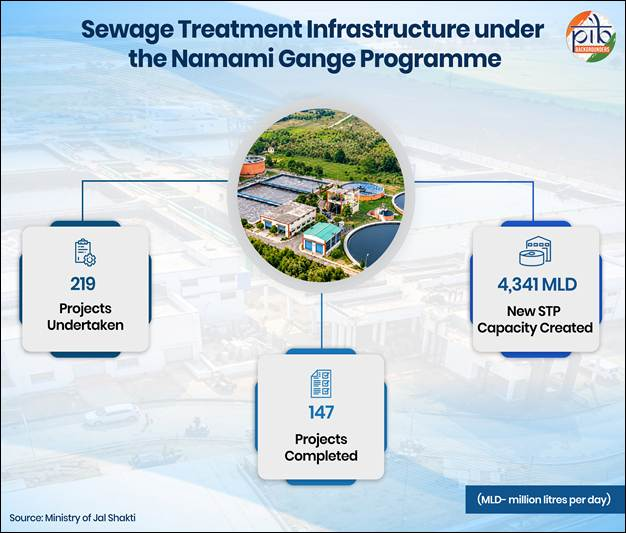
Progress Made So Far
Need for Technological Approaches
- Large cities: Centralised sewage treatment plants (STPs) treat wastewater collected through underground sewer networks.
- Small towns and villages: Decentralised treatment systems are useful where complete sewer networks are unavailable.
- Hilly areas: Compact technologies are needed because of difficult terrain, cold temperatures and limited accessibility.
- Land-constrained areas: Multi-storey STPs and compact treatment technologies reduce land requirements.
- Sustainability: Energy-efficient technologies, renewable energy and sludge management help reduce operating costs and environmental impact.
Important Sewage Treatment Technologies:
- Food Chain Reactor (FCR) technology: It improves upon the Activated Sludge Process and Sequential Batch Reactor by incorporating fixed artificial media and plant roots.
- Activated Sludge Process: Activated sludge refers to a mass of microorganisms cultivated in the treatment process to break down organic matter into carbon dioxide, water, and other inorganic compounds.
- Sequential Batch Reactor is a cyclic activated sludge treatment process which provides the highest treatment efficiency possible in a single-step biological process.
- Electrocoagulation and electro-oxidation: It is a non-biological treatment process that uses electric current and a coagulant metal anode to destabilise suspended and emulsified pollutants.
- These systems are suited to cold temperatures, hilly terrain and locations with limited access.
- Such systems have been implemented in Uttarakhand at locations like Badrinath and Chamoli.
- Constructed wetlands (CWs) are engineered systems that use natural processes to remove pollutants under controlled conditions.
- A CW system comprises water, plants, growing media (substrate), soil and microorganisms.
- NEREDA is another biological wastewater treatment technology: It uses the same bacteria as conventional activated sludge but forms compact aerobic granules with good settling properties.
- Soil Biotechnology: It combines physical processes such as sedimentation and infiltration with biochemical processes.
- The system uses a suitable mineral constitution, native microflora, and bio-indicator plants as key components.
Resource Recovery Under the Program:
- Biogas generation: Anaerobic digestion breaks down organic matter without oxygen, producing biogas that can generate electricity. At the 140 MLD Dinapur STP in Varanasi, biogas-based generation reportedly meets around 52–72% of actual monthly power consumption.
- Solar energy: Solar installations help reduce the dependence of STPs on conventional electricity.
- Sludge incineration: Thermal treatment can reduce sludge volume, with the resulting stabilised ash potentially used in products such as bricks or concrete, subject to suitability and applicable standards.
- Treated-water reuse: Properly treated wastewater can be reused for suitable purposes, reducing pressure on freshwater resources.
Significance of the technology-neutral approach
- Location-specific solutions: Different technologies can be selected according to local geography, population and infrastructure.
- Reduced costs: Compact and decentralised systems can avoid expensive sewer networks and reduce land requirements in suitable locations.
- Improved river health: Effective sewage treatment reduces organic pollution and helps improve dissolved oxygen levels in receiving waters.
- Energy efficiency: Biogas, solar power and energy-efficient treatment processes reduce operational energy requirements.
- Circular economy: Wastewater and sludge can become resources through reuse, energy recovery and appropriate material recovery.
Conclusion
- The Namami Gange Programme demonstrates that river rejuvenation requires more than constructing sewage treatment plants.
- A combination of conventional technologies, decentralised systems, nature-based solutions, energy recovery is essential to reduce pollution and ensure sustainable wastewater management across the Ganga basin.
Source: PIB
Previous article
State Bank of India (SBI) Dark-Web Data Leak
Next article
Pumped Storage Hydropower
