


3 New Sites Added to India’s UNESCO Tentative List
Syllabus: GS1/Culture
Context
- Three Indian sites have been added to UNESCO’s Tentative List of World Heritage Sites, taking India’s Tentative List to 81 sites.
About
- The three sites are the Karst-mud-volcano Complex of Baratang and Andaman Subduction Volcanoes in the Andaman and Nicobar Islands, and the Sirpur Cultural and Archaeological Landscape in Chhattisgarh.
- Inclusion on the tentative list is a prerequisite for any property to be considered for nomination to the World Heritage List.
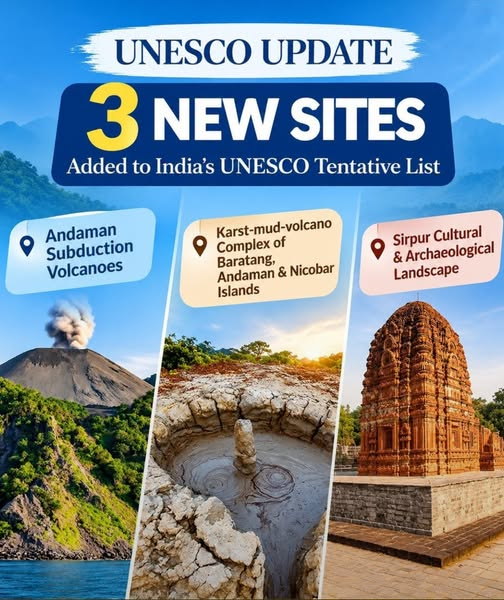
Baratang Karst-Mud Volcano Complex
- Location: Baratang Island, Andaman and Nicobar Islands.
- Significance: Features limestone caves and active mud volcanoes. Unlike conventional volcanoes, these release mud, water, and gases rather than molten rock.
Andaman Subduction Volcanoes (Narcondam & Barren Islands)
- Location: Andaman and Nicobar Islands.
- Significance: The site comprises Barren Island and Narcondam Island, which illustrate volcanic processes and ecological succession.
- Barren Island: Home to India’s only confirmed active volcano, with eruptions recorded since the late 18th century.
- Narcondam Island: A forest-covered volcanic island known for its biodiversity. It is particularly important for the Narcondam hornbill, a bird found naturally only on the island.
Sirpur Cultural & Archaeological Landscape, Chhattisgarh
- Location: Mahasamund district, on the eastern bank of the Mahanadi River, approximately 78 km from Raipur.
- Significance: Also known as Shripur, the town became the capital of the Kosala Kingdom under the Sharbhapuriya dynasty and expanded under the Panduvamshi dynasty. Its archaeological remains reflect its architecture, trade links and the influence of multiple faiths.
Do you know?
- India has 45 UNESCO World Heritage Sites, including 37 cultural sites, seven natural sites and one mixed site, following the inscription of the ancient Buddhist site of Sarnath in July 2026.
Source: TOI
Badr Memorandum of Understanding (MoU)
Syllabus: GS2/IR
Context
- Pakistan, Turkey, Qatar, and Indonesia have signed the Badr Memorandum of Understanding (MoU).
About
- Aim: To deepen military cooperation and strengthen their defence capabilities.
- The agreement seeks to promote defence manufacturing, military training, research and the development of domestic defence industries.
- Strengths of Country Involved: Turkey contributes its established defence industry, Qatar can offer financial resources, Indonesia has experience in joint development and domestic production, and Pakistan offers manufacturing capacity and skilled workforce.
- Meaning of ‘Badr’: In the Arabic Badr means full moon. The name may also refer to the Battle of Badr (624 CE), an important early military victory of Prophet Muhammad, although the precise reason for the name is unclear.
- Badr MoU vs Mecca Pact: The Mecca pact was signed in August between Saudi Arabia, Türkiye, and Pakistan, it focuses on collective defence, under which an attack on one member country is treated as an attack on all.
- The Badr memorandum seeks to build the military and industrial capabilities of its members.
Should India be worried?
- Military modernisation: It could help Pakistan to modernise its armed forces, expand domestic weapons production and strengthen its defence manufacturing ecosystem.
- Strategic Implications for India: Pakistan having greater access to defence technologies could affect India’s regional security calculations.
- Concerns over technology sharing: India has defence cooperation with Indonesia, including an announced $630 million missile deal involving BrahMos cruise missiles and Astra air-to-air missiles.
Source: TOI
Core Industries Growth
Syllabus: GS3/Economy
In News
- India’s core sector output growth accelerated to 7.9% in September, the fastest pace in the new series, from a revised 5.9% in August, supported by strong growth in iron ore, electricity, coal and refinery products.
What is the Index of Core Industries (ICI)?
- The Index of Core Industries (ICI) measures the monthly production performance of India’s major industrial sectors.
- The provisional index is generally released on the 20th of the following month or the next working day.
- These industries form the backbone of industrial activity.
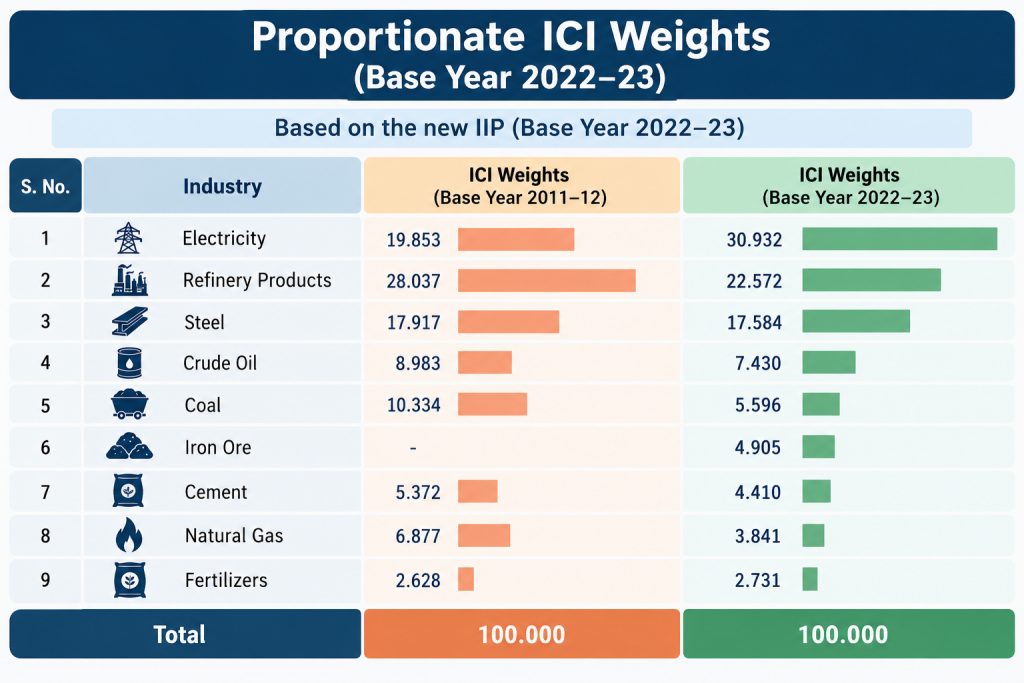
- Under the new 2022–23 base year series, the eight core industries’ combined weight in the Index of Industrial Production (IIP) is 32.88%, compared with 40.27% under the earlier 2011–12 series.
Key Changes in the Revised ICI Series (2022–23)
- The Office of Economic Adviser (OEA), Department for Promotion of Industry and Internal Trade (DPIIT), released the revised Index of Core Industries (ICI).
- The new ICI is released with the base year 2022-23, replacing the base year 2011- 12.
- In the updated Index of Core Industries (ICI), the number of core industries increased to nine following the inclusion of iron ore to the existing eight: coal, crude oil, natural gas, refinery products, fertilisers, steel, cement, and electricity.
- The index gives different weights to each of these sectors to arrive at a final figure.
- The new changes made in the ICI are based on the recommendations of a committee constituted under the chairmanship of Praveen Mahto in November 2025.
Methodological Changes
- Steel: Gross production data replaces net production data.
- Coal: Only raw coal is included; washed coal and coal middling are excluded to avoid double counting.
- Sectoral weights have been revised using the 2022–23 IIP series and normalised to 100.
Source: PIB
RBI MPC Highlights Widening Inflationary Pressure in Economy
Syllabus: GS3/Economy
Context
- The RBI’s Monetary Policy Committee (MPC) unanimously raised the repo rate by 25 basis points to 5.50 per cent earlier this month and shifted its policy stance to calibrated tightening.
- Members broadly acknowledged the risks posed by the West Asia conflict, rising oil prices and the spread of inflation beyond food and fuel.
What is the Repo Rate?
- The repo rate is the rate at which the RBI lends short-term money to commercial banks. It is the key policy tool used by the RBI to control liquidity, inflation, and economic growth.
- A lower repo rate means banks can borrow from the RBI at cheaper rates. This encourages banks to lower lending rates, leading to:
- Easier access to credit for consumers and businesses,
- Boost in investment, consumption, and economic activity,
- Increased liquidity and money supply,
- This can stimulate growth, especially during economic slowdowns.
What is the Monetary Policy Committee (MPC)?
- The MPC is a statutory body established under the RBI Act, 1934 (amended in 2016).
- It is responsible for fixing the benchmark interest rate (repo rate) to maintain price stability while keeping growth in mind.
- It consists of 6 members:
- 3 from the RBI (including the Governor as Chairperson),
- 3 external members appointed by the Government.
- Functioning: It meets at least four times a year (usually bi-monthly) and the decisions are made by majority, and each member has one vote. In case of a tie, the RBI Governor has the casting vote.
Flexible Inflation Targeting Framework (FITF)
- India adopted a Flexible Inflation Targeting Framework (FITF) in 2016. Under this, the government, in consultation with the RBI, sets an inflation target every five years.
- The current mandate specifies a CPI inflation target of 4%, with a tolerance band of ±2%, i.e. between 2% and 6%.
Source: TH
Whale Strandings on India’s Western Coast
Syllabus: GS3/Environment
Context
- A global database of blue whale strandings has highlighted India’s western coast, particularly Gujarat, as an important region for recording whale strandings.
Blue Whale (Balaenoptera musculus)
- Classification: The blue whale is a marine mammal belonging to the order Cetacea.
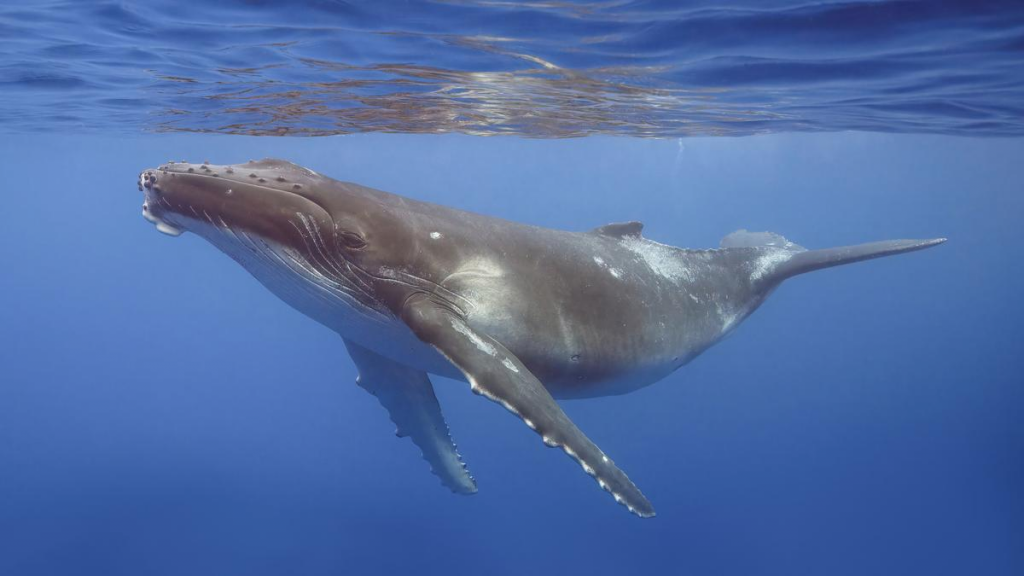
- Characteristics: It is the largest animal known to have lived on Earth, with adults commonly reaching approximately 24–28 metres in length.
- Distribution: Blue whales are found in all oceans except the Arctic Ocean.
- There are currently five recognised subspecies of blue whales.
- Northern Blue Whale: Found across the North Atlantic and North Pacific oceans.
- Antarctic Blue Whale: Found in the Southern Ocean; these are the largest of all blue whale subspecies.
- Pygmy Blue Whale: Found in the Indian Ocean and South Pacific Ocean; they are smaller in overall length.
- Northern Indian Ocean Blue Whale: Found in the Northern Indian Ocean.
- Chilean Blue Whale: Found in the waters off the coast of Chile.
- Conservation status: The blue whale is classified as Endangered on the IUCN Red List globally and is listed in Appendix I of the Convention on Migratory Species (CMS).
About Cetaceans
- Cetaceans are aquatic mammals belonging to the infraorder Cetacea. They include whales, dolphins and porpoises.
- Unlike fish, cetaceans breathe through lungs, are warm-blooded and give birth to live young. They must surface periodically to breathe.
- Around 30–35 cetacean species, along with the dugong, are reported from the waters of the Indian subcontinent.
International Whaling Commission
- The International Whaling Commission (IWC) was set up under the International Convention for the Regulation of Whaling, signed in 1946, as the global body responsible for the management of whaling and conservation of whales.
- A commercial whaling moratorium was adopted in 1982 and came into full force in 1986.
- Headquarters: Impington, United Kingdom.
- The Commission continues to regulate Aboriginal Subsistence Whaling, which is conducted by indigenous communities, often in remote parts of the world.
- The Convention recognises three different types of whaling: commercial, aboriginal subsistence and special permit (also known as scientific) whaling.
- Its membership includes 89 governments from all over the world.
- India has been a member of the International Whaling Commission since 1981.
Source: TH
Asian Para Games 2026
Syllabus: Miscellaneous
In News
- The Asian Para Games 2026 began in Aichi-Nagoya, Japan, with the continental multi-sport event.
Asian Para Games
- The Asian Para Games, also known as Para Asiad, is a multi-sport event regulated by the Asian Paralympic Committee that’s held every four years after every Asian Games for athletes with physical disabilities.
- Both events have adopted the strategy used by the Olympic and Paralympic Games of having both games in the same city.
- The 5th Asian Para Games are being held in Aichi-Nagoya, Japan, bringing together para-athletes from across Asia to compete across multiple sports.
Asian Games
- It is also known as the Asiad and is the biggest sporting competition in Asia, conducted once every 4 years.
- It is organised by the Olympic Council of Asia (OCA) and now involves 45 countries or regions.
- The official tagline was “Imagine One Asia”. This is the third time Japan is hosting the Asian Games; the previous editions were held in Tokyo (1958) and Hiroshima (1994).
India’s Participation
- India’s participation in the Asian Games began with the first edition held in New Delhi in March 1951 on a proposal by Prof. G.D. Sondhi, India’s representative on the International Olympic Committee (IOC).
- The Games were first mooted during the first Asian Countries Conference in New Delhi in 1947 to promote unity, to re-establish links amongst Asian countries after World War II, and to encourage collaboration in the post-colonial era.
- President Rajendra Prasad inaugurated the first event at the National Stadium. 489 competitors from 11 countries competed in six sports.
Source: Air
National Police Commemoration Day
Syllabus: GS3/Internal Security
Context
- The Police Commemoration Day is observed on 21st October every year.
About
- On October 21, 1959, Indian policemen were martyred in an ambush by Chinese troops at Hot Springs, Ladakh.
- The day commemorates their supreme sacrifice and all police personnel who have laid down their lives in the line of duty.
- A memorial was erected at Hot Springs and members of Police Forces from different parts of the country trek to Hot Springs to pay homage to the martyrs.
- Since the year 2012, the Police Commemoration Day Parade has been held at the National level at the Police Memorial.
National Police Memorial (NPM)
- Dedicated by: Prime Minister on Police Commemoration Day, 2018.
- Location: New Delhi.
- It comprises a Central Sculpture, a Wall of Valour and a museum.
- The Wall of Valour: 30 feet tall granite sculpture stands at the police memorial with the names of over 35,000 martyrs who sacrificed their lives in the line of duty.
Source: AIR
Previous article
Pumped Storage Hydropower
Next article
News In Brief 22-10-2026
