


Syllabus: GS3/Infrastructure/Energy; Environmental Sustainability
Context
- India is expanding its pumped storage hydropower capacity to support renewable energy integration, grid stability, and energy security.
What Is Pumped Storage Hydropower?
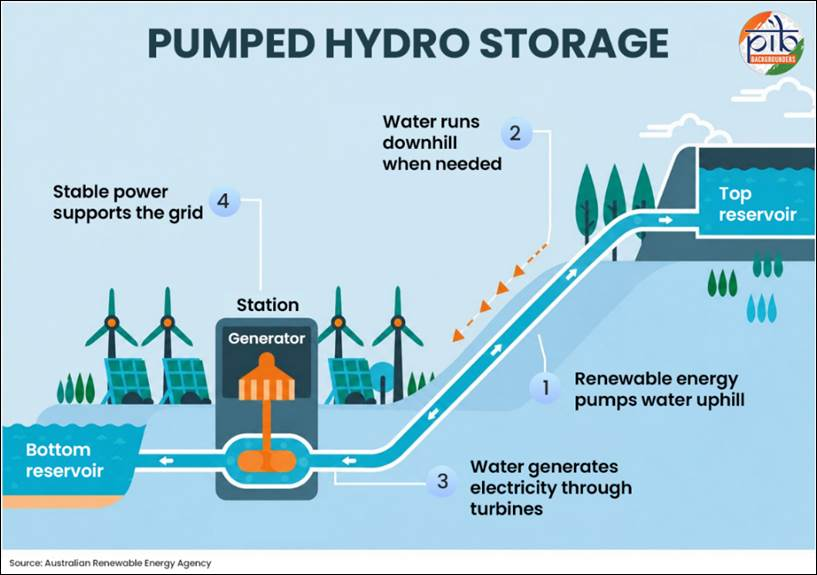
- Pumped Storage Projects (PSPs) are large-scale energy storage systems that use water and gravity to store electricity. They are often described as “water batteries.”
- A typical PSP consists of two reservoirs at different elevations. During periods of surplus electricity, water is pumped from the lower reservoir to the upper reservoir. When demand rises, the stored water is released through turbines to generate electricity.
- PSPs help balance fluctuations in solar and wind power generation, meet peak electricity demand, and improve grid reliability.
Types of Pumped Storage Projects
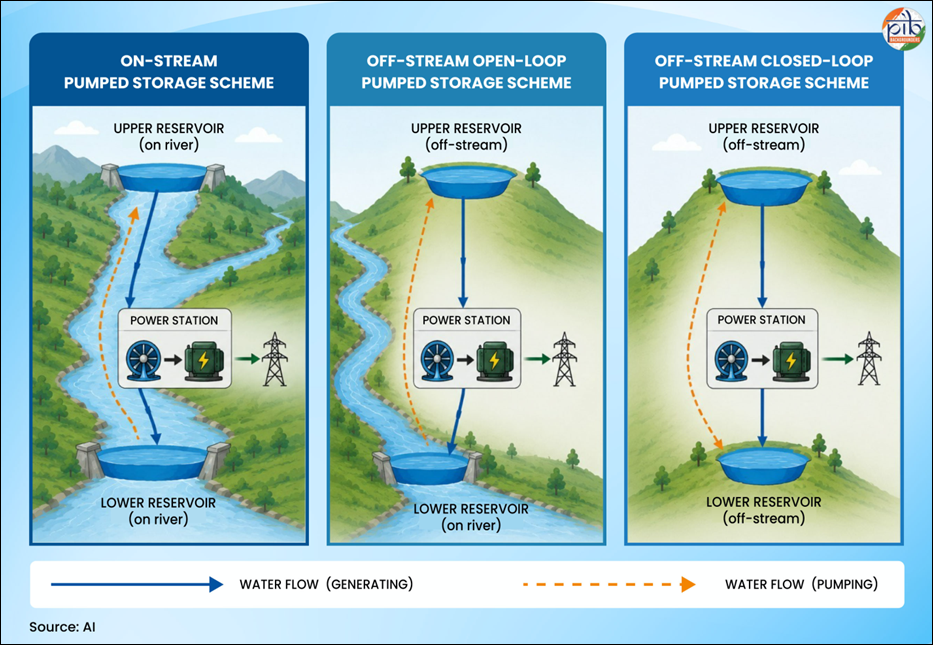
- On-stream Pumped Storage: Both reservoirs are located on a river, stream or nallah.
- Off-stream open-loop: One reservoir is located on a river, stream or nallah, while the other is away from a perennial natural watercourse.
- Off-stream closed-loop: Both reservoirs are located away from perennial rivers, streams and nallahs. Such projects can help reduce impacts on river ecosystems, although site-specific environmental assessments remain essential.
India’s Pumped Storage Potential
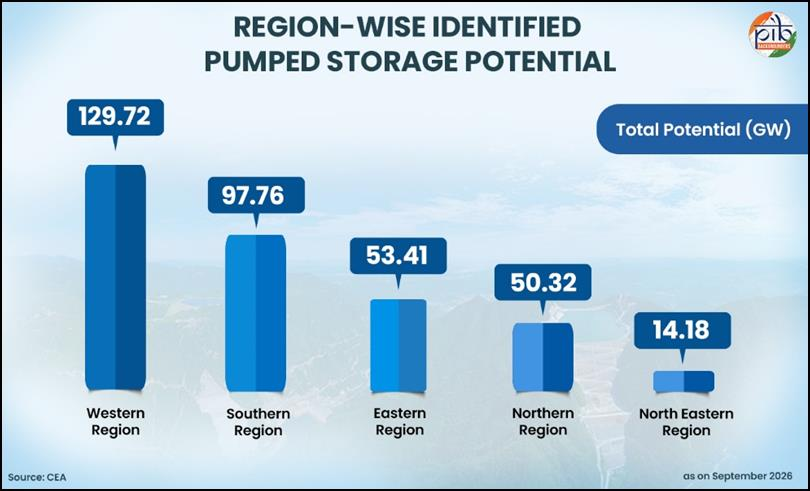
- Operational Capacity: As of August 2026, India has 7.43 GW of operational PSP capacity across 10 projects. The projects have installed capacity above 25 MW.
- Under Construction/ implementation Stage: A further 15.87 GW across 11 PSPs is under construction and/or under implementation across the country.
- Next Stage of Pipeline: 10.40 GW across 8 projects has been concurred or appraised by the Central Electricity Authority (CEA).
Global Installed Capacity PSPs
- Pumped Storage Hydropower is the world’s most widely deployed form of large-scale energy storage, reflecting its established scale and maturity relative to other storage technologies.
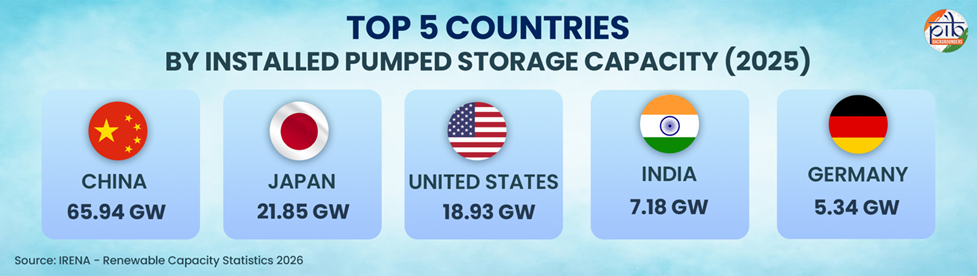
- Global installed pumped hydro capacity stood at 159.8 Gigawatts at the end of 2025, according to the International Renewable Energy Agency (IRENA).
- China accounted for nearly 66 Gigawatts of this capacity, followed by Japan and the United States with around 22 Gigawatts and 19 Gigawatts, respectively.
- India ranks fourth globally in installed pumped storage capacity, with 7.18 Gigawatts at the end of 2025.
Government Initiatives
- PSP Development Guidelines: The Ministry of Power issued guidelines to promote pumped storage development in 2023.
- Tariff-Based Competitive Bidding: Guidelines notified in 2025 provide a framework for procuring storage capacity and stored energy.
- Transmission charge waiver: Eligible PSPs awarded for construction by 30 June 2028 can receive a 100% Inter-State Transmission System (ISTS) charge waiver for 25 years from commercial operation.
- Faster approvals: The CEA’s timeline for Detailed Project Report concurrence has been reduced from 90 days to 50 days.
- Integrated planning: The government is integrating energy storage and transmission planning to improve grid flexibility and accommodate greater renewable energy capacity.
Significance of Pumped Storage Hydropower
- Renewable energy integration: Stores surplus electricity generated during periods of high solar and wind output.
- Grid stability: Helps balance electricity supply and demand and supports peak-load management.
- Energy security: Reduces the challenges associated with variable renewable generation.
- Long-duration storage: Complements battery storage by shifting large quantities of electricity across longer periods.
Challenges
- High initial capital costs and long construction periods.
- Geographical constraints, including suitable elevation differences, geology and water availability.
- Potential environmental impacts on forests, aquatic ecosystems and local communities.
- The need for transmission connectivity, clearances and coordinated project execution.
Conclusion
- Pumped storage hydropower can play an important role in India’s clean energy transition by providing long-duration storage, improving grid flexibility and enabling greater integration of renewable energy.
- Its successful expansion will depend on balancing infrastructure development with environmental safeguards and efficient project implementation.
Source: PIB
Previous article
Technology and Innovation under Namami Gange
Next article
News In Brief 22-10-2026
