


Syllabus: GS3/Science and Technology
Context
- Scientists in Vienna and Beijing have independently developed the world’s first two operating nuclear clocks.
What is a Nuclear Clock?
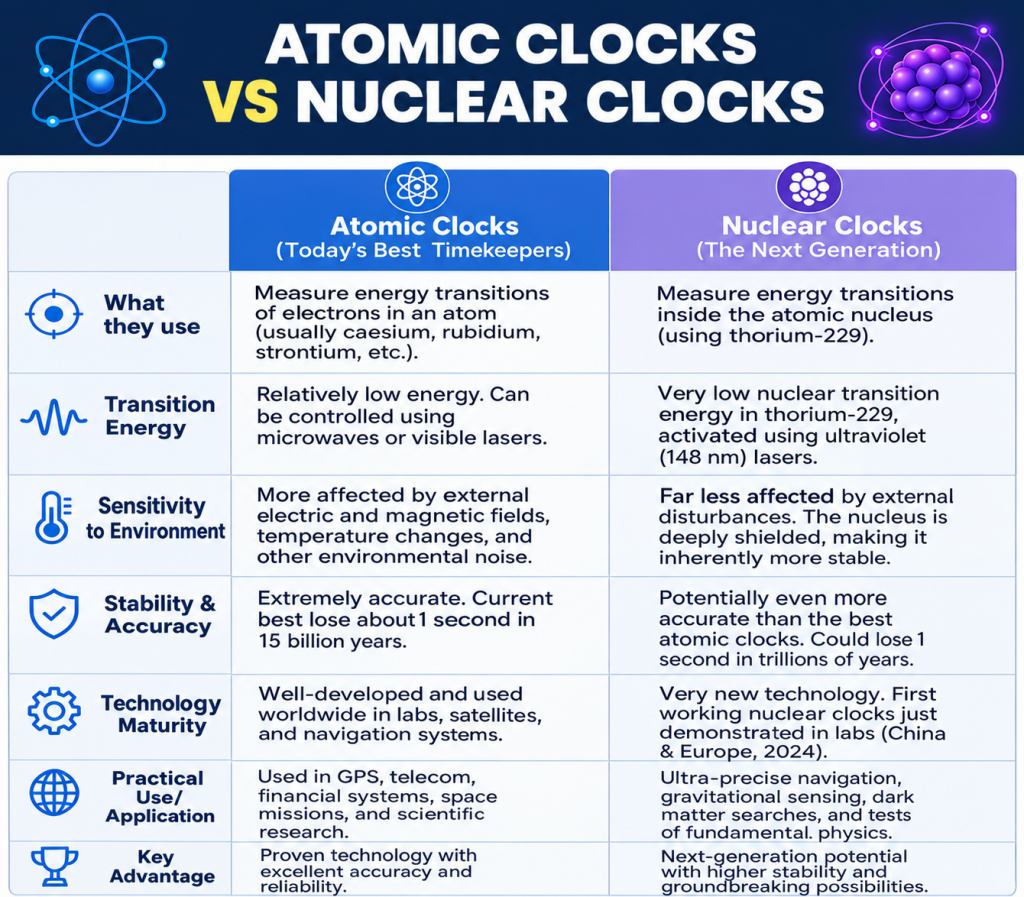
- Nuclear clocks are precision timekeeping devices that measure time using the frequency of energy transitions within an atomic nucleus.
- They are not powered by nuclear fission or fusion. The term ‘nuclear’ refers to the part of the atom that acts as the timekeeping reference.
- It measures time by using lasers to make subatomic particles called protons and neutrons jump back and forth between energy levels inside the nucleus of an atom, in this case thorium-229.
- Both the Vienna and Beijing teams used thorium-229, a particular isotope of the radioactive element thorium, embedded in calcium fluoride crystals.
- Unlike most atomic nuclei, which require extremely high-energy radiation to excite them, thorium-229 has a relatively low-energy nuclear transition that can be stimulated using laser light.
How Is a Nuclear Clock Different from an Atomic Clock?
- First developed in 1949, atomic clocks are among the most accurate timekeeping devices ever developed.
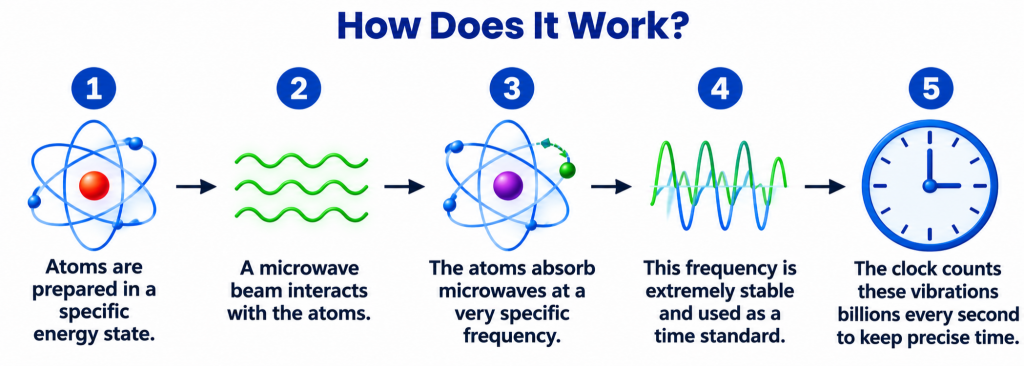
- Unlike ordinary clocks, which measure time through mechanical movements or the vibrations of quartz crystals, atomic clocks rely on the behaviour of atoms.
- Conventional atomic clocks measure time by using lasers or microwaves to make subatomic particles called electrons jump back and forth between two energy levels in an atom’s shell, using elements such as cesium or strontium.
- In fact, the internationally recognised definition of a second is based on a specific energy transition in the caesium-133 atom.
Potential Applications
- Systems such as GPS determine a receiver’s position by measuring the time taken by signals to travel from satellites.
- Even tiny timing errors can translate into significant positioning errors, making more precise clocks potentially valuable for navigation systems.
- Precise timing synchronises data transmission across mobile networks, fibre-optic infrastructure and communication systems.
- Accurate time synchronisation helps establish the chronological order of transactions and supports reliable operation of financial networks.
- Nuclear clocks could help scientists investigate interactions between ultralight dark matter and ordinary matter, as well as test whether fundamental constants of nature vary over time.
Challenges in Developing Nuclear Clocks
- Limited performance: Current nuclear clocks have not yet surpassed the most accurate existing atomic and optical clocks.
- Laser technology: Generating and stabilising the required vacuum-ultraviolet laser light is technically demanding.
- Material requirements: Developing crystals with suitable optical properties and sufficient thorium concentration remains important for improving performance.
- Experimental complexity: Researchers need to improve stability, reproducibility and the ability to operate the clocks reliably in practical conditions.
- Limited immediate applications: Their use in navigation, communications and other operational systems remains prospective rather than established.
Source: IT
Next article
News In Short 12-10-2026
