


Syllabus: GS3/ Economy
In Context
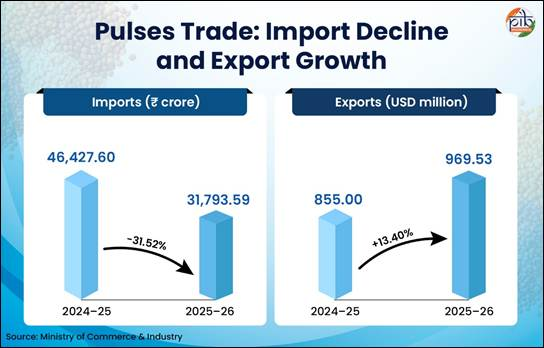
- India is the world’s largest producer of pulses, yet it remains a major importer.
About
- Pulses contribute significantly to India’s agricultural exports and remain a vital part of Indian diets, ensuring nutritional security.
- Recognising this importance, the government launched the ‘Mission for Aatmanirbharta in Pulses’ on October 11, 2025 with financial allocation of ₹11,440 crore spanning 2025–26 to 2030–31.
Mission for Aatmanirbharta in Pulses: Key Features
- Under the Mission, by 2030-31, production is expected to reach nearly 350 lakh tonnes, with yield rising to 1,130 kg per hectare.
- Focus on enhancing production of Tur, Urad and Masoor
- Promotion of climate-resilient seeds and improved seed quality
- Distribution of 87.5 lakh free seed kits and 126 lakh quintals of certified seeds over six years
- Expands pulse cultivation area by 35 lakh hectares to reach a total targeted area of 310 lakh hectares by 2030–31.
- Cluster-based approach covering 489 districts to intensify production
- Establishment of 1,000 processing units (dal mills)
Technology and Governance
- Traceability: The SATHI portal tracks seeds from production to sale, curbing spurious seed supply.
- Farm-level data: Krishi Mapper geo-tags demonstrations, while AgriStack with Digital Crop Survey links Farmer IDs, soil health and verified plots for accurate forecasting.
- Market linkage: E-Samriddhi and Vistaar enable direct payments and price information.
- Monitoring: A three-tier Steering Committee oversees implementation from national to district level.
Significance
- Nutritional security: Pulses are the main affordable protein source for a largely vegetarian population. Higher domestic output reduces protein deficiency and supports schemes like PDS and PM POSHAN.
- Farmer income: Assured procurement removes the price risk that has pushed farmers towards wheat and rice. Pulses also fix nitrogen, lowering fertilizer needs and subsidy burden.
- External stability: Lower imports conserve foreign exchange and insulate India from volatile supplier countries and export bans.
- Inflation control: Domestic supply reduces the recurrent spikes in pulse prices that raise food inflation.
- Sustainability: Rice-fallow cultivation and crop diversification improve land use, soil health and climate resilience.
Challenges
- Low productivity: Pulses are grown mostly on rainfed, marginal land, so yields remain below Canada and Myanmar and fluctuate with monsoon variability.
- Procurement gaps: Only about 60% of registered farmers have benefited so far, and procurement is concentrated in a few States. The MSP-based support historically favoured wheat and rice, so awareness and logistics for pulses remain weak.
- Uneven price signals: Masur’s modest MSP hike may discourage its cultivation, which risks undermining the Mission’s own crop targets.
- Import and trade policy volatility: Frequent shifts in import duties and stock limits create uncertainty for farmers and traders.
- Seed and extension weaknesses: Slow seed replacement, limited high-yielding variety coverage and weak extension services restrict yield gains.
- Post-harvest losses: Inadequate storage and fragmented processing reduce farmer realisation. Only 18 of 23 approved PMKSY pulse units are complete.
Way Forward
- Technology and breeding: Expand short-duration, pest-resistant and heat-tolerant varieties, backed by ICAR research and seed hubs.
- Stable policy: Align import duties with the sowing calendar and avoid abrupt changes, so farmers get predictable price signals.
- Procurement reform: Widen coverage to more States and farmers, and consider price deficiency payments as a complement.
- Value chain: Speed up dal mill creation and invest in warehousing, FPO aggregation and e-NAM linkage.
- Cropping system integration: Promote pulses as intercrops and in rice-fallow lands, with incentives linked to water and fertiliser savings.
- Demand side: Strengthen pulses inclusion in PDS and nutrition programmes to build a stable market.
Source: PIB
Previous article
Preventive Detention and Right to Protest
