

Biovigilance Programme of India
Syllabus: GS2/Governance; Health
In News
- The Ministry of Health and Family Welfare has approved the Biovigilance Programme of India.
Biovigilance Programme of India
- It will monitor and prevent adverse events linked to medicines and biological products used in organ and tissue transplantation.
- It will also cover products administered to both organ and tissue donors and recipients.
- It will be led by the Indian Pharmacopoeia Commission (IPC).
- Indian Pharmacopoeia Commission (IPC) is an autonomous institution of the Ministry of Health and Family Welfare which sets standards for all drugs that are manufactured, sold and consumed in India.
- It will complement the Pharmacovigilance Programme of India (PvPI), which monitors adverse drug reactions, and the Materiovigilance Programme of India (MvPI), which tracks adverse events associated with medical devices.
Source: IE
PBSHABD
Syllabus: GS2/Governance
In News
- Prasar Bharati’s PBSHABD user base reached 3,600 media organisations in two years and free access extended until March 2027.
Background
- Prasar Bharati is India’s autonomous public service broadcaster which was formed on 23 November 1997 under the Prasar Bharati Act, 1990 with Akashvani and Doordarshan as its two elements.
- Its mandate includes the promotion of fair and balanced flow of information in the public interest. The core of this position has been news collection.
- Prasar Bharati News Service (PBNS) was initially an internal news wire providing content to Akashvani and Doordarshan.
- In March 2024, its scope was broadened to turn this internal news resource into a news-sharing service.
PBSHABD
- It stands for Prasar Bharati – Shared Audio-Visuals for Broadcast and Dissemination.
- It was launched by the Ministry of Information and Broadcasting (MIB) in 2024 in New Delhi.
- It is a news feed service of Prasar Bharati, open to media users round the clock.
- It supplies timely, authentic and ready-to-use news content from India and the world.
- It has text, video, audio, photos and infographics in 15 Indian languages spanning approximately 50 categories for media organisations to use.
- Its users are registered media organisations, digital publishers and content creators. Newspapers, news television channels and digital news publishers form the bulk of this base.
Source: PIB
Deen Dayal Upadhyaya Grameen Kaushalya Yojana 2.0
Syllabus: GS2/Governance
In News
- The Government is creating a more responsive, technology-driven, and outcome-oriented skilling ecosystem through DDU-GKY 2.0.
Deen Dayal Upadhyaya Grameen Kaushalya Yojana (DDU-GKY)
- The Ministry of Rural Development (MoRD) introduced Deen Dayal Upadhyaya Grameen Kaushalya Yojana (DDU-GKY) in 2014 under the National Rural Livelihoods Mission.
- It is a placement-linked skilling program for rural youth, with a focus on sustainable livelihoods for rural youth.
- It has been delivering placement-linked vocational training to rural youngsters in the age group of 15-35 years from disadvantaged homes for more than a decade.
- It also fosters social inclusion by ensuring coverage for SC/ST communities (50%), women (33%), and persons with disabilities (5%). Over the last decade, the initiative has developed to focus more on employment outcomes and post-placement support.
Upgraded Version
- In May 2025, the Government released the improved DDU-GKY 2.0 Guidelines, which further enhanced the framework around training, placements, employment sustainability, and post-placement support.
- It offers training in several industries like aerospace and aviation, agriculture, beauty and wellness, green jobs, healthcare, textiles and others based on industry requirements.
- The Union Budget 2026-27 has kept the focus on rural skilling with an allocation of ₹750 crore for DDU-GKY.
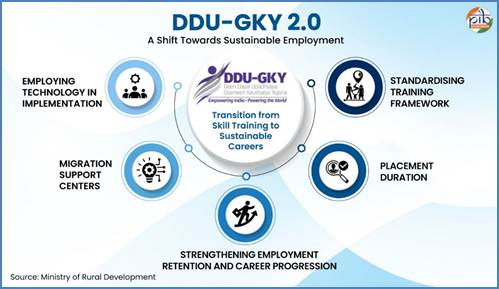
Two specific programs are underway under DDU-GKY 2.0
- Roshni: It is meant for the unique needs of the Left Wing Extremism (LWE) impacted districts notified by the Ministry of Home Affairs.
- There is a need for training in home skills and a 40% reservation for women candidates.
- The program has now been extended to Aspirational Districts for local infrastructure, education, health, natural resources and traditional skills.
- Himayat: This is a particular DDU-GKY initiative for Jammu & Kashmir and Ladakh. It serves rural and urban youth, BPL and APL populations and fosters wage, self, and gig work. The scheme is 100 per cent nationally sponsored and implemented with the help of the States through the specialised Mission Management Units.
Importance
- DDU-GKY 2.0 represents an important step towards building a skilled, empowered, and self-reliant rural workforce for the future.
- It also promotes India’s vision of Viksit Bharat @2047 that aims to transform the country into a global economic and knowledge hub.
Source: PIB
Gaza Board of Peace
Syllabus: GS2/International Relations
Context
- The US-backed Board of Peace has proposed a six-month, $2.45-billion recovery programme for Gaza, covering projects related to infrastructure, housing, healthcare, economic revival, digital services and security.
What is the Board of Peace?
- The Board of Peace (BoP) is an international organisation established to promote peace, stability, reconstruction and effective governance in conflict-affected regions, with its immediate and major focus on the post-war transition in Gaza.
- U.S. President Donald Trump proposed the Board as part of his framework for achieving a lasting peace in Gaza following the Israel–Hamas conflict.
- He serves as the Chairman of the Board of Peace.
- The Board’s framework received international backing through UN Security Council Resolution 2803 (2025), which endorsed the broader Gaza peace and transitional framework.
- Members: The organisation has brought together a group of countries as founding members, including the United States, Egypt, Israel, Jordan, Qatar, Saudi Arabia, Türkiye and the UAE, among others.
Source: HT
BRICS and the Changing Global Tax Architecture
Syllabus: GS2/ International Relations
Context
- The BRICS tax heads meeting has highlighted the grouping’s effort to develop common positions on international taxation and strengthen the voice of large developing economies in ongoing negotiations for a new global tax framework.
About
- The members focused on international taxation, transfer pricing, revenue statistics, digital tax administration and capacity building, alongside constructive engagement with the UN Framework Convention on International Tax Cooperation (UNFCITC).
- India’s BRICS Tax Initiatives: India is sharing experiences in faceless assessment, pre-filled tax returns, real-time invoice authentication and AI-enabled taxpayer assistance with BRICS partners.
- India established two new working groups on international taxation and transfer pricing and revenue statistics during its 2026 BRICS tax chairship.
- The BRICS Tax Cross-Learning Lab and Tax Support Network are intended to strengthen peer learning and institutional cooperation.
- The first in-person BRICS Young Tax Professionals Capacity Building Programme was organised in India in April 2026 and has been institutionalised as an annual programme.
UN Framework Convention on International Tax Cooperation
- The UNFCITC is a proposed global framework intended to strengthen international tax cooperation and make global tax governance more inclusive and transparent.
- In 2023, the UN General Assembly adopted a resolution initiating the process for a new international tax convention.
- Negotiations began in 2025, with the process expected to move towards finalisation of the convention and related protocols by 2027.
Source: HT
India Rejects OIC Group’s Remarks on Kashmir
Syllabus: GS2/International Groupings
Context
- India categorically rejected the references to Kashmir in the Joint Communique of the Contact Group on Jammu and Kashmir of the Organisation for Islamic Cooperation (OIC).
About OIC
- Established: 1969, in Rabat, Morocco.
- Trigger Event: Response to the arson attack on Al-Aqsa Mosque in Jerusalem.
- Headquarters: Currently in Jeddah, Saudi Arabia.
- Membership: Open to UN member states with a Muslim majority (57 member states as of 2026).
- Goals and Mandate: Present itself as the “collective voice of the Muslim world”. It promotes solidarity and unity among members.
- Membership & Voting:
- Full membership requires consensus in the Council of Foreign Ministers.
- Observer status follows a similar process.
- Decisions: Preferably by consensus, or by two-thirds majority of those present and voting.
- Key Organs
- Islamic Summit: Highest authority, composed of Heads of State, meets every 3 years.
- Council of Foreign Ministers (CFM): Primary decision-making body, meets annually.
Source: AIR
Siang Upper Multipurpose Project
Syllabus: GS3/Infrastructure
Context
- The Arunachal Pradesh Cabinet has approved an Empowered High-Level Committee to guide and coordinate the pre-feasibility survey for the proposed Siang Upper Multipurpose Project (SUMP).
About the Project
- Location: The project has three designated sites, of which two are in Siang district and one is in Upper Siang district.
- Capacity of SUMP: 11,000 megawatts (MW).
- The Union government declared the project a National Project in 2008, reflecting its strategic importance.
Siang River
- The Siang originates in Tibet, where the river is known as the Yarlung Tsangpo.
- It flows eastward for more than 1,000 km before making a major bend around Namcha Barwa and entering Arunachal Pradesh as the Siang.
- In Assam, the Siang joins the Dibang and Lohit rivers and forms the Brahmaputra.
Source: TH
Satellite Smart Anti-Airfield Weapons (SAT-SAAW)
Syllabus: GS3/ Defence
Context
- The Defence Ministry has signed a contract of over 810 crore rupees with Bharat Dynamics Limited (BDL) for the procurement of 160 Satellite Smart Anti-Airfield Weapons (SAT-SAAW) along with associated equipment for the Indian Air Force (IAF).
About Smart Anti-Airfield Weapons (SAT-SAAW)
- The SAT-SAAW is an air-to-ground precision-guided glide bomb designed to strike enemy airfields from a long stand-off range.
- The weapon has been designed and developed by the Defence Research and Development Organisation (DRDO) and will have 60 per cent indigenous content.
- It can be launched from Jaguar, Hawk and Su-30MKI aircraft, allowing the IAF to engage airfield targets without having to approach them directly.
- The delivery of SAT-SAAW is scheduled between 2027-2028 and 2028-2029.
- The indigenous SAAW project was first approved in 2013, underwent flight testing from 2016 to 2021, and was officially inducted into the IAF in 2021.
Source: AIR
Naoero
Syllabus: GS1/Places in News
Context
- At the UN General Assembly, President David Adeang announced that Nauru will be known as Naoero.
- The change restores an ancestral name, language and national identity.
About Naoero
- Naoero, an island country in the southwestern Pacific Ocean. It consists of a raised coral island located in southeastern Micronesia, 25 miles (40 km) south of the Equator.
- Naoero is the third smallest country in the world. Vatican City is the smallest country in the world.
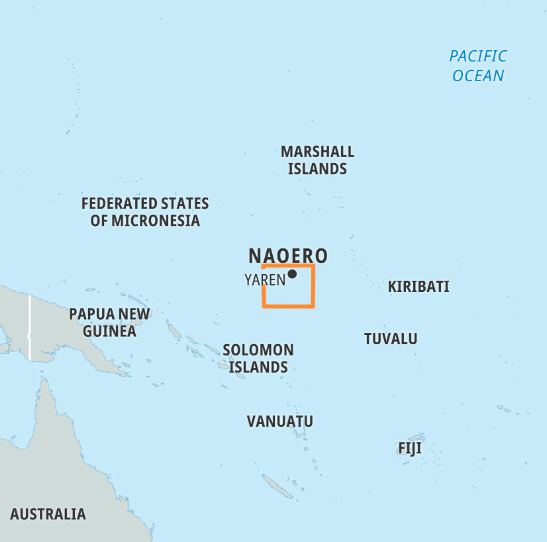
- It is home to about 12,000 people, and became independent in 1968 after colonial rule under the United Kingdom, New Zealand, Australia and Germany.
- Its international code is changing from NRU to NRO, and its people will be known as dei-Naoero instead of Nauruan.
Source: IT
Previous article
3rd National Conference of Anti-Narcotics Task Force (ANTF)
Next article
News In Short 24-09-2026
