


Syllabus: GS3/Economy
Context
- Recently, the Make in India completed its 12 years, with India’s manufacturing expansion spanning electronics, automobiles, pharmaceuticals, steel, railways, defence and strategic technologies.
About Make in India
- Make in India was launched on 25 September 2014 with the aim to make India a global hub for manufacturing, design and innovation.
- Its broad approach was based on facilitating investment, encouraging innovation, improving infrastructure and simplifying government processes under the principle of ‘Minimum Government, Maximum Governance’.
- Over time, the initiative evolved into Make in India 2.0 expanding to 27 sectors, 15 manufacturing and 12 services sectors.
Achievements of Make in India
- Growth in Manufacturing: Manufacturing GVA expanded at a CAGR of 10.88% in 2022-23 to 2025-26 (at constant prices).
- Manufacturing Index of Industrial Production (IIP) increased 7% during April-July 2026 over the corresponding period of 2025.
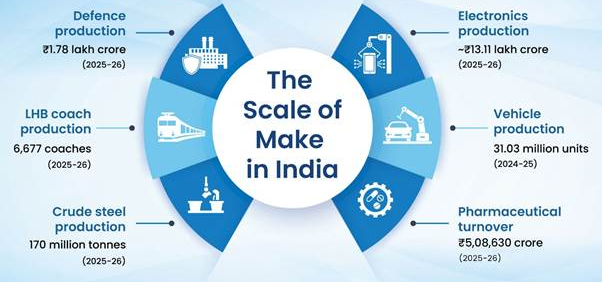
- Electronics production rose nearly seven-fold, from about ₹1.9 lakh crore in 2014-15 to ₹13.11 lakh crore in 2025-26.
- Vehicle production was 31.03 million units in 2024-25, which was about 33% higher than in 2014-15.
- Crude steel output grew to 170 million tonnes from 81.7 million tonnes.
- Indigenous defence manufacturing has grown from ₹46,429 crore to a record ₹1.78 lakh crore in 2025-26.
- India’s pharmaceutical sector is presently the third largest in the world by volume and 11th largest by value, with sales of ₹5,08,630 crore in 2025-26.
- Expanding Domestic Capabilities: India has produced indigenous VIKRAM3201 and KALPANA3201 microprocessors for space applications.
- Solar module production capacity has grown from 2.3 GW in 2014 to 192 GW in June 2026.
- Indigenous capabilities have emerged in EV drive systems, aircraft structures, railway components and nuclear components.
- Effort to develop capabilities in strategically essential technology is a pilot plant for Nd-Fe-B rare-earth permanent magnets at ARCI, Hyderabad.
- Capital Goods and Machinery: The manufacturing of capital goods and heavy engineering equipment was close to quadruple at ₹5.70 lakh crore in 2024-25 from ₹2.87 lakh crore in 2019-20.
- Earthmoving and mining machinery gained 160.3 percent, machine tools 132.2 percent, and heavy electrical equipment 103.5 percent.
- Reforms and Investment: Make in India has been supported by institutional reforms and investment facilitation:
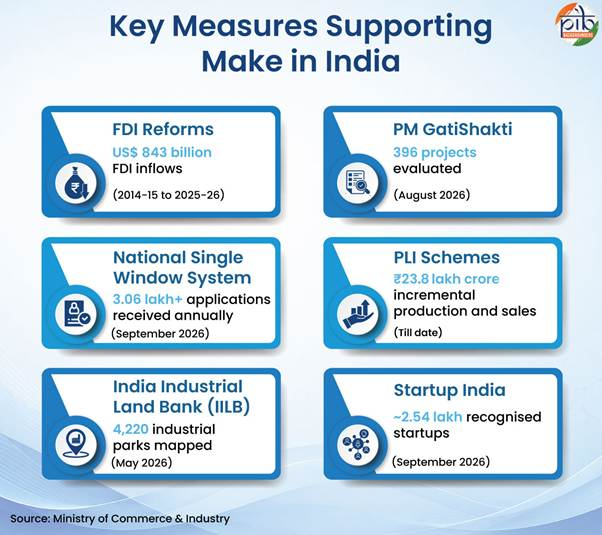
- $843 billion cumulative FDI during 2014-15 to 2025-26.
- National Single Window System (NSWS) covering more that 327 Central and 3,452 State approvals.
- India Industrial Land Bank mapping 4,220 industrial parks.
- PM GatiShakti’s Network Planning Group evaluating 396 projects worth ₹18.66 lakh crore.
- PLI initiatives in 14 sectors supported production and sales of ₹23.8 lakh crore and 14.6 lakh employment, and Startup India had over 2.54 lakh recognised startups.
- New Initiatives Launched: The next phase is increasingly concentrated on strategic sectors:
- Semicon 2.0: ₹1.275 lakh crore
- Mobile Phone Manufacturing Scheme: ₹62,500 crore
- Bharat Audyogik Vikas Yojana (BHAVYA): ₹33,660 crore for 100 industrial parks
- Rare-earth magnet scheme: ₹7,280 crore
- Bharat Audyogik Vikas Yojana Rasayan (BHAVYA Rasayan): ₹3,030 crore for three chemical parks
- PLI for Specialty Steel: covering advanced categories such as CRGO steel, titanium alloys and coated steel.
Related Issues & Concerns
- Higher production does not automatically translate into higher domestic value addition, mass employment or stronger global value-chain integration.
- India continues to face challenges relating to MSME competitiveness, skill gaps, technology acquisition, logistics, critical-input dependence and uneven integration with global manufacturing networks.
- The key challenge, therefore, is to ensure that manufacturing growth becomes employment-intensive, innovation-driven and export-oriented, rather than remaining concentrated in selected sectors or stages of production.
Way Forward
- India needs to move from assembly-led manufacturing towards deeper value addition by:
- Integrating MSMEs into global value chains.
- Increasing public and private R&D and industry-academia collaboration.
- Developing specialised skills for semiconductors, EVs, aerospace, biotechnology and advanced manufacturing.
- Building reliable domestic supply chains for critical minerals, rare earths and strategic components.
- Linking industrial incentives more closely with productivity, exports, innovation and technology transfer.
- Improving logistics, infrastructure and ease of doing business at the State and local levels.
Conclusion
- After 12 years, the character of Make in India is changing. The focus is no longer simply on ‘making more’, but on making more of the value chain in India.
- The next stage will determine whether expanded production capacity can translate into technology leadership, productive employment, resilient supply chains and sustained participation in global manufacturing.
Previous article
News In Short 24-09-2026
Next article
France Proposed to Enhance Functioning of the UN
