

Syllabus: GS2/Health/Governance
Context
- Eight years ago, Ayushman Bharat was rolled out with the idea that every Indian should have access to top-quality and affordable healthcare.
About
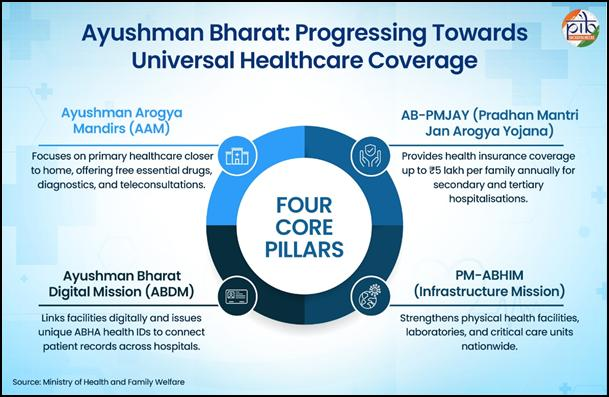
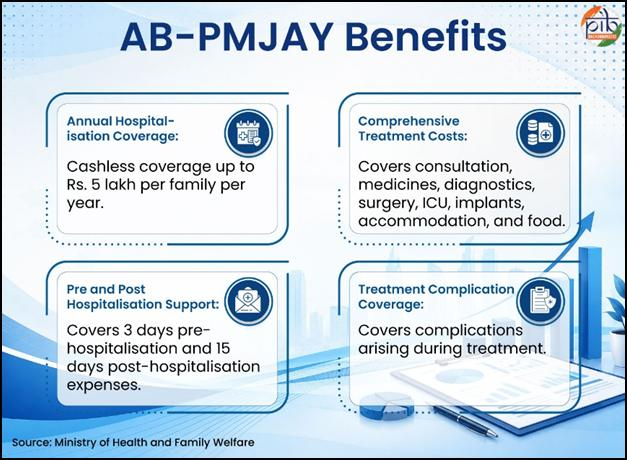
- The Government launched the Ayushman Bharat Pradhan-Mantri Jan Aarogya Yojana (AB PM-JAY) in 2018.
- Aim: To achieve universal health coverage.
- It is a public health assurance scheme and covers secondary and tertiary care.
- It is one of the world’s largest public healthcare schemes, with about 33% of India’s population (over 48.51 crore people) already holding Ayushman cards.
What is Universal Health Coverage?
- It means that all people have access to the full range of quality health services without financial hardship.
- Key components of UHC include:
- Access to Care: Everyone should be able to obtain necessary health services when they need them.
- Quality Services: The care provided should be effective, safe, and of good quality.
- Financial Protection: Individuals should not face financial difficulties due to medical expenses.
- UHC is rooted in the universal human right to health, affirmed in international covenants and the Alma-Ata Declaration (1978), which prioritised comprehensive primary healthcare.
Need For Universal Health Coverage in India
- High Out-of-Pocket Expenditure: A significant share of healthcare spending is borne directly by households, which can push vulnerable families into financial distress.
- Unequal Access to Healthcare: Rural, tribal and remote areas often face shortages of doctors, specialists, diagnostic facilities and quality hospitals, creating geographical disparities.
- Large Disease Burden: India faces a dual burden of communicable and non-communicable diseases, requiring accessible preventive, primary and specialised healthcare.
- Preventive and Primary Healthcare: UHC can shift the focus from expensive hospital-based treatment towards prevention, early diagnosis and primary healthcare, reducing the burden on tertiary facilities.
- Demographic and Epidemiological Transition: With an ageing population and increasing prevalence of chronic diseases, India needs sustainable access to long-term and affordable healthcare.
Constitutional Basis for UHC:
- The Directive Principles of State Policy in Part IV of the Constitution provides a basis for the right to health.
- Article 39 (e) directs the state to secure the health of workers; Article 42 emphasises just and humane conditions of work and maternity relief; and Article 47 casts a duty on the state to raise the nutrition levels and standard of living, and to improve public health.
- The Constitution also endows the panchayats and municipalities to strengthen public health under Article 243G.
Challenges in Adopting UHC in India
- Resource Constraints: India faces significant funding limitations in healthcare, with a low public health expenditure compared to many other countries. This affects the ability to provide comprehensive services.
- Infrastructure Gaps: Many areas, especially rural regions, lack adequate healthcare infrastructure, including hospitals, clinics, and trained personnel, making access to care difficult.
- Healthcare Workforce Shortages: There is a shortage of healthcare professionals, particularly in rural areas, leading to disparities in access and quality of care.
- Fragmented Health Systems: India’s healthcare system is a mix of public and private providers, leading to inconsistencies in quality and accessibility.
- And, Health is a State subject, while financing and flagship schemes are centrally driven, leading to uneven outcomes.
Conclusion
- AB-PMJAY expands access to quality and affordable secondary and tertiary healthcare for eligible beneficiaries, while Ayushman Aarogya Mandirs bring comprehensive primary healthcare closer to communities.
- ABHA (Ayushman Bharat Health Account) enables individuals to create a unique digital health identity and access their health records across participating healthcare facilities.
- PM-ABHIM strengthens the health system’s infrastructure and preparedness by supporting the development of health centres, laboratories, and critical care facilities from the grassroots to the district level.
- These initiatives strengthen the continuum of healthcare, from primary care and digital health services to hospital-based treatment and resilient health infrastructure.
Source: PIB
Previous article
Partners for Multilateralism (P4M)
