

Tulu Language
Syllabus: GS1/ Culture
Context
- The Karnataka Cabinet has decided to accord additional official language status to Tulu for administrative purposes in the Dakshina Kannada and Udupi districts.
About Tulu
- Tulu is an independent Dravidian language with a history of more than 2,000 years, according to the Karnataka Tulu Sahitya Academy.
- It is primarily spoken in Dakshina Kannada, Udupi and parts of Kasaragod in Kerala.
- Historical evidence: The Charition papyrus, a Greek text dated to around the 2nd century BCE, mentions the characters of the Western coast of Karnataka speaking a peculiar language, which is now proven to be Tulu.
- The Tulu-speaking people are mentioned in Tamil Sangam literature of the 2nd century.
- The Registrar General and Census Commissioner recognise Tulu as an independent language, and Census reports provide separate statistics on its speakers.
- Tulu is not a scheduled language, i.e., it is not included in the Eighth Schedule of the Constitution.
- Tulu historically had its own script, which was used for several older literary works. However, the Kannada script is now predominantly used for writing modern Tulu.
- The first Tulu dictionary, Manner’s Tulu-English Dictionary, was published in 1886.
Source: TH
Swachh Bharat Mission (SBM)
Syllabus: GS2/Government Initiatives
Context
- The Swachh Bharat Mission (SBM) has moved beyond toilet construction to focus on sustained sanitation practices and behavioural change in India.
About Swachh Bharat Mission (SBM)
- The Swachh Bharat (Clean India) Mission was launched on 2 October 2014 with the goal of achieving universal sanitation coverage and making India Open Defecation Free (ODF) by 2 October 2019, as a tribute to the 150th birth anniversary of Mahatma Gandhi.
- Toilet infrastructure: By offering financial incentives for building household toilets, as well as community toilets for slums and migrant populations.
- Behavioural Changes: To bring changes to the age-old idea that toilets in the home were unclean, the government ran several programmes with the participation of the private sector and NGOs to educate the population on the benefits of ODF.
- It has two Sub-Missions: the Swachh Bharat Mission (Gramin) – SBM(G) and the Swachh Bharat Mission (Urban) – SBM(U); being implemented by the Ministry of Jal Shakti, and the Ministry of Housing and Urban Affairs, respectively.
- SBM(G) sought to improve the levels of cleanliness through Solid and Liquid Waste Management activities and making Gram Panchayats Open Defecation Free (ODF), clean and sanitized.
- 2019 marked the end of the first phase of SBM(G), the second phase, started in 2020-2021, expands efforts with a focus on safe management of solid and liquid waste and sustainability of ODF.
- SBM (Urban) 2.0: Commenced in 2021 and is expected to run till 2026.
- Targets: Sustaining the achievements of phase 1 (2014–2021) and
- ensuring that treatment of both liquid and solid waste is achieved through the help of technology and private sector engagement.
- Targets: Sustaining the achievements of phase 1 (2014–2021) and
Source: DD News
Agentic Commerce
Syllabus: GS3/Economy
In News
- The payments industry is integrating agentic AI into its services.
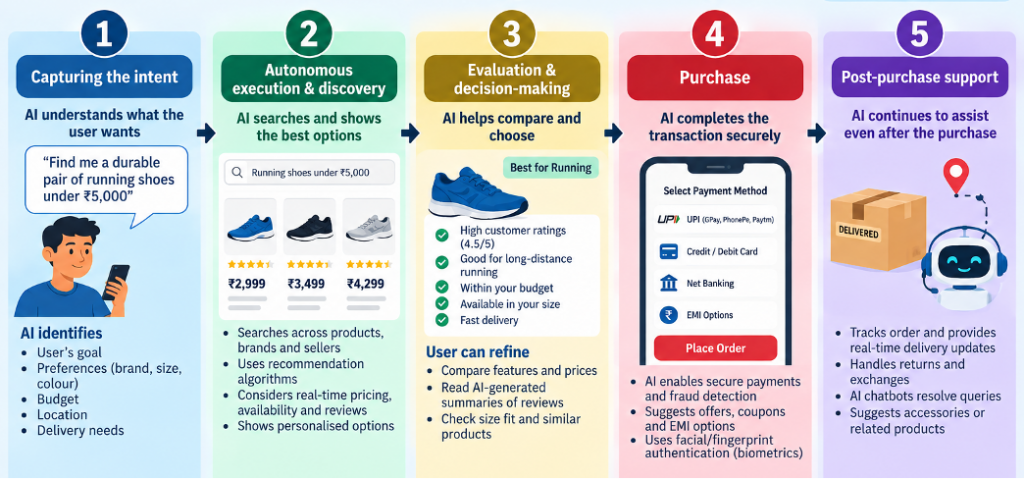
Agentic commerce
- It is a digital trade model under which AI agents streamline the buying process by discovering, negotiating, and executing on behalf of customers.
- This does not mean bypassing the need for authorisation.
- It only cuts down steps involved in a customer’s e-commerce journey, including the payments phase.
Importance
- Agentic AI can revolutionise B2B payments by forecasting cash-flow shortfalls, identifying checkout errors, reconciling bills, matching purchase orders, scheduling payments and enhancing working-capital management.
- EY predicts that agentic AI may automate up to 80% of regular treasury coordination and boost cash-flow forecasting accuracy to around 90% with good data and governance.
- At the same time, companies like BharatPe and Razorpay are creating AI-enabled merchant, checkout, and payment solutions, and SMEs without sophisticated ERP systems can also benefit from it.
Source: IE
Rising Sulphur Costs: New Fertiliser Problem
Syllabus: GS3/Economy
In News
- India has escaped a potential fertiliser crisis due to ample availability of urea and LNG, but rising sulphur costs are now affecting the availability of DAP, SSP and other phosphatic fertilisers.
Sulphur
- It is an important non-metal element and precious commodity used in fertilisers, chemicals, medicines, insecticides, rubber, water treatment and metal processing.
- It is a natural constituent of the earth’s crust and is mined and increasingly recovered as a by-product of oil and natural-gas processing and metal smelting.
- It is the preferred raw material for sulphuric acid, a vital ingredient for the production of phosphate and other fertilisers.
- It is also an important nutrient for crops, animals and humans, promoting plant development, enhancing the efficiency of nitrogen and phosphorus and helping to amend particular soils.
- It is also used in asphalt, synthetic rubber, chemicals, pharmaceuticals and industrial processes.
Consumption and Imports
- India consumes about 3.8–3.9 million tonnes of sulphur yearly, with most of the fertiliser-sector requirements being imported.
- The growing need for sulphuric acid to process nickel for EV batteries, particularly in Indonesia, is making the situation worse, while some exports have been blocked by Russia and China.
- The fertiliser sector in India is facing a two-fold supply and price problem given geopolitical conflicts, supply constraints and a rising industrial demand.
- Imported sulphur prices have almost doubled to $1,050-1,100 a tonne, partly on account of difficulties caused to the Russia-Ukraine and West Asia conflicts.
Source: IE
AASHVAST Labs for Securing Military Drones
Syllabus: GS3/ Science & Technology, Defence
Context
- The Indian Army is establishing six AASHVAST labs to examine drones and other electronic systems for firmware-level vulnerabilities, hidden codes and foreign-origin components that could compromise their functioning during military operations.
About AASHVAST Labs
- AASHVAST stands for Assessment and Analysis of Electronic Systems Hardware for Vulnerabilities and Security Threats.
- It is a Firmware Analysis and Validation Suite developed by QuickPay Pvt Ltd for the Directorate General of Electronics and Mechanical Engineers (DG EME).
- The labs will initially focus on military drones and UAV components, with CCTV cameras procured by the Army also expected to undergo similar security checks in the future.
Why is Firmware Security Important?
- Firmware is the low-level software embedded in electronic hardware that controls its basic functions.
- Vulnerabilities can be introduced during manufacturing, component integration or software upgrades.
- A compromised component could potentially cause a drone to deviate from its mission, stop functioning, terminate prematurely or behave abnormally under specific conditions.
Source: IT
SLINEX-26
Syllabus: GS3/Defence
Context
- The 13th edition of the Sri Lanka-India bilateral maritime exercise, SLINEX-26, was conducted at Visakhapatnam.
About
- Conceptualised in 2005, SLINEX has evolved into an important forum for fostering maritime cooperation, interoperability, and mutual understanding between the two Navies.
- Aligned with India’s vision of MAHASAGAR, SLINEX-26 reinforces India’s commitment to a secure, stable and inclusive maritime environment and further consolidates the enduring maritime partnership between India and Sri Lanka.
Source: PIB
Previous article
Persistent Decline in India’s Groundwater
Next article
News In Short 21-09-2026
