


Syllabus: GS2/Governance
In News
- The Government has enhanced rural development and last-mile service delivery through a broad network of frontline workers in health, nutrition, livelihoods, finance, sanitation, and community development.
Grassroots workforce
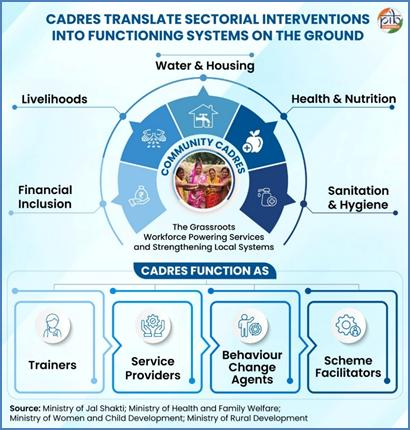
- Community Cadre Approach is a decentralised mechanism for successful last-mile delivery of services through a trained grassroots workforce.
- These community cadres carry out several interrelated functions.
- They are service providers ensuring access to key livelihood and financial services at the community level.
- They are change agents in behaviour, raising awareness and promoting the uptake of improved practices in health, sanitation and social inclusion.
Network of Frontline Workers in Rural Areas
- The network includes over 10.40 lakh Accredited Social Health Activists (ASHA), 10.58 lakh Anganwadi Workers (AWWs), and Auxiliary Nurse Midwives (ANMs) in health and nutrition.
- Over 9 lakh Community Resource Persons (CRPs) are active at the grassroots, serving areas such as agriculture, banking, insurance etc.
- In addition, there are frontline workers like Swachhagrahis, providing sanitation support.
Importance and Role
- Propagation of Skills and Training: Peer-to-peer community cadres act as trainers and change activists within their respective localities.
- From the same socio-cultural background, they use peer learning to instruct SHG members and rural households in contemporary farming techniques, enterprise management, and sustainable methods.
- Financial services: Community cadres supply needed doorstep financial services through Grassroots Financial Intermediation Business Correspondent (BC) Sakhis and Bank Sakhis.
- They allow rural residents to create accounts, avail of direct benefit transfers (DBT), process credit, and receive financial literacy without having to travel great distances to urban bank offices.
- Increasing Productivity and Livelihoods: sector-specific cadres, Krishi Sakhis, are working to promote sustainable farming and enhanced agricultural production methods.
- Pashu Sakhis enable livestock rearing households to improve animal health, reduce input expenses, and increase output.
- Matsya Sakhis and Van Sakhis empower communities dependent on fisheries and forest resources.
- CRP-EPs (Enterprise Promotion) are mentors for non-farm micro-enterprises.
- Health, nutrition, and social development: There are cadres such as ASHAs, AWWs, and social development CRPs who provide ongoing health monitoring and assistance.
- They also undertake key initiatives related to gender awareness, maternal-child health, sanitation, and social inclusion, not only economic progress.
- Closing the Citizen-State Trust Gap: Local cadres are trusted, localised channels between official institutions and rural citizens.
- They generate awareness on government welfare initiatives, collect field data, help in documentation, and facilitate entitlement delivery to the disadvantaged and marginalised sections.
Issues and Concerns
- Late payment: Many cadres get honorariums, stipends, or performance incentives that may be extravagant or paid late.
- Lack of resources and infrastructure: Frontline workers, especially in rural and hilly areas, are faced with issues such as insufficient connectivity, lack of digital resources, and safety equipment.
- Multitasking and Overburdened: The community cadres have to collect and distribute survey data for several initiatives by government departments. This fatigues them and diminishes their primary purpose.
- Capacity Building Needs: Need for continuous training and skill upgradation to match the ever-developing digital applications, financial goods, and novel agriculture approaches.
- Gender and Social Constraints: Most of these cadres are rural women.
- During field tours, they face social stereotypes, family chores, and safety risks.
Various Initiatives
- Deendayal Antyodaya Yojana-National Rural Livelihoods Mission: It established one of the country’s largest networks of women-led community institutions, mobilizing more than 10 crore rural households into around 92 lakh Self-Help Groups (SHGs) across the country.
- Village Organizations and Cluster Level Federations: These institutions are supported by a large network of Community Resource Persons (CRPs) working across different thematic areas.
- Business Correspondent (BC) Sakhis and Bank Sakhis: Trained women community cadres promoted under the DAY-NRLM who function as grassroots financial intermediaries.
- Poshan Bhi Padhai Bhi initiative: Aims to improve the quality of Early Childhood Care and Education (ECCE) through the Anganwadi system.
- Swachh Bharat Mission (Grameen): Aims to provide people with sustainable sanitation and hygiene services. At the core of this effort are Swachhagrahis (volunteers), who are the foot soldiers of the SBM.
- Jal Jeevan Mission: In line with the 73rd Constitutional Amendment, Jal Jeevan Mission promotes village-level planning and community participation through Panchayati Raj Institutions. Gram Panchayats and their sub-committees, Village Water & Sanitation Committees (VWSCs) or Pani Samitis, are empowered to plan, implement, operate, and maintain in-village water supply systems.
- VWSC members are selected through the Gram Sabha.
- Awaas Mitras are field-level facilitators under the Pradhan Mantri Awaas Yojana-Gramin (PMAY-G), supporting implementation, monitoring, and beneficiary assistance in rural housing.
Conclusion
- Community cadres on the front line have emerged as trusted partners in translating government programs into tangible benefits at the household level.
- They raise awareness, create capacity, facilitate access to services and encourage cross-sectoral convergence.
- Their work makes sure development gets to the people who need it most.
- As rural India continues to transform, consistent investment in these community-based institutions and frontline workers will be critical to scale up service delivery, improve livelihoods and promote social inclusion, thus fostering resilient, empowered and self-reliant rural communities.
- Addressing their structural difficulties will be critical in ensuring this rural transformation is sustained, and an inclusive economy is built.
Source:PIB
Previous article
India–EU FTA: Issue of Intellectual Property & Copyright
Next article
Mapping the Magnet Value Chain
