

Syllabus: GS3/ Science and Technology
Context
- In 2025, China’s export limitations on rare earth magnets and related minerals emphasised India’s dependence on vital stages of the permanent-magnet sector.
What are Rare Earth Magnets?
- Rare earth elements are a set of 17 elements, including the 15 lanthanides as well as scandium and yttrium.
- Rare earth elements such as neodymium, praseodymium, dysprosium and terbium are important for producing high-performance permanent magnets.
- The two main types are Neodymium (Nd-Fe-B) and Samarium Cobalt (SmCo) magnets.
- Despite the name, rare earth elements are not geologically rare but are difficult to extract economically due to their dispersed occurrence and the environmental cost of mining.
Availability of Rare Earth Magnets
- China controls over 85% of global rare earth magnet production, and dominates the supply chain from mining to refining to magnet manufacturing.
- India, despite having rare earth reserves (especially in monazite sands in Kerala, Tamil Nadu, Odisha), but lacks advanced refining capabilities and downstream magnet manufacturing industry.
Significance for India
- Energy Transition: High-performance magnets are used in EV motors and renewable-energy technologies, making magnet security crucial for India’s decarbonisation goals.
- Strengthens Advanced Manufacturing: Robotics, automation, precision machinery and other high-technology industries increasingly depend on compact and powerful permanent magnets.
- Enhances Strategic Security: Permanent magnets have applications in aerospace, defence, electronics and advanced weapon systems, making their supply chains strategically important.
- Reduces External Vulnerability: Developing capabilities across the value chain can reduce excessive dependence on a small number of foreign suppliers and improve India’s supply chain resilience.
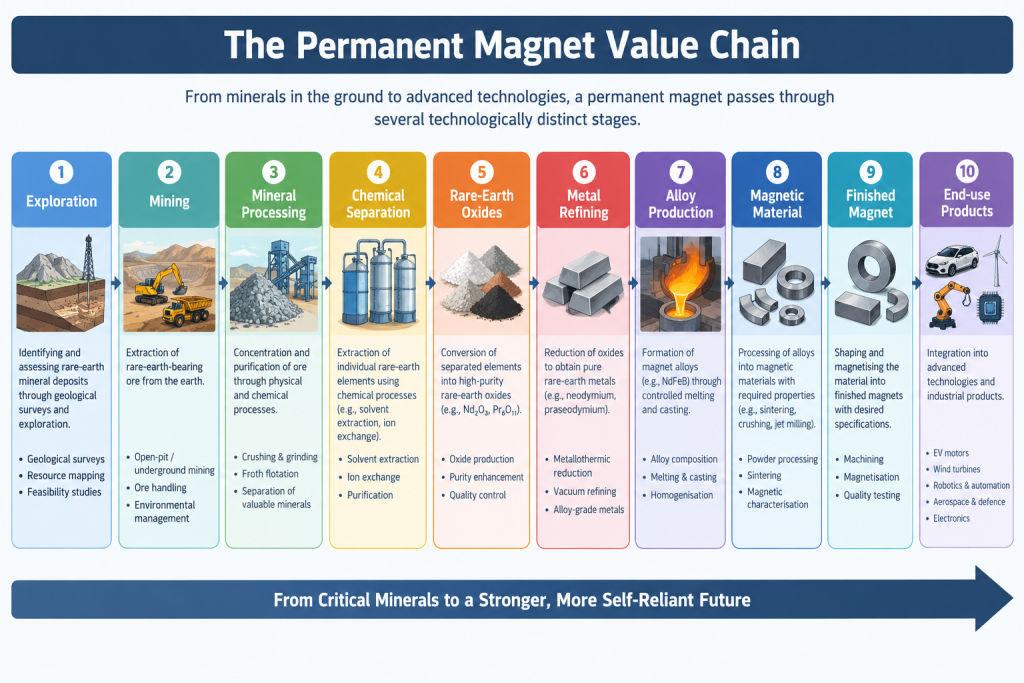
What are the challenges?
- Low-grade resources: India possesses significant rare-earth resources, but much of these are of low grade and associated with radioactive minerals such as monazite, making extraction complex and expensive.
- Limited midstream capabilities: India has capabilities in mining, separation and production of rare-earth oxides, but industrial-scale capacity for metals, alloys and permanent magnets remains limited.
- Dependence on imported magnets: Despite having domestic rare-earth resources, India remains dependent on imports for rare-earth permanent magnets and related products, particularly for advanced manufacturing applications.
Initiatives taken by India
- The National Critical Mineral Mission (NCMM) was approved in 2025 with an overall outlay of ₹34,300 crore and covers the complete critical-mineral value chain, from exploration and mining to beneficiation, processing and recycling.
- The government has expanded exploration of critical minerals through the Geological Survey of India (GSI) and amended the Mines and Minerals (Development and Regulation) Act, 1957, to facilitate greater exploration and mining.
- Critical-mineral blocks, including rare-earth blocks, have also been auctioned.
- Scheme to Promote Manufacturing of Sintered Rare Earth Permanent Magnets: It was approved in 2025 with a financial outlay of Rs.7280 crore.
- It aims to establish 6,000 Metric Tons per Annum (MTPA) of integrated Rare Earth Permanent Magnet (REPM) manufacturing in India.
- Khanij Bidesh India Limited (KABIL) has been established to acquire critical-mineral assets overseas and secure long-term supplies of minerals such as lithium, cobalt and rare earth elements.
- Strategic Magnet Manufacturing: A Rare Earth Permanent Magnet Plant at Vizag has been established for indigenous production of Samarium-Cobalt (SmCo) magnets, particularly relevant for strategic sectors such as defence and atomic energy.
- Rare Earth Corridors: The Union Budget 2026–27 announced dedicated Rare Earth Corridors in Odisha, Kerala, Andhra Pradesh and Tamil Nadu to strengthen the rare-earth ecosystem.
Way Ahead
- Critical-mineral security is not merely about possessing minerals; it is about possessing the technological capability to convert them into strategic industrial products.
- A national database should integrate information on resources, processing capacity, technology ownership, trade flows and downstream applications.
- Greater emphasis should be placed on separation, refining, alloy production and high-performance magnet manufacturing, rather than focusing only on mining.
Source: TH
Next article
Persistent Decline in India’s Groundwater
