

Syllabus: GS2/IR
Context
- The US House of Representatives passed the Lindsey O. Graham Sanctioning Russia and Iran Act of 2026, allowing the U.S. to impose tariffs of up to 100% on the top five purchasers of Russian oil.
About the Bill
- The bill calls for the US Trade Representative to reassess the top five purchasers every 180 days to adjust tariff rates based on changes in purchasing behaviour.
- Apart from China and India, the other top purchasers of Russian oil are Turkiye, Slovakia, and Hungary.
- It provides exceptions for countries that import less than 15% of their natural gas from Russia and are taking steps to reduce those imports.
- Supporters of the bill claim it’s necessary to choke off Russia’s energy income, weakening the Russian President’s ability to finance the war in Ukraine.
India’s Import of Russian Oil
- Invasion of Ukraine: Most of the Western countries avoided Russian crude following the country’s 2022 invasion of Ukraine.
- Russia began offering discounts on its oil to willing buyers, including Indian refiners.
- This is how a peripheral supplier of oil to India became India’s biggest source of crude, displacing the traditional West Asian suppliers.
- Security Amid West Asia Crisis: This proved to be a strong energy security hedge for India amid the West Asia crisis, as oil flows from the Gulf dried up.
- Unsubstitutable Supply Source: Despite the threat of sanctions, Russian crude remains the most practical and competitive source of supply for Indian refiners and is extremely difficult to replace in the current market.
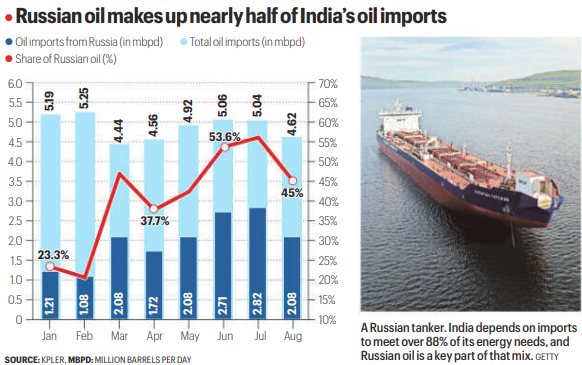
- India imported 2.08 million barrels per day (bpd) of Russian oil in August, accounting for 45% of the country’s total oil imports. The share was even higher, at over 50%, in the preceding two months.
Concerns for India
- Tight Global Supply Chains: For India, reducing Russian oil imports is just not an option in the prevailing circumstances of global energy supply tightness amid the West Asia crisis.
- Even for the U.S., taking away millions of barrels of Russian oil from the global market when energy flows from West Asia remain highly constrained wouldn’t be prudent.
- Higher import costs and inflation: If Russian supplies become inaccessible and India has to procure costlier alternatives, the impact could pass through to transport, manufacturing, agriculture, and consumer prices.
- India–US trade relations: The proposed tariff mechanism could add pressure to ongoing India–US trade negotiations. India has itself warned that such measures could affect bilateral relations.
- Strategic Autonomy: External pressure to alter India’s energy purchases can constrain India’s ability to pursue an independent foreign policy based on national energy-security interests.
Way Ahead
- Maintain diversified sourcing: While procuring crude from Russia, India could simultaneously expand supplies from the Middle East, Africa, the Americas, and other reliable sources to avoid excessive dependence on any single country.
- Pursue diplomatic engagement: India should engage both the U.S. and Russia to protect its energy-security interests while advocating that sanctions and tariff measures should not destabilise global energy markets.
- Strengthen strategic petroleum reserves: Expanding and efficiently managing strategic petroleum reserves can provide a buffer against sudden geopolitical or supply disruptions.
- Deepen energy partnerships: India should strengthen cooperation with major energy-consuming countries on emergency stockpiles, alternative supply routes and energy-resilience mechanisms.
- Balance affordability with strategic autonomy: The immediate priority should be ensuring affordable and uninterrupted energy supplies while gradually reducing vulnerability to geopolitical pressure.
Source: TH
Previous article
Balancing Private Participation with ISRO’s Core Capabilities
Next article
India’s Emerging Semiconductor Ecosystem
