


Syllabus: GS3/Science and Technology/Economy
Context
- Prime Minister inaugurated the SEMICON India 2026 exhibition features six Country Pavilions representing Japan, South Korea, Malaysia, the Netherlands, Singapore, and Sweden.
- Theme: “Silicon to Systems: Building the Ecosystem.
Semiconductors and Chip Making
- A semiconductor is a material whose electrical conductivity can be controlled.
- Conductors such as copper allow current to flow easily, while insulators strongly resist it.
- Semiconductor materials can be engineered to switch, amplify, sense or control electrical signals.
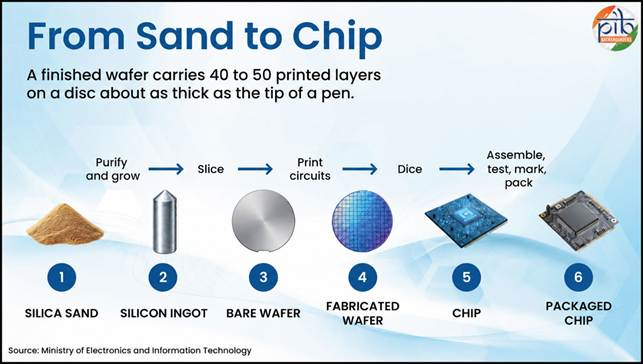
- Silicon is the most widely used semiconductor material. It is obtained from silica, which occurs abundantly in sand.
Semiconductor Ecosystem
- Global Status: Semiconductors have emerged as a strategic resource for economic growth, technological leadership, and national security.
- The global semiconductor market grew at a compound annual growth rate (CAGR) of 6.5 per cent between 2014 and 2024. It is projected to grow at 8.5 per cent over the next 5–10 years.
- However, recent disruptions have exposed vulnerabilities in the interconnected global semiconductor value chain.
- Geopolitical tensions have further highlighted the risks of supply dependence.
- Today, Taiwan, South Korea, Japan, China, and the United States dominate global semiconductor manufacturing.
- Taiwan alone accounts for over 60% of global chip production and nearly 90% of advanced chips.
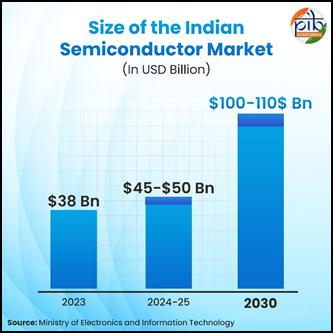
- India’s Position: India is witnessing rapidly rising semiconductor demand.
- It is projected to reach USD 110 billion by FY2030 and exceed USD 200 billion by FY2035, while domestic manufacturing remains at a nascent stage. India spent almost USD 150 billion on semiconductor product imports during FY17–FY25.
- Imports grew at a CAGR of 23 per cent during this period.
- If this trend continues, annual imports could reach USD 240 billion by 2035. Building a comprehensive semiconductor ecosystem is therefore an urgent national priority.
Various Steps
- India Semiconductor Mission 1.0
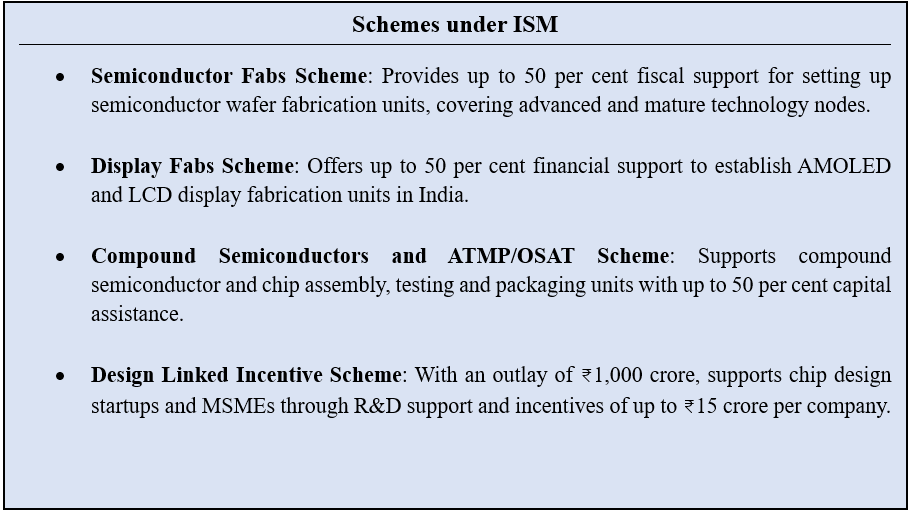
- India Semiconductor Mission 1.0 is a flagship programme launched in 2021 under the Ministry of Electronics and Information Technology (MeitY) to develop a comprehensive semiconductor and display manufacturing ecosystem in India.
- The Mission is supported by an incentive framework of ₹76,000 crore, offering fiscal support of up to 50% for silicon fabs, compound semiconductor facilities, assembly and testing units, and chip design.
- As many as 12 semiconductor manufacturing projects have been approved with an investment pipeline of about ₹1.64 lakh crore under the mission.
- These include silicon fabrication units, silicon carbide fabs, advanced and memory packaging facilities, and specialised assembly and testing infrastructure.
- India Semiconductor Mission 2.0
- It was announced in the Union Budget 2026–27.
- ISM 2.0 will focus on producing semiconductor equipment and materials in India, designing full stack Indian semiconductor intellectual property, and fortifying both domestic and global supply chains.
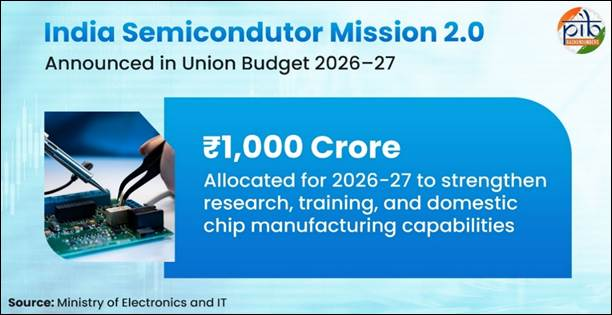
- Semicon 2.0 seeks to build the semiconductor ecosystem through six pillars- Design, Machines and materials, Setting up more fabs, Further strengthening the ATMP-OSAT industry, Research and Development and Talent development.
Why are Semiconductors Strategically Important?
- Foundation of the Digital Economy: Semiconductors form the core component of almost every modern electronic device and digital technology.
- National Security: Semiconductor chips are indispensable for defence equipment, surveillance systems, satellites, cybersecurity infrastructure and strategic communication networks.
- Industrial Competitiveness: Countries with strong semiconductor manufacturing capabilities are leveraging technological leadership and industrial competitiveness.
- Technological Sovereignty: Domestic semiconductor production is necessary to reduce the dependence on foreign suppliers and strengthen self-reliance.
Indigenous Microprocessors and Core Semiconductor Technologies
- Microprocessors form the foundational layer of modern digital infrastructure, powering devices and systems across telecommunications, mobility, healthcare, industry, defence, and space.
- India has made focused investments to build sovereign capabilities in advanced processor design as a core pillar of semiconductor self-reliance.
- A key milestone in this journey is the launch of DHRUV64, a fully indigenous 64-bit microprocessor developed by C-DAC under the Microprocessor Development Programme (MDP).
What are the Challenges?
- High Capital Investment: The establishment of semiconductor fabrication plants requires investments of several billion dollars and long gestation periods.
- Technology-Intensive Industry: Semiconductor manufacturing requires highly sophisticated technologies that are continuously evolving.
- Dependence on Imported Equipment: India remains dependent on foreign suppliers for advanced semiconductor manufacturing equipment and specialised machinery.
- Infrastructure Requirements: Semiconductor fabrication requires uninterrupted electricity, ultra-pure water and highly reliable logistics infrastructure.
- Skill Gaps: The industry requires a highly specialised workforce trained in semiconductor engineering, fabrication processes and chip design.
Conclusion
- India Semiconductor Mission 2.0 marks a decisive shift from ecosystem creation to ecosystem consolidation and global integration.
- By deepening support for manufacturing, design, and advanced skills, ISM 2.0 positions semiconductors as a strategic national capability—central to economic resilience, digital infrastructure, and technological sovereignty.
Source: TH
Previous article
U.S. Clears Russia Sanctions Bill
Next article
Melting of Glaciers: Causes & Impacts
