

Syllabus: GS3/Science & Technology
Context
- Recently, ISRO employee associations raised concerns over the proposed transfer of launch-vehicle manufacturing and spaceport operations.
India’s Emerging Private Space Ecosystem
- India’s space economy currently stands at $8.4 billion, accounting for 2–3% of the global space economy. It is expected to be $40–45 billion by 2030.
- The Indian Space Policy 2023 led to the entry of private players to space-related activities in India.
- Companies such as Pixxel, Dhruva Space, Skyroot Aerospace, Agnikul Cosmos, and Bellatrix Aerospace have emerged as pioneers of a new space era.
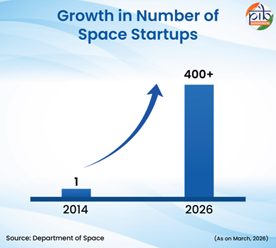
- Skyroot Aerospace became India’s first space-tech unicorn. Its Vikram-1 became the first privately developed Indian orbital-class rocket to successfully place a payload into Low Earth Orbit (LEO).
- Pixxel Space is building hyperspectral imaging satellites that provide Earth observation data to commercial customers and government agencies in India, Europe and the United States.
Major Reforms in the Space Sector of India
- Establishment of IN-SPACe (Indian National Space Promotion and Authorisation Centre, 2020): Acts as a single-window regulator and facilitator for private companies, authorising and promoting their participation in space activities.
- Corporatisation via NewSpace India Limited (2019): It was set up as ISRO’s commercial arm to transfer technology, manufacture satellites/launch vehicles through industry, and provide commercial satellite services.
- Schemes to encourage the private sector have been implemented by IN-SPACe: Seed Fund Scheme, Pricing Support Policy, Mentorship Support, Design Lab for NGEs, Skill Development in Space Sector, ISRO facility utilisation support and technology transfer to non-governmental entities (NGEs).
- The ₹1,000 crore Venture Capital (VC) Fund under IN-SPACe aims to accelerate private participation in the space sector.
- IN-SPACe also introduced the ₹500 crore Technology Adoption Fund (TAF).
- Liberalised FDI Policy for Space: The revised policy permits up to 74% automatic FDI in satellite manufacturing and operations, 49% automatic FDI in launch vehicles and spaceports, and 100% automatic FDI in the manufacturing of satellite components and subsystems.
- SpaceTech Innovation Network (SpIN): SpIN is a one-of-its-kind public-private collaboration for start-ups and SMEs in the space industry.
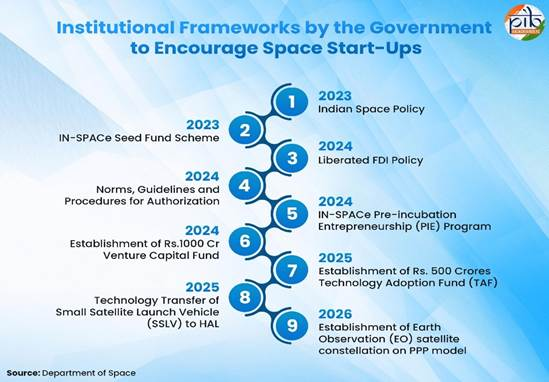
- Technology Transfers : India is gradually commercialising and transferring its major space launch systems to the private sector to increase its participation in the global space economy.
- The Small Satellite Launch Vehicle (SSLV) was operationalised in 2024 after three developmental flights. It takes around 3 days for 6 people to assemble it at a cost of roughly ₹30 crore as against the Polar Satellite Launch Vehicle (PSLV), which takes about 70 days, 60 workers and ₹100 crore.
- Hindustan Aeronautics Limited (HAL) has secured the ₹511-crore SSLV technology-transfer contract in 2025 and would produce a minimum of two vehicles using Indian Space Research Organization (ISRO) protocols prior to independently commercialising them after August 2027.
- The Polar Satellite Launch Vehicle (PSLV) has been commercialised in 2022 with a consortium of HAL and Larsen & Toubro (L&T) and ISRO has floated another Expression of Interest (EoI) for transfer of technology.
- The biggest launch vehicle of ISRO, Launch Vehicle Mark-3 (LVM3) is also being thrown available for private manufacturing with a fresh EoI being released in 2026 after the first attempt in 2024 to attract a successful bid failed.
- The Indian National Space Promotion and Authorisation Center (IN-SPACe) has also encouraged commercial engagement in operating the future Small Satellite Launch Complex (SLC) at Kulasekarapattinam, Tamil Nadu, with ISRO providing technical assistance, training and operational support.
Significance of the Privatisation of the Space Sector
- Private participation aims to increase launch frequency, reduce costs, attract investment, and expand India’s presence in the global space economy.
- Privatisation introduces competition into the space industry, which can drive both efficiency and innovation.
- Private players facilitate the commercialisation of space applications and services in agriculture, disaster management, urban planning, navigation, and communication, as well as in other sectors.
- Private companies have a greater degree of autonomy in making decisions, which enables them to take up new projects.
- It helps to generate employment, enable modern technology absorption and make the sector self-reliant.
What are the concerns?
- Preserving Core Expertise: The commercialisation can result in the erosion of ISRO’s in-house expertise and end-to-end technological capabilities.
- Public Investment: Technologies and infrastructure developed using public funds raise concerns regarding transparent valuation, accountability and adequate returns to the nation during technology transfer.
- Strategic Missions: Retaining strong in-house capabilities remains important for complex programmes such as Gaganyaan, Chandrayaan-4 and 5, the Bharatiya Antariksh Station, and future Mars and Venus missions.
Way Ahead
- India needs a complementary public–private model in which private industry expands manufacturing and commercial services while ISRO retains expertise in advanced R&D, strategic technologies, system integration and critical national missions.
- Technology transfer should be accompanied by transparent valuation, performance standards, institutional safeguards and mechanisms to preserve critical knowledge within the public sector.
Source: IE
Previous article
Stem Cell Therapy for Autism Restricted to Approved Clinical Trials
Next article
U.S. Clears Russia Sanctions Bill
