


Tamirabharani River
Syllabus: GS1/Geography; GS3/Environment
Context
- The Madurai Bench of the Madras High Court has declared Tamil Nadu’s Tamirabharani river a deity, thereby granting it legal personhood to curb pollution from funeral rites and waste dumping.
About
- In 2017, the Uttarakhand High Court recognised the Ganga and Yamuna as legal persons. However, the Supreme Court later stayed the order, citing practical and administrative difficulties, particularly since the rivers flow across multiple states.
- Globally, New Zealand’s Whanganui River became the first river in the world to be recognised as a legal person in 2017.
Tamirabharani River
- The Thamirabarani or Tamraparni or Porunai is a perennial river that originates from the Agastyarkoodam peak of Pothigai hills of the Western Ghats.
- It flows through the Tirunelveli and Thoothukudi districts of Tamil Nadu in southern India before draining into the Gulf of Mannar.
- It was called the Tamraparni River in the pre-classical period, a name it lent to the island of Sri Lanka.
Source: DTE
PM CARES Fund
Syllabus: GS2/Polity
Context
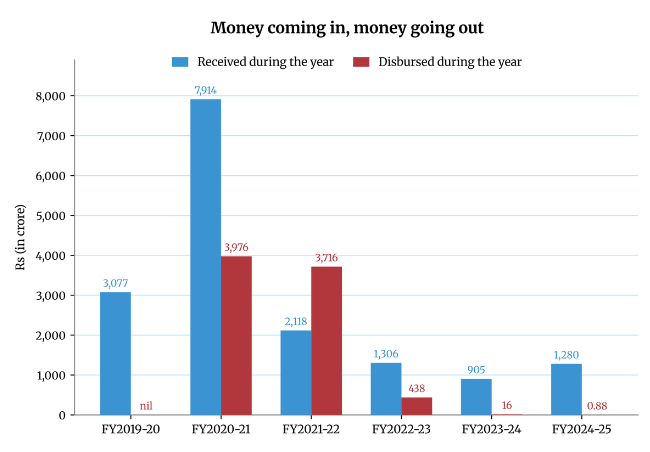
- The audited financial statements of Prime Minister’s Citizen Assistance and Relief in Emergency Situations (PM-CARES) Fund showed that while donations have dropped the utilisation of available funds was low.
About
- The corpus grew by 25.8% between 2022-23 and 2024-25 from ₹ 6,722 crore to ₹ 8,453 crore.
- However, in the same period, the utilisation dropped from ₹437.9 crore to just ₹87.5 lakh, which was just 0.01% or 10,000 times smaller than the available corpus.
About the PM CARES Funds
- PM CARES is a public charitable trust set up to raise funds for national emergencies such as Covid.
- It was set up in 2020, following the Covid outbreak.
- The fund was registered as a Public Charitable Trust and its trust deed has been registered under the Registration Act, 1908.
- PMNRF provides immediate relief to people affected by natural calamities, major accidents, riots, etc.
- The NDF is meant specifically for the welfare of members of the armed and paramilitary forces and support to their families.
Source: TH
BRICS calls EU’s Carbon Tax Punitive
Syllabus: GS2/IR
Context
- BRICS environment and climate ministers opposed the European Union’s (EU) Carbon Border Adjustment Mechanism (CBAM) calling it a discriminatory and protection measure that is not in line with international law.
CBAM
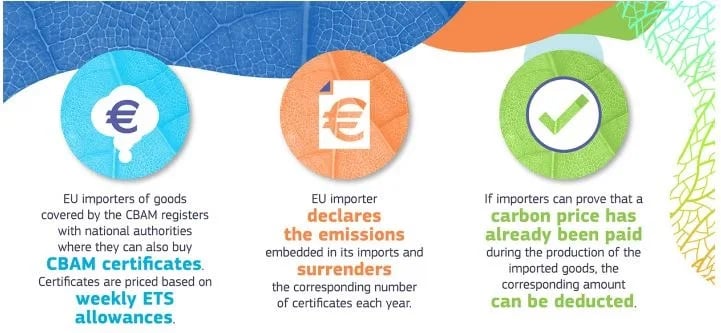
- CBAM is an import duty imposed by the European Union (EU) on goods produced by processes that lead to more carbon emissions than domestic European manufacturers are allowed to emit.
- It is introduced to put a “fair price” on carbon-intensive goods imported from non-EU countries.
- It is to create a level playing field with EU companies that account for their carbon emission through the bloc’s Emission Trading System (ETS).
- Application: It came into force on January 1, 2026, on six items: steel, aluminium, cement, fertilizer, hydrogen, and electricity.
Concerns of Developing Nations
- Environmental Compliance: Discussions on CBAM are under the Trade and Technology Council (TTC), with India and developing nations arguing that environmental issues shouldn’t be tied to trade.
- Impact on Exports: CBAM could affect 43% of India’s exports to the EU, including metals, textiles, chemicals, electronics, and vehicles.
- Iron and steel account for about 90% of India’s exports to the EU that fall within the CBAM framework.
- Violation of International Agreements: The Paris Agreement adopted in 2015 protects developing countries from the social and economic impacts of “response measures” against climate change.
- Dubai climate meeting (COP28) in 2023 acknowledged that “measures taken to combat climate change should not constitute a means of arbitrary or unjustifiable discrimination or a disguised restriction on international trade”.
- Benefits Developed World: Industries in developed economies with emissions standards comparable to the EU’s stand will benefit from a CBAM-like measure.
- CBAM, therefore, can have the net effect of helping industries in the developed world, while putting those in developing countries at a disadvantage.
About BRICS
- BRICS is an acronym that refers to a group of five major emergingnational economies:Brazil, Russia, India, China, and South Africa.
- Egypt, Ethiopia, Iran, Indonesia, Saudi Arabia, and the United Arab Emirates have joined BRICS as new full members .
- BRICS represents around 41% of the global population, around 24% of the global GDP and around 16% of global trade.
- Origin: BRIC started after the meeting of the Leaders of Russia, India and China in St. Petersburg on the margins of the G8 Outreach Summit in 2006.
- The term was originally coined by economist Jim O’Neill in 2001.
- Initially, the grouping was termed BRIC as South Africa was inducted in 2010 and from there on it has been referred to as BRICS.
- Summits: The governments of the BRICS states have met annually at formal summits since 2009.
- Decision Making: All decisions are taken by BRICS member states in full consultation and consensus.
- New Development Bank: Formerly referred to as the BRICS Development Bank, is a multilateral development bank established by the BRICS states.
- The Bank shall support public or private projects through loans, guarantees, equity participation and other financial instruments.
Source: TH
Introduction of Blackbucks Into Banni Grassland
Syllabus: GS3/Environment
In News
- The Gujarat Forest Department, with technical support from Greens Zoological Rescue and Rehabilitation Centre, Vantara, released 20 blackbucks (Antilope cervicapra) into the Banni Grassland of Kutch.
Blackbucks
- Blackbucks are found only in the Indian subcontinent.
- The animals are mainly seen in three broad clusters across India: northern, southern, and eastern regions.
- Males have corkscrew-shaped horns and black-to-dark brown coats, while the females are fawn-coloured.
- The species inhabits open grassland, dry thorn scrub, scrubland, and lightly wooded country as well as agricultural margins
- It is listed under Schedule 1 of the Wildlife Protection Act, 1972. Hunting and poaching blackbucks is a non-bailable offence and can invite a jail term of up to six years.
- It is worshipped by the Bishnoi community.
- It is listed as Least Concern by the IUCN Red List Threatened Species.
Banni grassland
- It is located in the Kutch district of Gujarat, and it is the largest grassland in Asia.
- It is a salt-tolerant grassland, meaning that it can survive and thrive in saline and arid conditions.
- It is home to more than 250 species of grasses, herbs, shrubs, and trees, some of which are endemic and endangered.
- It supports more than 350 species of birds, 50 species of mammals, 30 species of reptiles, and 10 species of amphibians.
- Some of the notable wildlife found in Banni are the endangered Indian wild ass, the Asiatic lion, the blackbuck, the chinkara, the caracal, the desert fox, the flamingo, the great Indian bustard, the pelican, and the sarus crane.
- It is inhabited by about 40,000 people, belonging to various pastoral communities, such as the Maldharis, the Rabaris, the Jats, the Mutwas, and the Meghwals.
Source:TH
India’s Makhana Sector
Syllabus: GS3/Economy
In News
- Makhana has emerged as one of India’s fastest-growing agri-food sectors, driven by rising health awareness, expanding domestic demand, and strong export potential.
Makhana
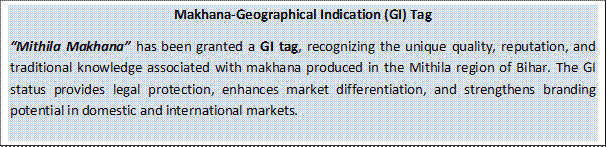
- It is scientifically called Euryale ferox. It is an aquatic crop that is primarily cultivated in shallow ponds, lakes, and wetlands.
- The seed is the part of the plant that gets eaten.
- Benefits: Makhana is a nutrient-dense food that is rich in carbs, good-quality protein, dietary fibre and key minerals including magnesium, potassium, phosphorus and iron.
- It is low in salt and cholesterol-free, which makes it a great option for a variety of dietary demands.
- It has a reduced glycaemic load and can be used by those who are managing diabetes.
- It is also good for the heart, helps with digestion, and has anti-aging qualities.
Present Status
- Production: India is the world’s largest producer of makhana, and it is supported by suitable agro-climatic conditions and long-standing cultivation practices, mainly in Bihar, West Bengal, and Assam.
- Bihar accounts for nearly three-fourths of India’s Makhana production and contributes around 80-85% of the global supply.
- Makhana cultivation is mainly concentrated in North Bihar.
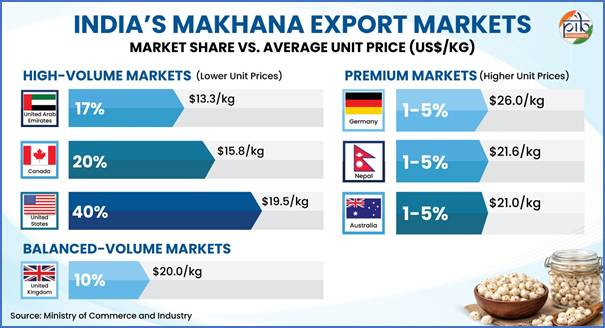
- Exports: India’s export markets are extremely concentrated. The United States (40%), Canada (20%), and the United Arab Emirates (17%) collectively account for 77% of the total makhana exports.
- But the big volume markets have significantly lower unit prices: US ($19.5/kg), Canada ($15.8/kg) and UAE ($13.3/kg). Smaller markets such as Germany (26.0/kg), Nepal (21.6/kg) and Australia (21.0/kg) attract premium prices, albeit in restricted numbers (1-5%).
- The United Kingdom is more mixed, with a 10 percent share of the market and average price realisations of $20/kg.
- This provides an opportunity to look outside the US and Gulf sectors to pursue premium-paying regions to improve total realisations.
Governments Steps
- The Government announced the setting up of the National Makhana Board in the Union Budget 2025-26.
- The Board was formally launched on 15th September 2025 in Bihar.
- This project is a big step in strengthening and modernising the makhana value chain.”
- Government has approved a Central Sector Scheme for Development of Makhana with an outlay of Rs. 476.03 crore for the period 2025-26 to 2030-31. The scheme focuses on promotion of research and innovation, supply of excellent seeds and enhancing farmers’ skills.
- It also intends to update harvesting and post-harvest procedures, promote value addition, branding and marketing, improve exports and strengthen quality control systems.
Source:PIB
Previous article
Corporate Investment in India
