


Syllabus: GS2/IR/GS3/Economy
Context
- India’s FTA journey is moving from expanding its network of agreements to making fuller use of the market access.
What is a Free Trade Agreement (FTA)?
- A Free Trade Agreement (FTA) is a pact between two or more countries where they agree to:
- Reduce or eliminate customs duties on goods;
- Liberalise trade in services;
- Provide investment protection;
- Ensure safeguards for intellectual property rights (IPR).
Major Highlights of India’s Recent FTAs
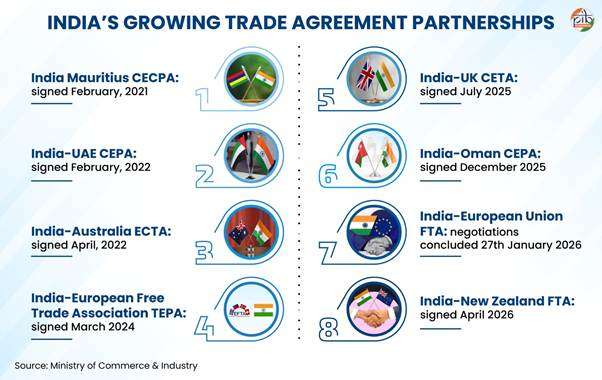
- In FY 2025-26, combined merchandise and services exports reached a record US$ 863.1 billion, including merchandise exports of US$ 441.8 billion.
- UAE and Australia illustrate the early progress under India’s recent trade agreements.
- India-UAE CEPA (2022): India exported merchandise worth US$ 37,359.11 million to the UAE in FY 2025-26.
- Among India’s trade agreements, the UAE was India’s largest export destination.
- Bilateral trade crossed US$ 100.06 billion in FY 2024-25, recording a 19.6% growth.
- India and the UAE set a new target of doubling trade to US$ 200 billion by 2032.
- India-Australia ECTA (2022): Total bilateral trade reached US$ 24.1 billion in FY 2024-25. India’s exports to Australia have increased from US$ 4 billion in FY 2020-21 to US$ 7.28 billion in FY 2025-26, recording 80%+ growth.
- From 2026 onwards, all Indian exports are now eligible for zero-duty access to the Australian market.
Significance of FTAs
- Facilitating Exporters’ Access to FTA Benefits: A trade agreement opens preferential market access, exporters generally need to provide proof of origin for their goods.
- A preferential Certificate of Origin (CoO) confirms that the goods meet the prescribed rules of origin. This allows qualifying goods to receive reduced or zero customs duties.
- A Wider Range of Products Reaching FTA Markets: The reach of an FTA is also reflected in the range of products entering partner markets. This product-level expansion is visible across several of India’s recent agreements.
- Market Access: These agreements expand market access across several labour-intensive sectors.
- Wider opportunities in these sectors enable smaller producers and local enterprises to participate more actively in international trade.
- Gains in Service Sector: India’s recent FTAs have expanded opportunities for service providers and professionals.
- Services account for nearly 30% of India’s employment and services exports stood at US$ 421.3 billion in FY 2025-26. Given its scale, the sector forms an important part of India’s FTAs.
Way Ahead
- As recent agreements enter a deeper phase of implementation, India is also widening its future trade agenda.
- Around ten trade agreements are under discussion including new negotiations with the Eurasian Economic Union, Peru, Chile, Israel, Canada and Maldives.
- Further, existing agreements such as the India-Korea CEPA and India-Sri Lanka ETCA are being upgraded.
- As businesses make greater use of the access secured under these agreements, their impact will extend.
- This will widen export participation, diversify trade and strengthen commercial relationships with partner markets.
Source: PIB
Previous article
Balancing Religious Sentiments and Constitutional Freedoms
Next article
Corporate Investment in India
