


Syllabus: GS2/Government Policies & Interventions; GS3/Energy
Context
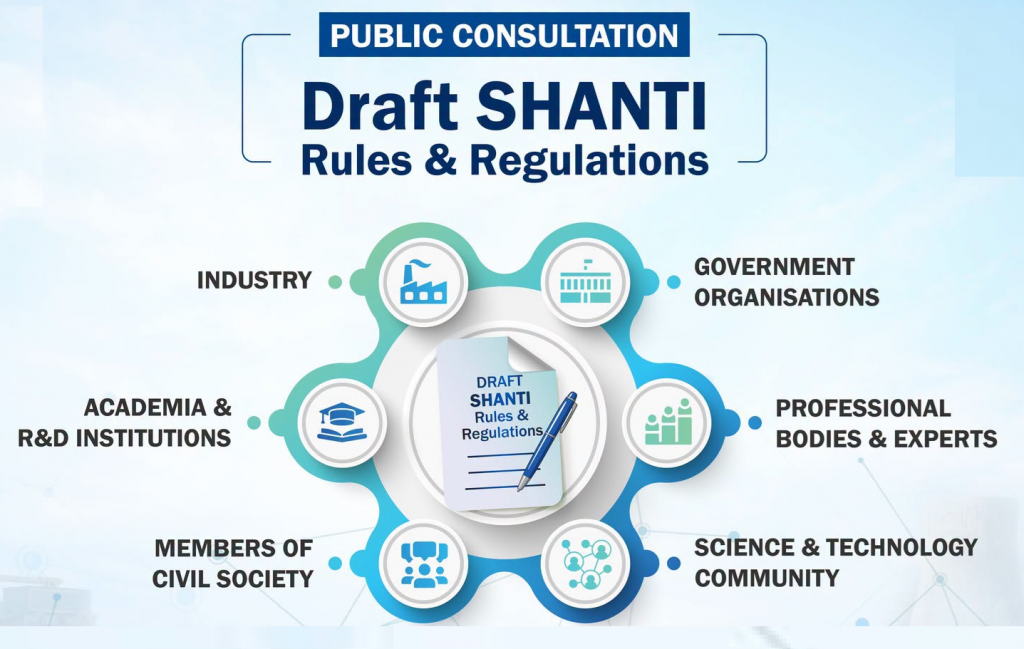
- Recently, the government has released the draft SHANTI Rules, 2026, proposing detailed norms on nuclear operator liability, insurance and financial security amid plans to expand nuclear power and private participation.
About Draft SHANTI Rules, 2026
- The draft SHANTI Rules, 2026 seek to operationalise the nuclear liability framework under the SHANTI Act, 2025 and provide greater regulatory clarity for the expansion and diversification of India’s nuclear sector.
- The rules combine strict operator liability, mandatory financial protection and lifecycle financial planning with provisions for wider applications of nuclear technology.
Key Provisions in Draft Rules
- Strict and No-Fault Liability: Nuclear installation operators would be strictly liable for nuclear damage, without requiring proof of fault.
- Liability would also cover damage occurring during the carriage of nuclear material.
- Mandatory Financial Protection: Operators need to maintain an insurance policy, financial security, or a combination of both.
- Financial security needs to be irrevocable and remain valid until all spent fuel is removed from the spent-fuel storage pool after removal from the reactor.
- These would be pledged to the Central Government, with a 1:1.33 security margin where shares, bonds or other financial instruments are used.
- Any shortfall must be immediately covered through additional insurance or financial security.
- Wider Nuclear Applications: The framework envisages nuclear technology beyond electricity generation, including captive power and process heat, hydrogen production, medical isotopes, education, training and research.
- Nuclear captive power for hard-to-abate industries.
- Emerging applications such as data centres, semiconductor manufacturing, quantum technologies, high-performance computing and AI-enabled technologies.
- Lifecycle Financial Planning: Licensed facilities would need financial arrangements for civil liability, operating costs, spent fuel and radioactive waste management, decommissioning and site remediation.
- Government-Owned Installations: Specified Central Government-owned installations may be exempted from obtaining insurance or other financial security, with the Central Government assuming liability for attributable damages.
- Periodic Review: An expert group would review maximum civil-liability limits every five years, drawing expertise from nuclear science, engineering, actuarial science, insurance, law and public interest.
Related Concerns & Issues
- Adequacy of compensation: Liability caps and financial-security requirements must provide meaningful compensation without making nuclear projects financially unviable.
- Private-sector risk: High insurance costs and potentially long-tail nuclear risks could affect private investment.
- Moral hazard: Government-backed liability for certain installations must not weaken safety incentives.
- Waste and decommissioning: Long-term radioactive waste management requires stable institutions, funding and technical capacity.
- Regulatory independence: Greater private participation increases the importance of a strong, transparent and technically capable nuclear regulator.
- Public trust and safety: Expansion must remain anchored in stringent safety standards, emergency preparedness and environmental safeguards.
India’s Nuclear Landscape
- Nuclear power is a key component of India’s clean-energy strategy, providing reliable, low-carbon baseload electricity alongside renewables.
- India has set an ambitious target of 100 GW of nuclear power capacity by 2047, as part of its long-term energy-transition strategy.
- The Department of Atomic Energy (DAE) and its public-sector undertakings have historically played a central role in India’s nuclear power programme.
- India is pursuing indigenous nuclear technologies, including Pressurised Heavy Water Reactors (PHWRs) and the development of Small Modular Reactors (SMRs).
- Nuclear technology has applications beyond electricity, including healthcare, agriculture, food preservation, industry, research and isotope production.
- The government is seeking greater private-sector participation to mobilise capital, technology and manufacturing capabilities and accelerate nuclear deployment.
- The expansion of nuclear power requires attention to nuclear safety, radioactive-waste management, spent-fuel management, decommissioning and emergency preparedness.
SHANTI Act, 2025
- It provides the statutory framework for the next phase of India’s nuclear-energy programme.
- It seeks to enable wider participation in nuclear power generation, while retaining strong government oversight over nuclear safety and security.
- The Act provides a framework for licensing nuclear installations and activities and establishes responsibilities for operators.
- It seeks to create greater legal and regulatory certainty for investment in the nuclear sector.
- The framework covers civil nuclear liability, including provisions relating to compensation for nuclear damage.
- It envisages mechanisms for financial security/insurance to meet nuclear-liability obligations.
- The legislation also supports the wider use of nuclear technology for non-power applications, subject to the applicable regulatory framework.
- Safety, security, environmental protection and safeguards remain central to the regulatory architecture.
- The Act is intended to facilitate India’s nuclear expansion while balancing energy security, climate objectives, public safety and strategic considerations.
Way Forward: Strengthening Liability and Enabling Private Participation
- India should pursue a risk-sensitive nuclear liability regime that balances investor certainty with public protection. It requires:
- Clear and predictable liability limits and insurance mechanisms.
- Independent and well-resourced nuclear safety regulation.
- Ring-fenced funds for waste management and decommissioning.
- Transparent emergency-response and public-disclosure mechanisms.
- Strong supplier and operator safety accountability.
- Periodic review of liability norms based on technological and actuarial evidence.
- Greater domestic capacity in nuclear manufacturing, insurance, safety technology and waste management.
Previous article
News In Short 18-08-2026
