


Syllabus: GS3/Economy
In News
- Corporate investment, as a share of GDP, has been declining in India.
Corporate Investment
- It refers to the acquisition of financial assets, business operations, or strategic projects by a company to generate financial returns or add long-term value.
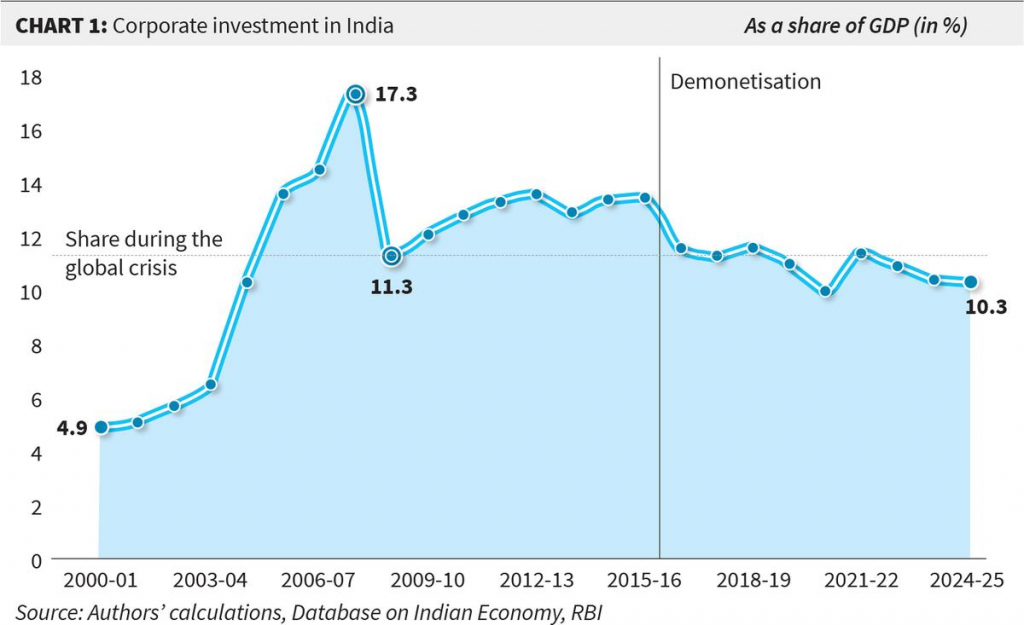
- Corporate investment as a percentage of India’s GDP has fallen, especially following the 2016 demonetisation.
- Investment grew from 6.5% of GDP in 2004 to 10.3% but began a long slide back after a delayed recovery from the global financial crisis.
- Demonetisation was a domestic policy shock, the GFC was an external shock.
- The investment collapse had already begun pre-COVID-19.
Factors Influencing Investment
- Expected profitability: Firms invest when they expect sufficiently profitable sales to occur in the future.
- Business confidence (animal spirits): More confidence about future demand and policy encourages investment.
- Cost and availability of credit: High interest rates and limited access to finance can discourage investment, particularly for smaller firms.
Strategic Importance
- Job creation: Capital spending on labour-intensive manufacturing and infrastructure brings millions of people into the workforce each year.
- Technology & Knowledge Transfer: Domestic ecosystems absorb advanced manufacturing norms, automation, and industrial R&D through foreign corporate equity.
- Welfare Effect: Private investment reduces the expenditure load of public debt, allowing the government to spend money on social welfare and health.
- Export Capacity Building: Infrastructure and capital generation scale up value-added manufacturing, thus promoting trade balances and foreign exchange reserves
Major Challenges
- Concentration risk: A considerable portion of capex is concentrated among a handful of large conglomerates, and mid-sized firm investment continues to be spotty.
- Geopolitical unpredictability and high input/energy costs lead to a cautious stance on long-term discretionary investments.
- Regulatory Bottlenecks: Long land acquisition, local regulatory clearances, and slow contract enforcement delay project commissioning.4.
- High Cost of Capital: Benchmark interest rates are higher, leaving mid-sized companies with no choice but to rely on internal accruals rather than new borrowing.
Governments Steps
- Production-Linked Incentive (PLI) Scheme: The PLI scheme covers 14 major areas like electronics, solar modules, medicines and speciality steel.
- It provides direct financial benefits for incremental manufacturing and has been successful in attracting domestic and worldwide supplier chains.
- Infrastructure Push (NIP & GatiShakti) – Government’s investment in roads, railroads and ports is at an all-time high under National Infrastructure Pipeline and PM GatiShakti.
- It is substantially decreasing logistical costs, enhancing ease and profitability of conducting business.
- Tax Rationalisation: The structural corporate tax rate reductions imposed in recent years have resulted in corporations retaining more of their earnings, so immediately enhancing their ability to internally finance investments via retained earnings.
- FDI Liberalisation has attracted the required foreign cash and latest technology by easing regulations on Foreign Direct Investment in key areas like defence, space and telecommunications.
Conclusion and Way Ahead
- India’s corporate investment landscape is swiftly turning from recovery to expansion, supported by healthy balance sheets, resilient domestic demand and focused government incentives.
- Sustaining this momentum requires that large corporates incorporate MSMEs more effectively in their supply chains with timely payments and also connect capital allocation to encourage green infrastructure and renewable energy adoption.
- As growth proceeds, careful coordination of fiscal and monetary policy will be critical to ensure stable borrowing conditions and effective management of inflation.
Source:TH
Previous article
India’s Trade Agreements
Next article
News In Short 19-08-2026
