


Vaishya Tekri Stupa in Ujjain
Syllabus: GS1/Ancient Indian History
Context
- The Madhya Pradesh government is considering fresh excavation at Vaishya Tekri in Ujjain, where a massive Buddhist stupa probably larger than Sanchi Stupa, was partially excavated in 1938–39.
What is Vaishya Tekri?
- Vaishya Tekri is a large archaeological mound located near Ujjain in Madhya Pradesh.
- It is believed to contain the remains of a large Buddhist stupa, popularly associated with the ancient Kanipura/Kanakgiri Buddhist establishment.
- Earlier excavations exposed portions of the main stupa as well as remains of two smaller stupas.
- The site has been tentatively dated to the Mauryan period, around the 3rd century BCE. The monument has traditionally been associated with Emperor Ashoka and his period of governance at Ujjain.
- The stupa is estimated to have an approximate diameter of 350 ft and a height of 100 ft or more.
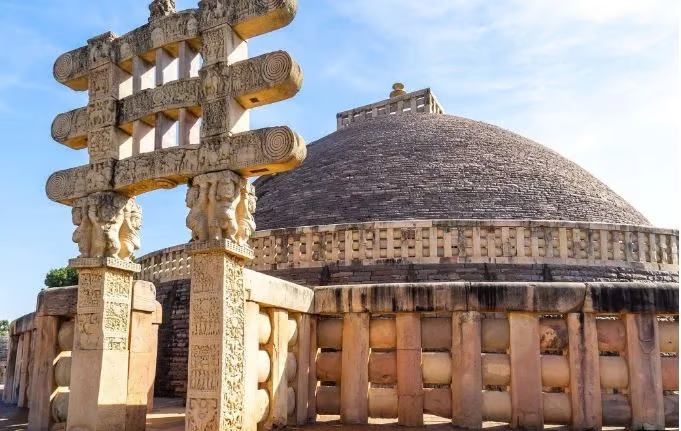
The Great Stupa of Sanchi
- A stupa is a Buddhist commemorative monument usually containing sacred relics of the Buddha or other saints.
- Established: The stupa was commissioned in the third century BCE by Emperor Ashoka of the Maurya dynasty.
- The stupa was subsequently enlarged and embellished during the Shunga and Satavahana periods.
- Structure: The Great Stupa is a hemispherical dome made of stone and brick, with a central structure that is a large, raised platform containing the relics of the Buddha.
- It is topped by a ‘harmika’ that holds the triple umbrella, or ‘chhatraveli’, which represents the three jewels of Buddhism – the Buddha, the Dharma, and the Sangha.
- Above the dome, there is a pillar-like structure called the chatra, which is a symbol of the Buddha’s presence and enlightenment.
- The Stupa is a UNESCO World Heritage site and a pilgrimage destination for Buddhists from around the world.
Source: TOI
Vital Chemotherapy Drugs are in Short Supply in India
Syllabus: GS2/Health
Context
- India is facing a critical nationwide shortage of two key chemotherapy drugs, cisplatin and carboplatin, driven by soaring global platinum raw material costs, West Asia shipping route disruptions, and domestic price caps.
About
- For patients, this has meant interruptions or delays in life-saving treatment.
- The government last month raised temporarily ceiling rates for the two drugs by 50%, to help restart halted domestic manufacturing lines.
- Cisplatin is a chemotherapeutic agent used in the treatment of solid tumors as well as certain blood cancers.
- Carboplatin is a second generation platinum compound that is also used to treat solid tumours.
- Both are among the most widely used chemotherapy drugs in India used in treating ovarian, head and neck, lung, gall bladder, urinary bladder, breast and testicular cancers.
Chemotherapy
- Chemotherapy is a drug treatment that uses powerful chemicals to kill fast-growing cells/Cancer cells in the body.
- Chemotherapy drugs can be used alone or in combination to treat a wide variety of cancers.
- Though chemotherapy is an effective way to treat many types of cancer, chemotherapy treatment also carries a risk of side effects.
Source: TH
Constitutional Limits on the Power of Arrest
Syllabus: GS2/ Polity
Context
- The Supreme Court, in Vihaan Kumar v. State of Haryana (2025), held that every arrested person must be properly and meaningfully informed of the grounds for his arrest.
Supreme Court Ruling
- The constitutionality of arrest needs to be examined to reinforce democratic values and ensure that the authority of the state and the liberty of the citizen are properly balanced.
- Failure to provide information shall amount to a violation of Article 22(1) of the Constitution and Section 47 of the BNSS, 2023.
- The verdict says that communicating the details of the arrest to relatives or providing ambiguous records does not satisfy the constitutional requirements.
- To fulfil the requirements of Article 22(2) and Section 58 of the BNSS, 2023, the arrest memo must contain the time of arrest.
Constitutionality of Arrest and Detention
- Article 22 provides procedural safeguards for a person who is arrested, including the right to be informed and the right to consult and be defended by his lawyer as soon as possible, and finally the right to be presented before the nearest magistrate within 24 hours, excluding the travel time.
- Arrest is different from detention. While detention is a temporary hold for investigation and the person is not charged with any offence, arrest is a formal police custody based on probable cause of the commission of an offence.
- In non-cognisable offences such as defamation, etc., a warrant is needed for arrest, whereas in cognisable offences such as murder, rape, etc., arrest is without a warrant.
Supreme Court Judgement
- In Arnesh Kumar v. State of Bihar (2014), the Supreme Court laid down guidelines for arrests to prevent the misuse of criminal laws.
- The court said that arrests should be an exception in cases where the punishment is less than seven years.
- The police must determine whether an arrest is necessary under Section 35 of the BNSS.
- The Supreme Court in Maneka Gandhi v. Union of India (1978) suggests that Article 21 is related to Articles 14 and 19.
- Of the two, Article 14 is an antithesis to arbitrariness, and the substantive natural justice emanates from it, whereas Article 19(1) incorporates procedural natural justice.
Source: TH
SraVaani
Syllabus:GS3/Science and Technology
In News
- Researchers at IISc’s SPIRE Lab, in collaboration with ARTPARK and with support from Google have released SraVaani.
SraVaani
- It is a multilingual Indian speech recognition model trained on 65 Indian languages and dialects, including 40-plus languages that today’s speech recognition systems do not officially support.
- SraVaani covers 20 scheduled languages and 45 regional languages and dialects, potentially opening speech AI capabilities to around 25 crore people as per the 2011 Census whose languages are not properly handled by current systems.
- Its coverage is designed to be pan-India, spanning 19 languages from the Northeast, 16 from eastern India, 9 from the west, 8 from the north, 6 from the south and 5 from central India, along with English and Sanskrit. The model even supports languages such as Garo, Angika, Chakma, Kokborok, Tulu, Bundeli and Bajjika.
Source:TH
World Elephant Day
Syllabus: GS3/Environment
Context
- As India observed World Elephant Day 2026 on 12 August, its commitment to elephant conservation remains steadfast.
About Elephants
- Elephants are Earth’s largest land animals and are highly intelligent. They also have the longest gestation period among mammals.
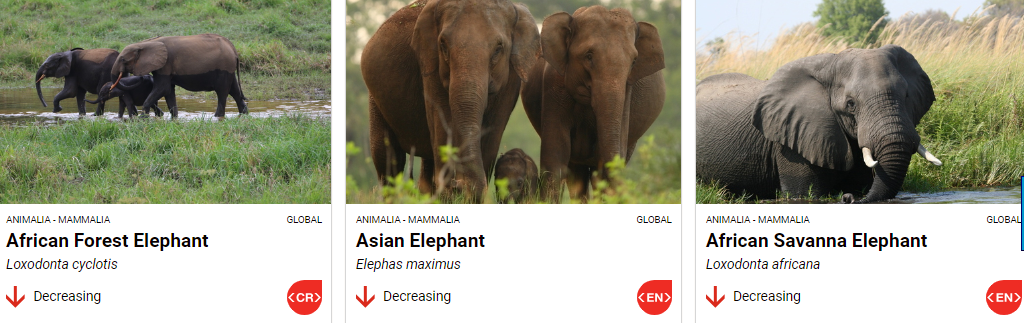
- There are three species of elephant: African Savanna (Bush), African Forest and Asian.
- The African savanna elephant is the largest elephant species.
- Threats: The greatest threat to African elephants is poaching for the illegal ivory trade, while Asian elephant populations are most at risk from habitat loss and resulting human-elephant conflict.
- IUCN Red List Status :
Do you know?
- India is home to over 60% of the world’s wild Asian elephants. The Synchronous All India Population Estimation of Elephants (SAIEE) 2021–25 estimates India’s wild elephant population at 22,446.
- The Government of India has declared the Indian elephant as a National Heritage Animal.
Initiatives for conservation of Elephants
- Project Elephant (PE): A centrally sponsored scheme launched in 1992 and implemented by the Ministry of Environment, Forest and Climate Change (MoEFCC) to provide financial and technical support to major elephant-bearing States for the protection of elephants, their habitats and corridors.
- Legal Protection: The Indian elephant receives the highest degree of legal protection under Schedule I of the Wildlife (Protection) Act, 1972.
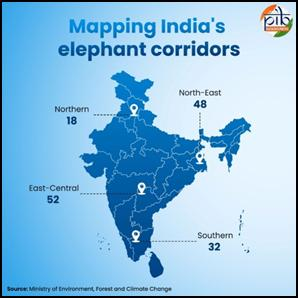
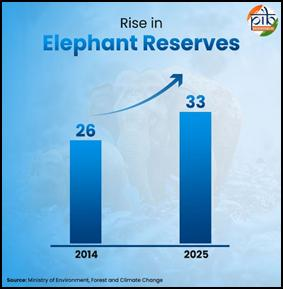
- Elephant Corridors and Reserve Network: Elephant corridors play an important role in elephant conservation in India. Currently, 150 corridors support elephant movement.
- Making Railways Safer for Elephants: Joint surveys identified 127 sensitive railway stretches covering 3,452.4 km, leading to measures such as underpasses, overpasses, ramps and bridge modifications. These interventions reduced train-hit elephant deaths from 26 in 2013 to 12 in 2024, a decline of over 50%.
- Monitoring the Illegal Killing of Elephants (MIKE) programme: Launched in 2003, it is an international collaboration that tracks trends in the illegal killing of elephants across Africa and Asia to assess the effectiveness of field-level conservation efforts.
- Operation Thunderbird: To fight against wildlife crime, Wildlife Crime Control Bureau (WCCB), Ministry of Environment, Forest and Climate Change, coordinated “OPERATION THUNDERBIRD” in India.
- Captive Elephant (Transfer or Transport) Rules, 2024: The Government notified these rules to regulate the movement of captive elephants.
Source: PIB
IOL Launches Indigenous ‘GARUD’ High Resolution Binoculars for Civil Market
Syllabus: GS3/Defence
Context
- India Optel Limited (IOL), a Mini Ratna Category-I Defence Public Sector Undertaking under the Department of Defence Production, has launched the indigenous ‘GARUD’ High Resolution Binoculars for the civil market.
About
- GARUD offers 8x magnification and a wide 7.6-degree field of view, enabling clear observation of distant objects while retaining a broad viewing perspective.
- Its weather-resistant construction enables reliable use across varied outdoor conditions.
- It is suited for a wide range of applications, including birdwatching, wildlife observation, nature exploration, travel, sports, forestry, marine activities and security-related applications.
- GARUD combines IOL’s experience in defence optics with modern technology for civilian users.
- Its launch makes the company’s optical capabilities available to the wider public, including outdoor enthusiasts and professionals.
Source: PIB
Previous article
Ease of Doing Business In India
Next article
AI Can Be Optimised for Better Healthcare
