


Syllabus: GS3/Economy
In Context
- India has undertaken wide-ranging reforms to create a more transparent and facilitation-driven business environment.
Ease of Doing Business (EoDB)
- It is the degree of ease or difficulty to start and operate a business in a country or region.
- It relies on things like the regulatory environment, bureaucratic procedures, legal structure, and efficiency of government services.
Present Status
- Investor confidence is growing in India’s business environment and improved Ease of Doing Business (EoDB).
- The progress is reflected in global assessments such as the Doing Business Report 2020 by the World Bank.
- India’s rank improved from 142 in 2014 to 63 in 2019, marking an advancement of 79 positions over five years.
- The IMD World Competitiveness Ranking 2025 factors in economic performance of the country, Government and business efficiency and infrastructure development for businesses.
- India’s rank improved from 43 in 2021 to 41 in 2025. This highlights a stronger business environment, improved governance and better digital and regulatory reforms.
- In 2020, 2022 and 2025, India was placed in Group A of the World Bank’s GovTech Maturity Index that evaluates digital transformation in the public sector.
- This category acknowledges countries that are trailblazers with innovative and advanced practices across Core Government Systems, Public Service Delivery, Digital Citizen Engagement and GovTech Enablers.
- Post 2014, India’s logistics competitiveness has improved with increased multimodal connectivity and infrastructure.
- World Bank Logistics Performance Index 2023 – India’s rank improved from 54th in 2014 to 38th in 2023.
Reforms in India’s Business Environment
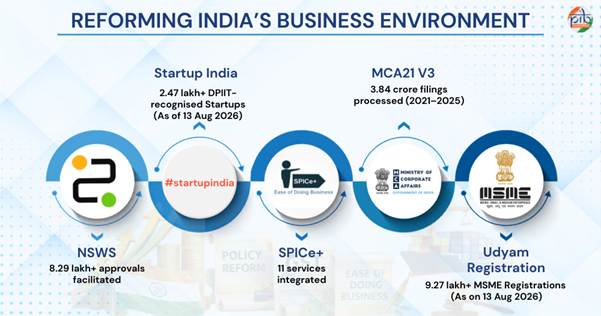
- Startup India: The Startup India plan was started in January 2016 to promote entrepreneurship and to build a healthy startup ecosystem. The objective is to make India a country of employment creators, not job seekers.
- Udyam Registration Portal was launched in July, 2020:
- It provides a free, paperless, and self-declaration-based approach for MSMEs (Micro, Small and Medium Enterprises).
- It provides an integrated digital, paperless registration process without any administrative bottlenecks and access to the CBDT (Central Board of Direct Taxes) and GSTN (GST Network) databases.
- Digital India Land Records Modernisation Program (DILRMP): DILRMP was launched in 2016 to improve the management of land records and to limit the extent of land/property disputes.
- The program will improve the accuracy of the land records management system.
- National Generic Document Registration System (NGDRS) – Ek Desh, Ek Panjikaran:
- The NGDRS has helped to ease property transactions and EoDB through a comprehensive user interface to register property and documents.
- The program also allows citizens to purchase land online. Buyers can know the circle rate of land, can determine property valuation as per current rates, and can know the type of land.
- National Single Window System (NSWS): NSWS is a single-window digital platform to help find and apply for approvals as per the firm’s requirements.
- PARVIESH: The PARVIESH site was created in August, 2018 to streamline Environment clearance (EC), Forest clearance (FC), Wildlife (WL) and Coastal Regulation Zone (CRZ) clearances.
- SPICe+ Form: The SPICe+ integrated web form was rolled out in 2020 to consolidate several of the government’s services under a single platform to accelerate business registration.
- MCA21 V 3.0.: MCA21 project is an AI-based effort which assists to a large extent in the transparency in the business sector of India.
- Government e-Marketplace (GeM): To digitise public procurement and make it more streamlined and inclusive, GeM was launched in 2016. The e-marketplace is the connecting link for women entrepreneurs, startups, micro and small businesses (MSEs), artisans, self-help groups (SHGs) and Divyangjans to the mainstream economy.
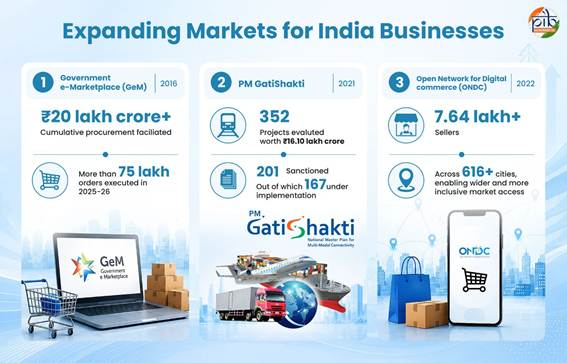
- ONDC (Open Network for Digital Commerce): ONDC is an initiative to promote open networks for all aspects of the exchange of goods and services on digital or electronic networks. Founded in April 2022 to bring digital trade to everyone.
- PM Gati Shakti Mission National Master Plan: PM GatiShakti National Master Plan was launched in October 2021 as a way-breaking program for integrated infrastructure development and multimodal connectivity.
- It is a single digital platform that integrates 58 Central Ministries and all States/UTs with 3199 data layers for collaborative infrastructure planning and implementation.
- Pradhan Mantri Mudra Yojana (PMMY): “PMMY was launched to bridge the gap of financial accessibility by providing collateral-free loans up to ₹ 20 lakh for small-scale enterprises.
- Since its inception in 2015, the scheme has disbursed loans of ₹40.07 lakh crore to over 57 crore accounts (as of 27th March 2026).
- GST was introduced in 2017 to replace an inefficient and dysfunctional indirect tax regime, which was a burden on both business and consumers.
- Earlier, we had a level of taxes like excise duty, service tax, VAT, CST, etc.
Importance of Ease of Doing Business
- Attracting Foreign Direct Investment: Global investors need regulatory institutions that are predictable, transparent and reliable. The relaxed standards on compliance and property purchase also help investor trust.
- Empowering MSMEs: Micro, Small and Medium Enterprises are the backbone of the Indian economy.
- Reducing the regulatory burden reduces the cost of doing business and encourages informal firms to formalise.
- Facilitates entrepreneurship: Simplified registration, licensing and compliance help startups, MSMEs and new enterprises to readily access the market.
- Job creation: To create formal jobs to absorb India’s young people, there is a need to create and develop firms faster.
- Global Competitiveness: Indian companies would be able to effortlessly get into the global supply chains through seamless logistics, digital integration of customs, and speedy environmental clearances.
Problems and Concerns
- Increased regulation: Changes in taxation, environmental and industrial legislation could discourage investment.
- The complexity of compliance rules has a disproportionate impact on MSMEs and start-ups, as they have fewer resources to comply.
- States and districts have performed differently, resulting in an uneven economic climate.
- Centre’s reforms may not lead to effective services at the local level
- Land and building delays: The conversion and building permits take time, as do the land and documentation.
- Limited access to finance: Availability of timely and inexpensive financing, especially to MSMEs, remains an issue.
- Poor infrastructure and logistics: Transport, ports, power, internet access, and logistical obstacles all add to the expense of conducting business.
Suggestions
- Capacity Building: Development of the capacity of local governments, technology, and human resources of municipalities and district administrations.
- Predictable policy regimes: Long-term consistency in trade and tax policy to enable global investors to plan decades without worry of retrospective change.
- There is a need for a single real-window systems for approval of processes
- Eliminate duplication in licensing, inspection and compliance processes.
- Reforms should be targeted to the requirements and restrictions of MSMEs and start-ups.
Conclusion
- India’s Ease of Doing Business journey is evolving from simplifying individual processes to building a more responsive and enterprise-friendly ecosystem.
- With stronger digital infrastructure, wider access to markets and finance, and greater regulatory certainty, businesses are better positioned to seize opportunities, scale sustainably and compete globally.
Source: PIB
Previous article
Financial Inclusion in India
Next article
News In Short 14-08-2026
