


Syllabus: GS3/Economy
Context
- Financial inclusion is central to India’s vision of equitable development, India has expanded access to banking, digital payments, credit, insurance, pensions and investment opportunities.
Financial Inclusion
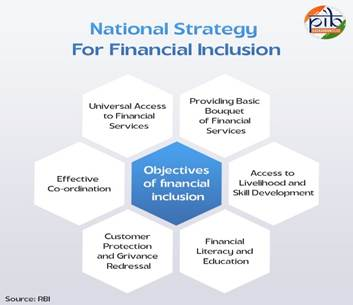
- Financial inclusion is the process of ensuring access to financial services and timely and adequate credit where needed by vulnerable groups such as weaker sections and low income groups at an affordable cost.
India’s Progress in Financial Inclusion
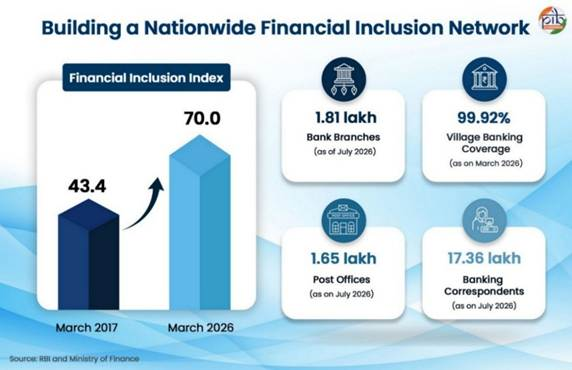
- RBI Financial Inclusion (FI) Index: It measures the extent of financial inclusion across access, usage and quality of financial services.
- It serves as a comprehensive indicator of progress in expanding formal financial services nationwide.
- The FI Index increased from 43.4 in 2017 to 70.0 in 2026, reflecting broad-based improvements across all three dimensions.
- The Global Findex Database is the world’s leading source of data on financial inclusion.
- It measures how adults access and use financial services across economies.
- Account ownership has reached 89% since 2011, reflecting significant gains in access to formal financial services and active account usage over the past decade.
- Banking access is delivered through branches, Business Correspondents and India Post Payments Bank (IPPB) outlets.
- In 2026, 99.92% villages in the country are covered with banking outlets within a 5 km radius.
Challenges
- Cybersecurity Risks: The increasing use of digital platforms raises concerns about data breaches and cyberattacks. Ensuring robust security measures to protect sensitive financial data is crucial.
- Lack of Digital Literacy: A significant portion of the population still lacks digital literacy and access to technology, which limit the reach and effectiveness of fintech solutions.
- Customer Trust: Building trust in digital financial services, especially among older demographics and those new to technology is challenging.
- Innovation and Scalability: Keeping pace with rapid technological advancements and ensuring that systems can scale effectively as user demand grows is a tough challenge.
Government Initiatives
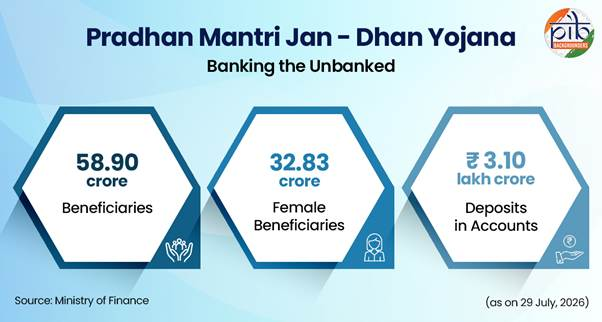
- Pradhan Mantri Jan Dhan Yojana (PMJDY): Aims to increase financial inclusion by facilitating the enrollment of new bank accounts for direct benefit transfers and access to financial services.
- JAM Trinity: The JAM Trinity Integrates Jan Dhan accounts, Aadhaar and mobile connectivity to strengthen financial inclusion.
- It enables Direct Benefit Transfer (DBT) for transparent and efficient delivery of government benefits.
- DBT reduces leakages, eliminates fake beneficiaries and minimises intermediaries in welfare delivery.
- Unified Payments Interface (UPI): It enables instant, interoperable and secure transactions between individuals and merchants in real time.
- Within India, 81% of total retail payment transactions are processed on UPI.
- Pradhan Mantri Jeevan Jyoti Bima Yojana (PMJJBY): PMJJBY (2015) is an annual renewable life insurance scheme which offers a ₹2 lakh life cover for individuals aged 18–50 years.
- The scheme provides immediate cover for accidental death and a 30-day waiting period for non-accidental death.
- Pradhan Mantri Suraksha Bima Yojana (PMSBY): PMSBY (2015) is also an annual renewable accident insurance scheme for savings bank account holders aged 18–70 years. It provides ₹2 lakh cover for accidental death or full disability, and ₹1 lakh for partial disability.
- The insurance is available at an annual premium of ₹20 which is auto-debited from the linked bank account.
- Atal Pension Yojana (APY): APY (2015) is a contributory pension scheme for workers in the unorganised sector, launched in 2015.
- It provides a guaranteed monthly pension ranging from ₹1,000 to ₹5,000 after attaining 60 years of age.
- PM Mudra Yojana: It provides collateral-free loans up to ₹20 lakh to non-corporate, non-farm micro and small enterprises across manufacturing, trading, services, and allied agricultural activities.
- PM SVANidhi: It is a first-of-its-kind micro-credit initiative focused on street vendors with government-backed credit guarantee support.
- It provides collateral-free loans in three progressive tranches of ₹15,000, ₹25,000 and ₹50,000.
- Kisan Credit Card (KCC): KCC provides timely and adequate credit to farmers through the banking system.
- It offers an ATM-enabled debit card, one-time documentation and flexible withdrawals.
- Jan Samarth: Jan Samarth is a unified digital platform for credit-linked government schemes.
- It connects beneficiaries directly with lenders, simplifying access to government-sponsored credit.
- National Centre for Financial Education (NCFE): The centre promotes financial education and awareness across all sections of society under the National Strategy for Financial Education.
- It conducts seminars, workshops, training programmes and awareness campaigns to strengthen financial literacy.
- Financial Education Programme for Adults (FEPA): FEPA was launched in 2019 by NCFE to promote financial awareness among adults.
- The programme covers farmers, women’s groups, ASHA and Anganwadi workers, SHGs, employees and skill development trainees.
- Nationwide Financial Inclusion Saturation Campaign: The four-month campaign was launched in 2025 to extend financial inclusion across 2.70 lakh Gram Panchayats and ULBs.
Conclusion
- India’s financial inclusion journey has evolved from expanding account ownership to enabling meaningful financial participation.
- A strong network of banks, digital infrastructure and government schemes has widened access to formal financial services.
- Together, these initiatives are building a more accessible, resilient and inclusive financial ecosystem that supports inclusive growth.
Source: PIB
Previous article
India’s Infrastructure Transformation
Next article
Ease of Doing Business In India
