

Syllabus: GS3/Science & Technology;
Context
- India is focusing more on the link between AI and its Digital Public Infrastructure (DPI) to improve governance, service delivery, Jan Vishwas (trust-based governance), and build state capacity for inclusive development.
Need for AI in Digital Public Infrastructure (DPI)
- India’s Digital Public Infrastructure, such as Aadhaar, UPI, DigiLocker, FASTag, GSTN, CoWIN and Direct Benefit Transfer (DBT), has changed governance by building digital identity, payments and data-sharing systems at a population scale.
- But the next phase of governance requires AI to make these platforms more intelligent, interoperable and citizen-centric.
- Why AI is needed:
- Population-scale Data Management: India creates massive digital datasets through UPI, GST, Aadhaar authentication and FASTag, which AI is able to analyse in real time.
- Strengthening State Capacity: AI is able to automate decision making, reduce administrative delays, and enhance policy implementation.
- Better Service Delivery: AI-enabled multilingual interfaces can break down linguistic and educational barriers to accessing government services.
- Fraud Detection: AI is able to do a better job of detecting fake beneficiaries, financial irregularities and leakages, preventing cases like Japan’s pension fraud with deceased beneficiaries.
- Improving Evidence-based Policy Making: AI is able to process unstructured administrative data to generate useful insights for welfare targeting and public spending.
Advantages and Significance of Integrating AI with DPI
- Strengthen Governance and State Capacity: AI has the potential to process large volumes of data for predictive governance, helping governments anticipate issues and act more efficiently.
- It also helps in faster grievance redressal and real time monitoring of schemes and strengthens the Jan Vishwas approach through transparent, accountable and responsive governance.
- Efficient Welfare Delivery: AI improves Direct Benefit Transfer (DBT) by identifying duplicate or fraudulent beneficiaries, minimising fiscal leakages and delivering welfare benefits to the eligible beneficiaries in a more efficient and inclusive manner.
- Enhanced Public Service Provision: Multi-language virtual assistants and AI-enabled chatbots increase access to government services. Their ability to simplify interactions facilitates digital inclusion, especially for rural populations and less educated groups.
- Higher Economic Formalisation: AI with GST, UPI and enterprise DPI can help in credit assessment, better worker-job matching, supply-chain efficiency and can fast track MSME formalisation.
- Digital Economy Boost: India contributes nearly 42% of the world’s digital payment transactions through UPI.
- Improved Public Health and Education: With anonymised public datasets, artificial intelligence can enhance disease surveillance, improve resource allocation, support personalised learning and improve healthcare planning leading to more efficient and responsive public services.
- Data-Driven Policymaking: AI-powered real-time analytics can enable evidence-based decision-making by improving infrastructure planning, disaster management, urban governance and agricultural support.
Related Efforts & Initiatives
- IndiaAI Mission: It aims to build AI infrastructure, innovation, datasets and skilled manpower.
- Digital India Programme: To widen digital governance and public services.
- Aadhaar enabled DBT: To enhance welfare delivery and minimise leakages.
- United Payments Interface (UPI) is the world’s largest real-time payments system.
- DigiLocker: Secure Digital Document Verification & Storage
- Open Network for Digital Commerce (ONDC): To promote open digital commerce ecosystems.
- Ayushman Bharat Digital Mission (ABDM): For inter operable digital health records.
- National Data Governance Framework Policy (proposed): It aims to enable responsible access to anonymised public datasets.
- Jan Vishwas (Amendment of Provisions) Act, 2023: To improve ease of living and trust-based governance.
- Enterprise DPI (Universal Enterprise Number, Entity DigiLocker, API Setu and Single Source of Truth for Regulation) to simplify business compliance.
Way Forward: DPI Enhancement Driven by AI
- Build a secure, interoperable and AI-ready digital infrastructure, not isolated digital silos built on API-based governance.
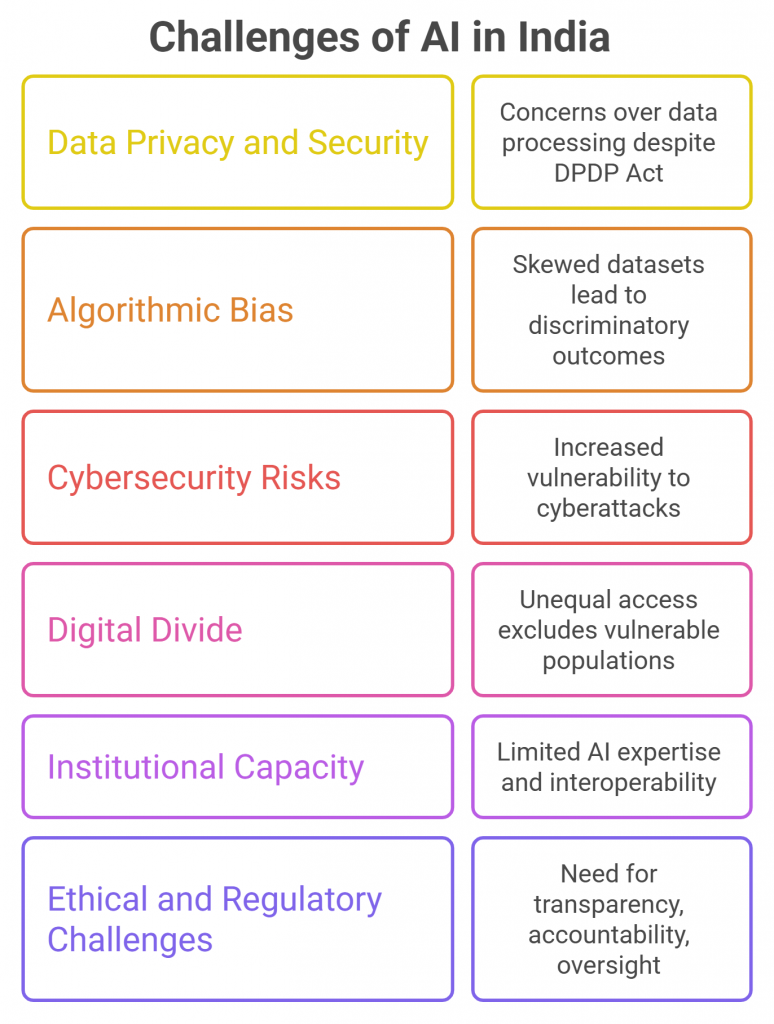
- Ensure privacy-by-design, informed consent and strong implementation of the Digital Personal Data Protection framework.
- Support local AI models, open data, research bodies and AI talent to reduce dependence on foreign technologies.
- Encourage multilingual AI interfaces to enhance accessibility and narrow the digital divide.
- Provide specialised training and establish dedicated AI units to build institutional AI capacity within government.
- Promote responsible innovation through public-private partnerships while ensuring transparency, accountability and ethical AI standards are met.
- Expand Enterprise DPI and integrate it into labour, social security, and skilling platforms to facilitate formal employment and access to credit.
- Support the development of open, anonymised public data commons to enable academic research and evidence-based policy making.
Conclusion
- Kautilya’s Arthashastra stressed that strength, timing and strategy must be in sync for successful governance.
- India is strong today with its world class Digital Public Infrastructure.
- The next stage of governance reform is to integrate AI with DPI to improve state capacity, enhance service delivery, reduce leakages and foster inclusive growth.
- AI-enabled DPI can help India leapfrog from a digital infrastructure to a genuinely intelligent, citizen-centric state, realising the vision of Jan Vishwas and accelerating India’s journey to mass prosperity with robust data governance, privacy protections and institutional reforms.
| Daily Mains Practice Question [Q] Artificial Intelligence (AI) integrated with Digital Public Infrastructure (DPI) has the potential to redefine governance and enhance state capacity in India. Discuss. |
Previous article
Need For India’s Geoeconomic Strategy
