

Syllabus: GS1/Climatelogy; GS3/Environment/Energy
Context
- As per the Centre for Research on Energy and Clean Air (CREA) India’s power system stands to be strained more by the developing El Niño than that of any other country.
Major Highlights
- El Nino Conditions: The India Meteorological Department (IMD) confirmed that El Niño conditions had emerged over the equatorial Pacific and were expected to strengthen through the monsoon.
- It has forecast below-normal southwest monsoon rainfall at 90% of the long-period average, with a 60% chance of a deficient season.
- Rise in Power Generation Gap: CREA projects that weaker wind and hydropower output, combined with rising demand for air conditioning, could open a generation gap of nearly 18 TWh (terawatt-hour) over a period of one year to June 2027.
- Coal Fired Plants: The gap would most likely be filled by coal-fired power plants, resulting in an estimated 17 million tonnes of additional carbon dioxide emissions.
- Solar Remains Stable: Unlike hydropower and wind, solar generation is expected to remain largely stable during El Niño conditions, reinforcing its growing role in India’s energy transition.
- Vulnerability Due to Weather: The findings suggested that India’s power system is becoming increasingly vulnerable to weather driven demand shocks rather than only fluctuations in renewable energy output.
El Nino
- El Niño means Little Boy in Spanish. It is a climate phenomenon characterized by the periodic warming of sea surface temperatures in the central and eastern equatorial Pacific Ocean.
- During El Niño, trade winds weaken.
- Warm water is pushed back east, toward the west coast of the Americas and as a result cold water is pushed towards Asia.
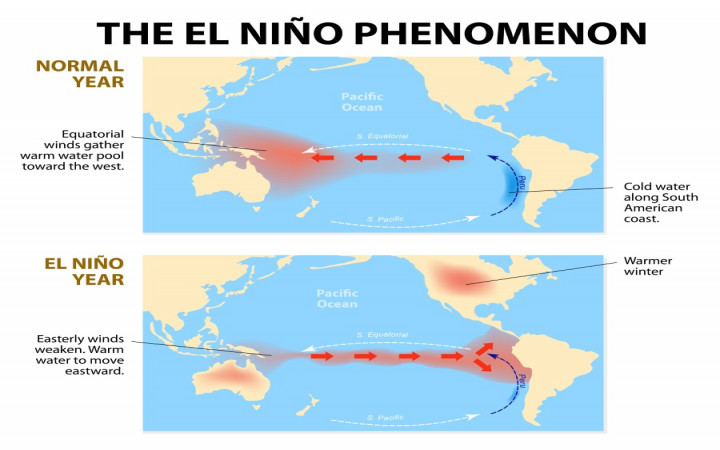
- Impact of El Nino on weather patterns: It leads to rise in global temperature, weakens monsoon, increases risk of wildfires and triggers extreme weather events such as hurricanes, and cyclones, particularly in the Pacific Ocean and Atlantic.
Electricity Generation Capacity of India
- In 2025, total electricity generation increased by 1%,coal generated electricity declined by 4% and renewable electricity generation grew by 22%.
- As of March 2026, non-fossil installed capacity reached 283.46 GW — 150.26 GW of solar, 56.09 GW of wind, 51.41 GW of large hydro and 8.78 GW of nuclear.
- 44.6 GW of solar and 6 GW of wind were added in 2025-26.
- Coal remains the largest single source of power, at about 42% of installed capacity, though coal generation fell 3.69% over the year.
- Grid operators curtailed around 2.1 TWh of solar and wind generation last year to keep coal fired plants operating because of limited system flexibility.
- Deploying just 10 gigawatt hours (GWh) of battery storage could have absorbed that surplus renewable electricity and shifted it to evening peak demand, reducing reliance on coal.
- It is desirable that India must move much faster on batteries and grid upgrades so that clean energy can meet future demand surges.
Energy Storage
- Energy storage refers to systems that can store excess renewable electricity during periods of high generation and discharge it when demand rises but power generation remains low.
- Energy storage systems convert electricity from renewable sources such as solar and wind, when it is available, into forms that can be stored.
- Later, it converts these back into electricity when need arises.
Types of Energy Storage
- Pumped hydro storage (PHS) uses surplus electricity to pump water from a lower reservoir to a higher one. When electricity demand peaks, it releases the stored water downhill through turbines to generate power.
- Battery Energy Storage Systems (BESS) technology stores electricity chemically and discharges it when needed.
- Lithium-ion batteries, particularly lithium iron phosphate (LFP) batteries, are currently the dominant technology for grid-scale storage because of their falling costs, high efficiency and long operational life.
- Concentrating solar-thermal storage systems: This technology uses mirrors that capture and focus sunlight onto a receiver.
- As the receiver gets heated, materials such as molten salt are circulated inside the receiver to store the heat.
- Compressed-air energy storage systems use excess electricity to compress air and store it in underground caverns or tanks.
- Flywheel energy storage systems store electricity as rotational energy by spinning a rotor at extremely high speeds.
- Gravity energy storage systems use electricity to lift heavy weights to higher elevations. When electricity is needed, the weights are lowered, converting gravitational energy back into electricity through generators.
India’s Energy Storage Capacity
- The government is primarily focusing on the two major systems above: PHS and BESS.
- At present, India has an installed BESS capacity of around 0.27 GW.
- PHS capacity stands at about 7.2 GW. There are plans, however, for a massive scale-up over the next decade.
- A Central Electricity Authority (CEA) plan projects the country’s total energy storage capacity to reach 174 GW/888 gigawatt hours by 2035-36.
- This includes 80 GW/321 GWh of BESS and 94 GW/567 GWh of PHS.
Way Ahead
- The 2026-2027 El Niño should be viewed as a test of India’s electricity system rather than simply another weather event.
- The modelling, which compares the projected El Niño period with the preceding La Niña phase, suggests climate variability could increasingly shape electricity demand, renewable generation and fossil fuel use.
- The findings suggest the growing importance of batteries, transmission upgrades and grid flexibility alongside renewable energy expansion as India seeks to build a more resilient power system.
Source: TH
Previous article
Reimagining Urban Infrastructure for Flood Resilience
Next article
AI Governance and a Voice for the Global South
