


Rakhigarhi
Syllabus: GS1/ History and Culture
Context
- The Archaeological Survey of India (ASI) has sent nearly 5,000-year-old skeletons unearthed at Haryana’s Rakhigarhi, for scientific examination and facial reconstruction.
Rakhigarhi
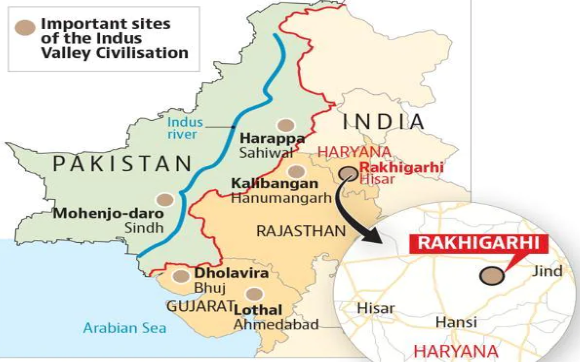
- The present-day Rakhigarhi is located 27 km from the Ghaggar river, in the Ghaggar-Hakra river plain in Haryana.
- The archaeological site, dating back to 2600-1900 BCE.
- It is the largest Harappans site in the Indian Subcontinent.
- The site was first excavated by Amarendra Nath of Archaeological Survey of India (ASI).
- Findings
- Granary: A granary belonging to the mature Harappan phase (2600 BCE to 2000 BCE) has been found here. It has 7 rectangular or square chambers.
- Culture, clothing and worship: Fire altars and apsidal structures were revealed in Rakhigarhi.
- Cemetery and burial sites: A cemetery of Mature Harappan period is discovered at Rakhigarhi, with eight graves found.
Harappan Civilization
- The Harappan civilization is believed to be one of the oldest world civilizations together with Egypt and Mesopotamia.
- It was developed along the river Indus and for that reason it is also known as the Indus Valley Civilization.
- The Harappan civilization is identified as a Bronze-age civilization because many objects have been found that are made up of copper based alloys.
Source: IE
First Amendment
Syllabus: GS2/Polity
Context
- On June 18, 1951, the First Amendment to the Indian Constitution came into force.
About
- The amendment altered the scope of three fundamental rights: freedom of speech, equality and property rights.
- It also created a new constitutional mechanism through which certain laws could be protected from challenge on the ground that they violated fundamental rights.
- These changes were enacted before independent India’s first general elections.
Key Provisions
- Reasonable Restrictions on Fundamental Rights: It amended Article 19(2) to allow the State to impose reasonable restrictions on the freedom of speech and expression in the interests of: Public order, friendly relations with foreign states, incitement to an offence, security of the State, etc.
- Protection of Land Reform Laws: Added Article 31A and Article 31B to protect laws related to agrarian reforms from being challenged on the grounds of violating Fundamental Rights.
- Creation of the Ninth Schedule: Established the Ninth Schedule under Article 31B. Laws placed in the Ninth Schedule were initially protected from judicial review on grounds of violation of Fundamental Rights.
- The scope of protection given to the Ninth Schedule was later examined by the Supreme Court in the landmark I.R. Coelho v. State of Tamil Nadu case.
- Special Provisions for Socially and Educationally Backward Classes: Inserted Article 15(4), enabling the State to make special provisions for the advancement of socially and educationally backward classes, and for Scheduled Castes and Scheduled Tribes.
Source: IE
UN Food Agencies Warn Acute Hunger in 13 Hot Spots
Syllabus: GS3/ Food Security
Context
- United Nations’ food agencies have warned that acute hunger is expected to worsen across 13 global hotspots in the coming months due to conflict, climate shocks and funding shortages.
About
- The Food and Agriculture Organisation (FAO) and World Food Programme (WFP), in a joint report,said that around 266 million people are already facing high levels of acute food insecurity.
- Sudan, South Sudan, Yemen and Palestine remain the countries of greatest concern, while Nigeria and Somalia have been added to the high-risk list as famine threats grow.
- The report noted that funding for food assistance has fallen by nearly 60 per cent since 2022, even as humanitarian needs continue to rise.
- The UN agencies also warned that spillover effects from the Middle East conflict and an Ebola outbreak in eastern Congo are further disrupting livelihoods and aid access.
What is Food Security?
- Food security exists when people have access to enough safe and nutritious food for normal growth and development, and an active and healthy life.
- By contrast, food insecurity refers to when the aforementioned conditions don’t exist.
- Acute food insecurity is any type that threatens people’s lives or livelihoods.
- The global standard for measuring acute food insecurity is the Integrated Food Security Phase Classification, or IPC for short. It describes five levels, from “no/minimal food insecurity” (IPC Phase 1) to “catastrophe” or “famine” (IPC Phase 5).
Ammonia Gas
Syllabus: GS3/ S&T
In Context
- An ammonia gas leak at a private seafood processing and export facility in Tiruvallur district of Tamil Nadu has hospitalized many working people.
What Is Ammonia (NH₃)?
- Ammonia (NH₃) is a colourless gas with a strong, pungent smell. It is a simple inorganic compound made up of nitrogen and hydrogen.
- Although it occurs naturally in small quantities during the decomposition of organic matter, it is also produced on a large scale because of its wide industrial and agricultural applications.
- Industrial ammonia is commercially produced through the Haber–Bosch process, in which atmospheric nitrogen reacts with hydrogen under high temperature and pressure in the presence of an iron catalyst.
- It is majorly used in fertilizers industries, chemical industries and in food processing due to its excellent cooling efficiency.
Source: TH
Biochar
Syllabus: GS3/ Agriculture/ Environment
Context
- Biochar is emerging as a sustainable solution to convert agricultural waste into a valuable resource for improving soil health and mitigating climate change.
What is Biochar?
- Biochar is a charcoal-like substance that’s made by burning organic material from agricultural and forestry wastes (also called biomass) in a controlled process called pyrolysis.
- Unlike ordinary organic matter, biochar decomposes very slowly and can remain in the soil for hundreds of years.
- It is highly porous, enabling it to store water, nutrients, and beneficial microorganisms.
Benefits of Biochar
- Agricultural Productivity: Studies indicate that biochar can improve crop yields by 10–30%, particularly in nutrient-deficient soils.
- Carbon Credits: Biochar can generate carbon credits because it removes carbon from the atmosphere and stores it in soil.
- Under internationally accepted standards, one tonne of certified biochar can generate approximately 2–2.8 tonnes of carbon dioxide-equivalent credits.
- Water Retention: Biochar acts like a sponge and stores water within its porous structure. Research shows that it can increase the water-holding capacity of soils by 10–25%.
Source: TH
Govt Prepares to Notify Western Ghats Eco Sensitive Areas
Syllabus: GS3/Environment
Context
- The Western Ghats may soon receive stronger legal protection in at least three states through the notification of Ecologically Sensitive Areas (ESAs).
- Once notified, these areas will face stricter curbs on mining, polluting industries, and large construction projects.
What are Ecologically Sensitive Areas?
- ESAs are designated regions identified for special environmental protection because of their rich biodiversity, fragile ecosystems or critical ecological functions.
- They are notified under the Environment (Protection) Act, 1986.
- The Supreme Court in 2022, directed that every protected forest, national park and wildlife sanctuary should have a mandatory eco-sensitive zone of at least one kilometre from its demarcated boundary.
- Restrictions: Certain activities are prohibited, some are tightly regulated, while others are encouraged to ensure development does not come at the cost of ecological damage.
- Getting an ESA status also means that any development project in the area will be subject to stricter environmental scrutiny.
Western Ghats
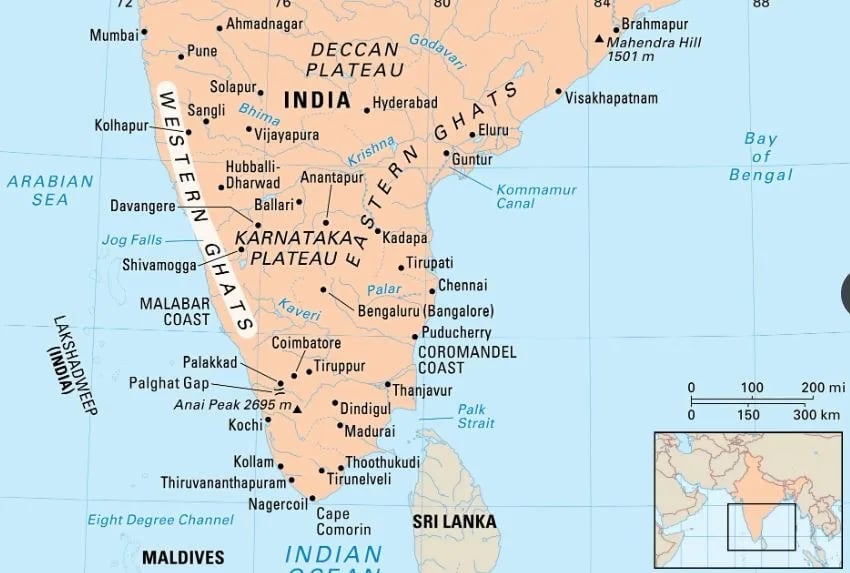
- The Western Ghats, also known as the Sahyadri Hills, are a mountain range that runs parallel to the western coast of India.
- Location: The Western Ghats extend for about 1,600 kilometers from Gujarat in the north to Tamil Nadu in the south.
- It stretches across six states: Gujarat, Maharashtra, Goa, Karnataka, Kerala, and Tamil Nadu.
- Biodiversity: The Western Ghats are considered one of the 8 “hottest hotspots” of biological diversity in the world.
- Covering an area just under 6% of India, the Western Ghats contain more than 30% of all plant, fish, herpeto-fauna, bird, and mammal species found in India.
- Many species are endemic, such as the Nilgiri tahr (Hemitragus hylocrius) and the lion-tailed macaque (Macaca silenus).
- 50% of India’s amphibians and 67% of fish species are endemic to this region.
- Threats: The region faces threats from deforestation, mining, agricultural expansion, and infrastructure development.
- Conservation: In 2012, the Western Ghats were inscribed as a UNESCO World Heritage Site.
- Major Peaks in the Western Ghats: Anamudi is the highest peak in the Western Ghats, located in Kerala.
- Doddabetta is the highest point in Tamil Nadu.
Source: IE
Previous article
Ashtalakshmi – The North-East at the Heart of India’s Growth Story
Next article
India Becomes World’s Top Ship Recycling Nation
