


Pride Month and the Evolution of LGBTQ+ Rights in India
Syllabus: GS1/Society; GS2/Social Justice
Context
- June is observed globally as Pride Month to celebrate the LGBTQ+ community and raise awareness about issues of equality, inclusion, and human rights.
About LGBTQ+ Community
- LGBTQ+ is an umbrella term for lesbian, gay, bisexual, transgender, and queer persons, with ‘+’ representing other identities that are not specifically included in these letters.
- Notably, LGBTQ+ persons do not conform with traditional gender roles and expectations, display sex characteristics that do not fit the typical male or female binary, and their gender identities that differ from the sex they were assigned at birth.
What is Pride Month?
- Pride Month traces its origins to the 1969 Stonewall Uprising in New York City.
- It commemorates the struggle for LGBTQ+ rights and celebrates diversity and inclusion.
- In India, the ‘Friendship Walk’ held in Kolkata on 2 July 1999 is widely regarded as the precursor to the country’s Pride Parade movement.
India’s Position on LGBTQ+ Rights
- As per census 2011, there were 4.87 lakhs persons in India who opted for “other” in gender category.
- Transgender Rights: NALSA v. Union of India (2014) recognised the right to self-identify gender.
- It recognises transgender as the “third gender” upholding their fundamental rights.
- Decriminalisation: Navtej Singh Johar v. Union of India (2018) decriminalised consensual homosexual acts (Section 377 partially struck down).
- Constitutional Provisions: Article 14 Right to equality, Article 15 No discrimination on grounds of sex and Article 21 Right to life and personal liberty.
- Legislation: The Transgender Persons (Protection of Rights) Act, 2019 provides legal recognition of transgender identity.
Source: IE
Zojila Tunnel
Syllabus: GS1/ Geography
Context
- The Zojila Tunnel achieved its final breakthrough in June 2026, marking a significant milestone in India’s efforts to establish all-weather connectivity between Kashmir and Ladakh.
About Zojila Tunnel
- The Zojila Tunnel is a 13.14-km-long single-tube, bi-directional road tunnel being constructed beneath the Zojila Pass in the Himalayas.
- It is located at an altitude of approximately 11,578 feet and connects Baltal in Kashmir with Meenamarg in Ladakh.
- The tunnel is designed as a two-lane horseshoe-shaped structure and is among the world’s longest road tunnels at such a high altitude.
- The project is being executed by Megha Engineering & Infrastructures Ltd.
- The tunnel has been constructed using the New Austrian Tunnelling Method (NATM).
- NATM relies on sequential excavation, immediate support measures such as shotcrete and rock bolting, and continuous geotechnical monitoring, allowing engineers to respond flexibly to changing ground conditions during tunnelling.
Strategic Importance
- It will provide all-weather connectivity between Kashmir Valley and Ladakh.
- It will reduce dependence on the snow-bound Zojila Pass, which remains closed during winter due to heavy snowfall and avalanches.
- It will improve military logistics and troop mobility in areas close to the Line of Actual Control.
Source: TH
Pradhan Mantri Surakshit Matritva Abhiyaan (PMSMA)
Syllabus: GS2/Government Initiatives
Context
- The 10th anniversary of the Pradhan Mantri Surakshit Matritva Abhiyan (PMSMA) was observed.
About PMSMA
- Launched on June 9, 2016, PMSMA provides free, comprehensive antenatal care to pregnant women — particularly those in their second and third trimesters — at designated government health facilities on the 9th of every month.
- Key Services: Under PMSMA, pregnant women receive:
- Clinical examinations and risk assessment;
- Blood and urine tests;
- Ultrasonography;
- Essential medicines and supplements;
- Counselling on nutrition, birth preparedness, and safe pregnancy practices.
- The Doctor Volunteer System: The programme encourages voluntary participation of private-sector specialists, including obstetricians, gynaecologists, radiologists, and physicians, to provide antenatal care services on the 9th of every month.
- In 2022, the government launched the Extended PMSMA (e-PMSMA) to strengthen tracking and follow-up of high-risk pregnancies.
- Achievements:
- India’s Maternal Mortality Ratio (MMR) declined from 130 per lakh live births (2014–16) to 87 per lakh live births (2022–24).
- The initiative contributes to India’s commitment towards achieving the Sustainable Development Goal (SDG) target of reducing maternal mortality to below 70 per 100,000 live births by 2030.
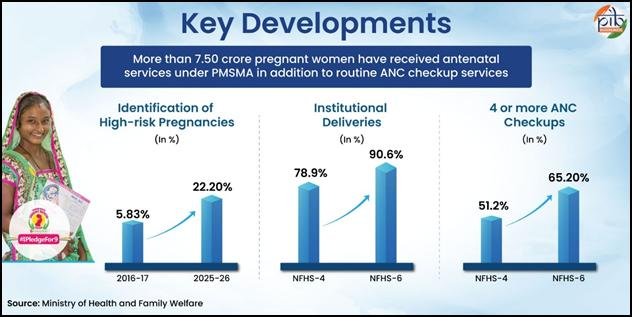
Working Alongside Other Maternal Health Initiatives
- PMSMA does not operate in isolation. It forms part of a larger ecosystem of maternal and child health programmes implemented by the Government.
- The Janani Suraksha Yojana (JSY) promotes institutional deliveries. Since 2014-15, it has benefited more than 11.96 crore women as of March 2025.
- The Janani Shishu Suraksha Karyakram (JSSK) provides free healthcare services to pregnant women and newborns. Since 2014-15, more than 18.05 crore beneficiaries have received support under the scheme.
- The Surakshit Matritva Aashwasan (SUMAN) strengthens quality maternal healthcare through a network of over 99,290 facilities.
- Other initiatives such as Prime Minister’s Overarching Scheme for Holistic Nourishment (POSHAN) Abhiyaan, Pradhan Mantri Matru Vandana Yojana (PMMVY), and Labour Room Quality Improvement Initiative (LaQshya) address maternal nutrition, maternity benefits, and quality of care in labour rooms.
- Together, these programmes create a comprehensive framework for maternal and newborn health.
Source: PIB
Preventive Detentions
Syllabus: GS2/Polity and Governance
Context
- The Allahabad High Court recently raised concerns over the alleged misuse of preventive detention laws.
What is Preventive Detention?
- Preventive detention refers to the detention of a person without trial in order to prevent them from committing an act that may threaten public order, national security, or other vital state interests.
- Unlike punitive detention, which is imposed as punishment after conviction by a court of law, preventive detention is based on the apprehension that a person may engage in activities prejudicial to:
- Security of the State;
- Defence of India;
- Public order;
- Foreign affairs; or
- Maintenance of essential supplies and services.
- The Constitution divides the legislative power to enact preventive detention laws between the Union and the States.
Constitutional Provisions
- Article 22(3) of the Constitution provides for preventive detention laws, Article 22(4) contain the following safeguards against abuse of this power:
- No law providing for preventive detention shall authorise the detention of a person for a longer period than three months. Detention beyond this 3-month period requires clearance from an Advisory Board.
- The 44th Amendment Act of 1978 has reduced the period of detention without obtaining the opinion of an advisory board from three to two months. However, this provision has not yet been brought into force, hence, the original period of three months still continues.
Source: IE
Pradhan Mantri Ujjwala Yojana
Syllabus: GS2/Governance
Context
- The Union Ministry of Petroleum & Natural Gas has indicated that subsidised LPG cylinders for households under the Pradhan Mantri Ujjwala Yojana (PMUY) have been reduced from nine to four.
About
- As per the latest information, the subsidy for Ujjwala customers is limited to ₹300 per cylinder for the first four units each year, reflecting average annual consumption of four to five cylinders.
- Domestic cooking gas LPG prices were raised by ₹29 per cylinder marking the second increase in three months as state-owned fuel retailers continue to grapple with elevated global energy costs.
- The PMUY beneficiary pays an effective ₹642 for a 14.2 kg cylinder, and the general consumer in Delhi pays ₹942, against a cost of supply that has now risen to over ₹1,600.
About Pradhan Mantri Ujjwala Yojana
- In 2016, Government of India launched Pradhan Mantri Ujjwala Yojana (PMUY).
- The objective of the scheme is to replace harmful cooking fuels such as coal and firewood with clean LPG to protect women & children’s health by reducing indoor smoke pollution.
- Eligibility: Initially, LPG connections were provided to women belonging to Below Poverty Line (BPL) households identified through the Socio-Economic and Caste Census (SECC) 2011.
- Under PMUY 2.0 (launched in 2021) eligible beneficiaries include: Migrant families, scheduled Castes (SCs) and Scheduled Tribes (STs), most Backward Classes (MBCs), beneficiaries of the Pradhan Mantri Awas Yojana, forest dwellers, other poor households not covered earlier.
- The scheme provides a completely free LPG connection, including the first refill and a stove.
- PMUY initially aimed to provide 8 crore free LPG connections to poor households, achieving this target in September 2019.
- To reach more families, PMUY 2.0 was launched in 2021, distributing an additional 1.6 crore connections by 2022.
- Achievements: More than 10 crore LPG connections have been released under the scheme.
- LPG coverage in India has increased significantly, approaching universal household coverage.
- Contributed to improved health outcomes and reduced dependence on biomass fuels.
Source: LM
Gallantry Awards
Syllabus: GS3/Defence
Context
- President conferred Gallantry Awards to the personnel of the Armed Forces, Central Armed Police Forces, and State and Union Territory Police during the Defence Investiture Ceremony at Rashtrapati Bhawan.
About
- The President conferred seven Kirti Chakras, 15 Vir Chakras and 29 Shaurya Chakras.
- One of the four Gaganyatris chosen for India’s Human Space Flight Mission Gaganyaan, Group Captain Prasanth Balakrishnan Nair was awarded Kirti Chakra for his indomitable spirit and bravery.
About Gallantry Awards
- Gallantry Awards are given by the Government of India to honour acts of bravery, sacrifice, and exceptional courage by members of the armed forces, paramilitary forces, and civilians.
- They are classified as wartime (gallantry in the face of enemy) and peacetime awards.
- Administered by: Ministry of Defence (for armed forces) and Ministry of Home Affairs (for police and civilians).
- Awarded by: President of India.
- These gallantry awards are announced twice in a year – first on the occasion of the Republic Day and then on the occasion of the Independence Day.
- Wartime Gallantry Awards: Param Vir Chakra (PVC), Mahavir Chakra (MVC) and Vir Chakra.
- These were instituted on 26 January 1950, and were deemed to have effect from 15 August 1947, the date of India’s independence.
- Peacetime Gallantry Awards: Ashok Chakra, Kirti Chakra, Shaurya Chakra.
- The Government instituted three more gallantry awards on 4 January 1952, also with retrospective effect from 15 August 1947.
- Originally, they were named as: Ashoka Chakra Class-I, Ashoka Chakra Class-II and Ashoka Chakra Class-III.

- Order of Precedence: Param Vir Chakra (PVC), Ashoka Chakra (AC), Maha Vir Chakra (MVC), Kirti Chakra (KC), Vir Chakra (VrC), Shaurya Chakra (SC).
- All six awards can be conferred posthumously.
Source: AIR
Tejas
Syllabus: GS3/Defence
Context
- The Defence Minister reviewed the progress of major ongoing projects of Hindustan Aeronautics Limited (HAL) where delays in the delivery of Light Combat Aircraft (LCA) Tejas Mk1A was also discussed.
About
- The Ministry of Defence had signed a contract to buy 97 light combat aircraft, of the Tejas Mark-1A variant, for the Indian Air Force from Hindustan Aeronautics Limited.
- This procurement aims to replace the aging MiG-21 fleet soon to be phased out.
- With just 29 fighter squadrons against a sanctioned strength of 42.5, the Tejas Mk1A induction has become an operational necessity for the IAF.
Tejas Mk-1A
- Developed by Hindustan Aeronautics Limited (HAL), Tejas is the world’s lightest fighter aircraft in its class.
- It is a 4.5 generation, all weather and multi-role fighter aircraft.
- The aircraft is designed to be a multi-role aircraft capable of taking up offensive air support, close combat and ground attack roles at ease.
- LCA Mk1A is the most advanced version of the LCA Tejas.
- It is equipped with AESA Radar, EW suite consisting of radar warning and self-protection jamming, Digital Map Generator (DMG), Smart Multi-function Displays (SMFD), Combined Interrogator and Transponder (CIT), Advanced Radio Altimeter and other advances features.
Source: TH
Herbicide-Tolerant Mustard Hybrids
Syllabus: GS3/ Agriculture
Context
- India is set to begin large-scale cultivation of imidazolinone-resistant (IMI-resistant) mustard hybrids during the 2026–27 rabi season.
About
- The hybrids are designed to control Orobanche (Phelipanche), a parasitic weed that attaches itself to the roots of mustard plants.
- It draws water and nutrients from the host plant, reducing growth and productivity.
- Since much of the parasite remains underground, manual removal is difficult and often ineffective.
What are IMI-Resistant Mustard Hybrids?
- These are mustard hybrids resistant to imidazolinone (IMI) herbicides.
- They have been developed through mutation breeding, not through genetic modification (GM).
- Mutation breeding involves selecting and preserving naturally occurring genetic mutations that confer desirable traits.
How does it work?
- The technology is based on the enzyme Acetolactate Synthase (ALS), which is essential for plant growth.
- IMI herbicides normally inhibit ALS, causing susceptible plants and weeds to die.
- In the new hybrids, a mutation in the ALS gene makes the enzyme resistant to the herbicide.
- Farmers can spray IMI herbicides across the field, killing weeds while the mustard crop survives.
Source: TH
Previous article
Amplifying’ Random Numbers Brings a Breakthrough in Digital Security
Next article
Report on Datasets for State Finance Commissions
