

Syllabus: GS32/Judiciary; E-Governance
Context
- The Supreme Court AI committee has proposed draft regulations that bar AI-assisted sentencing without mandatory human oversight.
- The proposed regulations come amid concerns expressed by the top court over the growing reliance on AI by courts in rendering judgments.
Major Highlights of the Regulations
- It permits the use of AI for administrative functions such as case management, preparation of cause lists, scheduling of hearings, transcription of court proceedings and translation of judgments.
- AI systems cannot be used for “risk scoring” in court processes, this includes assessing flight risk, predicting recidivism, evaluating bail eligibility, or determining the credibility of parties or witnesses.
- The processing of personal data through AI systems shall be governed by the provisions of the Digital Personal Data Protection Act, 2023.
- AI systems must not perpetuate bias on grounds of race, religion, caste, sex, gender, disability, language, economic status, or any other ground prohibited under the Constitution.
- AI-assisted judicial systems should not “widen digital divides” and must remain accessible to all stakeholders.
- To supervise the adoption of AI in the judiciary, it proposes the creation of a full-time “apex body” at the Supreme Court.
Use of AI in India’s Justice System
- In the Supreme Court, High Courts, National Informatics Centre (NIC) AI tools are now assisting various functions such as:
- Transcription of oral arguments,
- Translation of judgments,
- Identification of defects in e-filing,
- Legal research, and
- Metadata extraction.
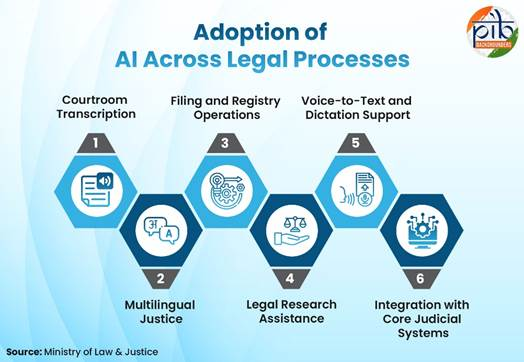
- Over the past decade, courts have moved from basic computerisation to nationwide digital platforms, real-time data systems, virtual courts and multilingual judgment access.
- Latest technologies like AI and its subsets Machine Learning (ML), Optical Character Recognition (OCR), Natural Language Processing (NLP) are being used in the e-Courts software applications developed under the eCourts Project.
Significance of Use of AI in Judiciary in India
- Backlog of Cases: India’s judicial system faces a backlog cases, undermining public trust in timely justice.
- AI can streamline case management, reduce backlog, and speed up judicial processes.
- Overcrowding in Prisons: Indian prisons have been housing more inmates than their capacity for decades now, AI can streamline the complaint registration process, track investigations, flag necessary actions, and assess investigation quality.
- Translation and Accessibility: India has 22 scheduled languages and hundreds of dialects. AI-powered translation can make judicial documents and judgments accessible across linguistic barriers.
- The SUVAAS (Supreme Court Vidhik Anuvaad Software) project has translated thousands of judgments into regional languages.
- Enhanced Accuracy: AI can prevent neglect of crucial evidence and ensure a more meticulous and reliable criminal justice process.
- Improving Access to Justice: AI chatbots and virtual assistants can help litigants, especially those without legal representation, navigate procedures, track case status, and file petitions.
Concerns/Challanges
- Bias and Dependence: AI-enabled legal research may show search bias, excluding relevant precedents.
- Over-reliance risks reducing adjudication to rule-based outputs, sidelining nuanced human judgment.
- Data Protection and Privacy: Absence of clear frameworks on storage and use of judicial data raises concerns.
- Infrastructure Gaps: Courts face uneven Internet connectivity, outdated hardware, and limited technical expertise.
- Ethical Concerns: The use of AI in sensitive areas like sentencing and parole decisions raises moral and ethical questions about fairness and justice.
- Exclusion of Human Insight: AI may overlook nuanced factors in cases that require human empathy and judgment.
Way Ahead
- A balanced approach must be taken to ensure AI tools respect privacy, civil liberties, and ethical standards, while preventing misuse.
- By leveraging AI, India’s criminal justice system can become more efficient, accessible, and just, while ensuring safeguards are in place to address any challenges.
Source: TH
Previous article
News In Short 04-06-2026
