


Zimbabwe
Syllabus: GS1/Geography
Context
- India and Zimbabwe agreed to enhance bilateral defence ties by expanding existing cooperation.
About
- Zimbabwe is a landlocked country situated in south-central Africa between the Limpopo and Zambezi rivers, covering an area of over 390,000 sq km.
- It is bounded by Zambia to the north and northwest, South Africa to the south, Mozambique to the east and northeast, and Botswana to the southwest.
- Zimbabwe lies entirely north of the Tropic of Capricorn and forms part of the southern African plateau.
- The Victoria Falls, located on the border between Zimbabwe and Zambia, is the world’s largest sheet of falling water.
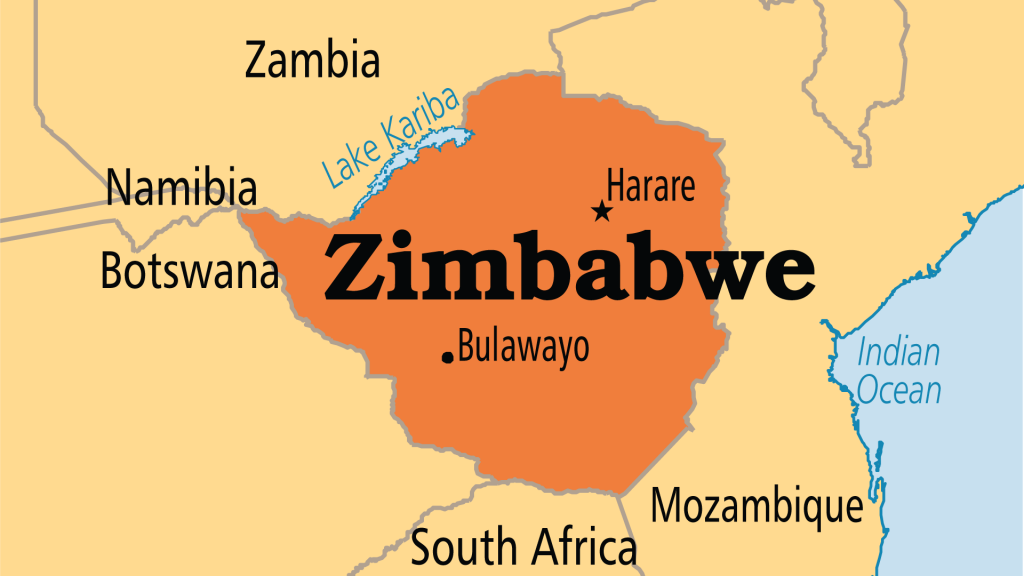
Source: AIR
National Awards for e-Governance (NAeG) 2026
Syllabus: GS2/ Governance
Context
- The Government of India has announced the winners of the National Awards for e-Governance (NAeG) 2026.
- A total of 17 initiatives were selected across seven award categories, comprising 10 Gold Awards, 6 Silver Awards, and 1 Jury Award.
About National Awards for e-Governance (NAeG)
- The awards are presented annually to promote excellence in e-governance and digital public service delivery.
- They recognize innovative use of technology to improve governance, transparency, accountability, and citizen-centric services.
- It is instituted by the Department of Administrative Reforms and Public Grievances (DARPG).
- The awards cover initiatives implemented by Ministries, Departments, States, UTs, Districts, Urban Local Bodies, and Gram Panchayats.
Major Award-Winning Initiatives (Gold and Silver Awardees)
- Agri Stack: Developed by the Ministry of Agriculture and Farmers Welfare.
- Creates a digital ecosystem for farmers through unique farmer identities and land-linked databases.
- It facilitates targeted delivery of subsidies, crop insurance, credit, advisories, and government schemes.
- e-Jagriti: It is a digital platform for filing and tracking consumer complaints, and developed by the Ministry of Consumer Affairs.
- Mahakumbh 2025 Digital Governance Model: Implemented by the Prayagraj Mela Authority.
- It demonstrated large-scale use of technology in managing one of the world’s largest religious gatherings.
- Blood Bag Traceability and Citizen Interaction Portal: It is developed by Kerala Development and Innovation Strategic Council (K-DISC) and enables end-to-end tracking of blood units from donation to transfusion.
- AI-enabled Clinical Decision Support system in eSanjeevani telemedicine service: It is developed by the Ministry of Health and Family Welfare.
Jury Award
- Project: Real-Time Precise Positioning Services through CORS Network.
- It provides highly accurate geospatial positioning services using a network of Continuously Operating Reference Stations (CORS).
Source: PIB
India- Nepal Border Disputes
Syllabus: GS2/IR
Context
- Nepal Prime Minister has said that Nepal too has encroached upon some Indian territories, in what is considered to be the first such public statement by a Nepali head of government.
India- Nepal Border Disputes
- India and Nepal share a border of about 1,751 km, but disputes persist in certain sectors.
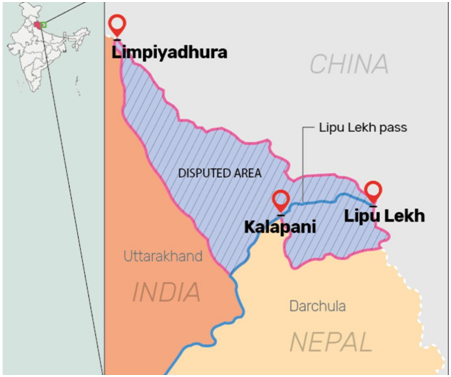
- Kalapani–Lipulekh–Limpiyadhura Dispute: Nepal has asserted its claim based on the Sugauli Treaty of 1816, signed between the East India Company and Guru Gajraj Mishra.
- Under the Treaty, the Kali River was marked as Nepal’s western boundary with India.
- Nepal claims the river originates at Limpiyadhura, which would place the Lipulekh and Kalapani regions within its territory. Conversely, India maintains that the river begins at a lower point near Kalapani, keeping the Lipulekh Pass, a strategic tri-junction between India, Nepal, and China, within its state of Uttarakhand.
- The Kali River has changed direction over the years, causing confusion in defining the border.
- Susta Border dispute: Susta is a disputed territory between Nepal and India. It is administered by India as part of West Champaran district of Bihar.
- Nepal claims the area a part of West Nawalparasi District under Susta rural municipality, alleging that over 14,860 hectares of Nepali land in Susta has been encroached upon by India.
Causes of Border Disputes
- Different interpretations of the Treaty of Sugauli (1816).
- Shifting river courses, especially in the Terai region.
- Incomplete boundary demarcation in a few segments.
- Strategic significance of Himalayan passes such as Lipulekh.
Existing Mechanisms for Resolution
- Joint Technical Level Boundary Committee.
- Joint Boundary Working Group (BWG).
- Regular diplomatic dialogues through the India–Nepal Joint Commission.
Source: TH
PAC Flags Gaps in PMKVY
Syllabus: GS2/ Governance
In News
- The Public Accounts Committee (PAC) of Parliament recently raised serious concerns about the implementation of the Pradhan Mantri Kaushal Vikas Yojana (PMKVY) as the scheme appears to have been training people for industries that aren’t necessarily hiring.
About Pradhan Mantri Kaushal Vikas Yojana (PMKVY)
- It was launched in 2015 under the Ministry of Skill Development and Entrepreneurship.
- PMKVY was conceived as a national mission to equip India’s large and young workforce with industry-aligned skills.
- The scheme operates through the National Skill Development Corporation (NSDC) and aims to bridge the gap between what Indian youth are capable of and what the job market actually demands.
Public Accounts Committee (PAC)
- It is the oldest parliamentary committee in India, established in 1921 under the Government of India Act, 1919.
- The committee is reconstituted annually. The Chairperson of the PAC is appointed by the Speaker of the Lok Sabha from among its members.
- Since 1967-68, by convention, the Chairperson is usually chosen from the Opposition party.
- The PAC examines government revenue and expenditure to ensure that public funds are utilized efficiently, economically & for the purpose approved by Parliament
- It scrutinizes the Comptroller and Auditor General (CAG) reports on government expenditure.
- Ensures that funds sanctioned by Parliament are spent in accordance with legislative approval.
- The committee consists of 22 members 15 members from Lok Sabha 8 & 7 members from Rajya Sabha.
Source: TH
India–Venezuela Ties Gain Strategic Momentum
Syllabus: GS2/ IR
Context
- Acting President of Venezuela, Delcy Rodríguez, visited India and held talks with PM Modi.
Key Outcomes of the Visit
- Towards a Long-Term Energy Partnership: Both sides discussed moving from spot purchases to long-term crude oil supply contracts. India and Venezuela explored cooperation across the entire energy value chain, including:
- Upstream activities such as oil exploration and production.
- Downstream activities such as refining and petrochemicals.
- Cooperation in Critical Minerals: Discussions covered critical minerals, gold, and diamond mining.
- Cooperation in Other Sectors: Agriculture and farm mechanization, Animal husbandry, Transportation and logistics, Automotive manufacturing, Science and technology.
Significance of Venezuela for India
- Energy Security: Venezuela possesses the world’s largest proven crude oil reserves.
- India is the world’s third-largest consumer of crude oil and imports more than 85% of its oil requirements.
- Indian refineries are well-equipped to process Venezuela’s heavy crude oil.
- Stronger ties can deepen India’s engagement with the Latin American region and reduce overdependence on traditional energy suppliers.
- Securing Critical Minerals for Future Industries: Venezuela possesses significant reserves of critical minerals, including rare earth elements, nickel, and other strategic resources.
- India’s Latin America Outreach: Venezuela serves as an important gateway for expanding India’s economic and diplomatic engagement in Latin America.
About Venezuela
- Location: Venezuela is located on the northern coast of South America.
- It is bordered by Colombia to the west, Brazil to the south, Guyana to the east, and the Caribbean Sea lies to the north.
- Capital: Caracas.
- Major Physiographic Regions:
- Northwestern Venezuela is traversed by the northeastern extension of the Andes.
- The Lake Maracaibo Basin is a major geological and geographical region in northwestern Venezuela.
- Llanos the vast, tropical savanna plains occupying over 250,000 square kilometers of central Venezuela.
Source: IE
Prime Minister Research Chair (PMRC) Scheme, 2026
Syllabus: GS2/Governance
Context
- The Department of Higher Education has invited applications for the Prime Minister Research Chair (PMRC) Scheme 2026.
About
- It is a flagship national initiative by the Department of Higher Education, Ministry of Education.
- Aim: To bring Indian-origin researchers working abroad to leading Indian institutions for high-impact research in priority sectors.
- The initiative is structured around three pillars: Lead Institutions, Host Institutions and PMRC Fellows.
- Applicants can apply under the following categories:
- Young Research Fellows (YRF): Less than five years of post-PhD experience.
- Senior Fellows (SF): Five years to less than 10 years of post-PhD experience.
- Research Chairs (RC): Ten years or more of post-PhD experience with proven research leadership.
- An Empowered Committee chaired by the Principal Scientific Advisor to the Government of India will oversee the selection of participating institutions and fellows.
- Eligible applicants include Indian nationals working abroad, Overseas Citizen of India (OCI) cardholders and Persons of Indian Origin with significant achievements in research, innovation and technology.
- Eligible host institutions include government higher educational institutions ranked among the top 100 in the National Institutional Ranking Framework (NIRF) Overall or Engineering categories, or among the top 50 in the NIRF Research category.
- National laboratories and research institutions under agencies such as the Department of Science and Technology (DST), Department of Biotechnology (DBT), Indian Council of Medical Research (ICMR) and Council of Scientific and Industrial Research (CSIR).
- PMRC Fellows will receive fellowship and research grant support, access to laboratories and research infrastructure, and opportunities to work with leading government institutions in the country.
Source: AIR
Neelkanth Mishra Appointed as World Bank Executive Director
Syllabus: GS2/IR
Context
- The Appointments Committee of the Cabinet has approved the appointment of Neelkanth Mishra as Executive Director, World Bank Headquarters, Washington, DC, for a tenure of three years.
About
- He will represent a South Asian constituency comprising India, Bangladesh, Bhutan and Sri Lanka at the World Bank’s board.
- He succeeds Parameswaran Iyer, who has held the position since February 2023.
- The Executive Director is part of the World Bank’s board, which oversees policies, lending decisions and development priorities.
World Bank
- It was founded in 1944.
- The World Bank is like a cooperative, made up of 189 member countries.
- It provides financial and technical assistance to developing countries to reduce poverty and promote economic development.
- These member countries, or shareholders, are represented by a Board of Governors, who are the ultimate policymakers at the World Bank.
- Generally, the governors are member countries’ ministers of finance or ministers of development.
- Main Institutions of the World Bank Group:
- IBRD (International Bank for Reconstruction and Development): It lends to middle-income and creditworthy low-income countries.
- IDA (International Development Association): It provides low-interest loans and grants to the poorest countries.
- IFC (International Finance Corporation): It supports private-sector development.
- MIGA (Multilateral Investment Guarantee Agency): It encourages foreign investment by providing guarantees.
- ICSID (International Centre for Settlement of Investment Disputes): It resolves investment disputes.
Source: AIR
Biomimicry
Syllabus: GS3/ Environment
In News
- Biomimicry is shifting business innovation from mere replication to nature-inspired breakthroughs, offering sustainable frameworks across industries.
About
- Biomimicry involves learning from and replicating nature’s billions of years of evolutionary ingenuity to design sustainable, efficient human solutions. Rather than exploiting nature, it positions nature as mentor and model.
- Its applications are transformative like Japan’s Shinkansen bullet train, redesigned after the kingfisher’s streamlined beak, eliminating disruptive tunnel pressure waves while enhancing speed and energy efficiency.
- As India advances its green transition, integrating biomimicry into manufacturing, urban design, and agriculture can drive innovation that is inherently circular, resource-efficient, and ecologically harmonious.
Source: ET
India–UK Critical Minerals Global Supply Chain Observatory (GSCO)
Syllabus: GS3/ S&T
In News
- The India–UK Critical Minerals Global Supply Chain Observatory (GSCO) has been formally launched.
About
- It was announced during the 2025 Prime Ministers’ bilateral summit and finalized via a March 2026 Research Collaboration Agreement.
- The GSCO is a tripartite joint initiative spearheaded by TEXMiN (Technology Innovation in Exploration & Mining Foundation at IIT-ISM Dhanbad), the Indian Institute of Technology (ISM) Dhanbad, and the University of Cambridge.
- The GSCO aims to mitigate supply risks through market intelligence, supporting both strategic decision-making and the goals of the National Critical Mineral Mission (NCMM).
National Critical Mineral Mission (NCMM)
- Background & Launch: The NCMM was approved by the Union Cabinet of India in January 2025, with a total outlay of approximately ₹16,300 crore over a period of 7 years (up to 2030–31).
- It is anchored under the Ministry of Mines.
- Objectives: Ensure a reliable and sustainable domestic supply of critical minerals such as lithium, cobalt, nickel, graphite, rare earth elements (REEs), titanium, and others.
- Reduce India’s import dependence for minerals vital to the energy transition (EVs, solar panels, wind turbines, batteries) and defence/electronics sectors.
Source: TH
Previous article
AI Could use 3% of World’s Power by 2030: UN Report
Next article
Internationalisation of Higher Education in India
