

Syllabus: GS2/ Governance, GS3/ Economy
Context
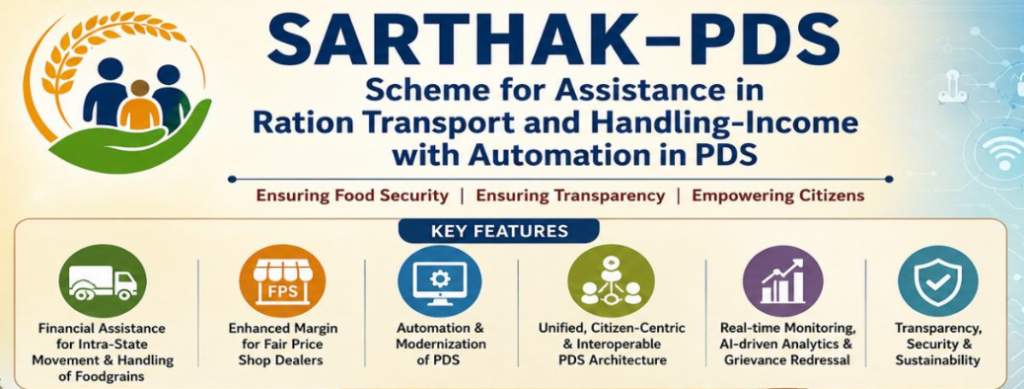
- The Cabinet Committee on Economic Affairs (CCEA), approved the continuation and integration of two key food distribution schemes under a new umbrella programme titled “Scheme for Assistance in Ration Transport and Handling-Income with Automation in PDS” (SARTHAK-PDS).
About
- The SARTHAK-PDS scheme integrates two existing initiatives;
- Assistance to State Agencies for intra-State movement of foodgrains and FPS dealers’ margin under NFSA and
- Scheme for Modernization and Reforms through Technology in Public Distribution System (SMART PDS) with the objective of strengthening implementation of the National Food Security Act.
- The scheme proposes the use of advanced technologies such as Artificial Intelligence (AI), Machine Learning (ML), Natural Language Processing (NLP) and Blockchain to modernise and optimise PDS operations.
What is a PDS System?
- The Public Distribution System (PDS) is a food security mechanism in India through which essential food commodities are distributed to eligible beneficiaries at subsidised prices through Fair Price Shops (FPSs).
- The system primarily distributes rice, wheat and coarse grains to economically weaker sections of society.
- The PDS is a joint responsibility of the central and state governments.
- The central government, through the Food Corporation of India (FCI), procures, stores, transports, and allocates food grains to the states.
- State governments manage the system at the ground level, including allocating food within the state, identifying eligible families, and issuing ration cards.
Evolution of the Public Distribution System (PDS) in India
- PDS in the 1960s: The modern PDS emerged during the food shortages of the 1960s and after the Green Revolution, the system expanded to tribal, remote and poverty-prone regions during the 1970s and 1980s.
- The Revamped Public Distribution System (RPDS) was launched in 1992 to strengthen food distribution in remote, hilly and tribal areas.
- The Targeted Public Distribution System (TPDS) was launched in 1997 to direct food subsidies specifically towards Below Poverty Line (BPL) families.
- The Antyodaya Anna Yojana (AAY) was launched in 2000 to provide highly subsidised food grains to the “poorest of the poor” households.
Constitutional and Global Commitments
- Right to Food Under Article 21: The Supreme Court has interpreted the Right to Food as an essential component of Article 21, which guarantees the Right to Life.
- Sustainable Development Goals:
- SDG 2 (Zero Hunger) aims to end hunger, achieve food security, improve nutrition, and promote sustainable agriculture globally by 2030.
- SDG 3 (Good Health and Well-being) aims to ensure healthy lives and promote well-being for all at all ages.
Challenges with the PDS System
- Diversion of Food Grains: A significant portion of food grains is leaked during transportation or diverted to the black market.
- Exclusion due to Biometric Verification: Many people lose access to their monthly rations as their names are struck off the PDS rolls after biometric verification, requiring them to apply for new ration cards.
- Inclusion and Exclusion Errors: Non-eligible households receive benefits, burdening the system.
- Genuine beneficiaries are excluded due to flaws in the identification process.
- Corruption at Fair Price Shops (FPS), such as under-weighing food grains, selling poor-quality goods, or charging higher prices, undermines the system’s effectiveness.
- Inadequate warehousing facilities lead to spoilage and wastage of food grains.
- Nutritional Limitations: The PDS largely focuses on cereals and does not adequately address nutritional diversity through pulses, millets and protein-rich foods.
Reforms and Modernization Efforts
- National Food Security Act, 2013: Enacted to provide legal entitlement to subsidized food grains to two-thirds of India’s population.
- Ensures the coverage of 75% of rural and 50% of urban population.
- The Targeted Public Distribution System (Control) Order of 2015 was issued by the Ministry of Consumer Affairs, Food and Public Distribution.
- It established responsibilities for the Centre and States, and set up a grievance redressal mechanism.
- Digital Ration Cards: The introduction of digital ration cards and Aadhaar-based biometric authentication aims to eliminate fake and duplicate ration cards.
- Direct Benefit Transfer (DBT): In some regions, DBT has been implemented, where money is transferred directly to the bank accounts of beneficiaries instead of providing food grains.
- Citizen-centric applications such as Mera Ration, Anna Mitra, Rightful Targeting Dashboard and Anna Sahayata have also been introduced to improve access and transparency.
Way Ahead
- Infrastructure Expansion: Strengthen storage and transportation facilities to support the growing scale of operations.
- Technological Integration: Leverage artificial intelligence and blockchain for real-time tracking and reducing inefficiencies.
- Implement social audits and public grievance redressal mechanisms to hold PDS stakeholders accountable and address issues like corruption and leakages.
- Expanding Nutritional Basket: The government should include pulses and fortified food items in the Public Distribution System to improve nutritional security.
Source: DD News
Previous article
News In Short 27-05-2026
Next article
IBC Transforming India’s Debt Recovery Ecosystem
