


El Niño
Syllabus: GS1/ Geography
Context
- The possible emergence of El Niño conditions, along with global oil price shocks, has intensified concerns over rising inflation in India.
What is El Nino?
- El Niño is the warming of seawater in the central-east Equatorial Pacific that occurs every few years.
- During El Niño, surface temperatures in the equatorial Pacific rise, and trade winds, east-west winds that blow near the Equator, weaken.
- Impact: In El Niño years, India faces warmer temperatures and less rainfall, causing droughts in some regions.
- This affects agriculture, water resources, and ecosystems.
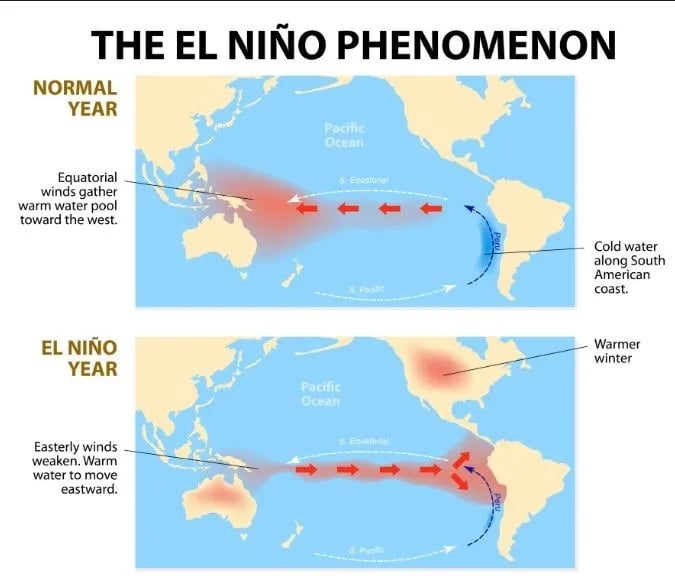
Impact of El Niño on Indian Economy
- Reduced rainfall due to El Niño adversely affects kharif crops like rice, pulses, and oilseeds, leading to lower agricultural output and supply shortages.
- Decline in food supply caused by El Niño conditions results in higher food prices, which in turn pushes up overall inflation due to the high weight of food in India’s inflation basket.
- Poor agricultural output under El Niño reduces farmers’ incomes, thereby weakening rural demand and adversely impacting overall economic growth.
Source: IE
Indonesia
Syllabus: GS1/Geography
Context
- A magnitude 7.4 earthquake struck the Northern Molucca Sea off Indonesia’s Ternate island.
About Indonesia
- Basic Geography:
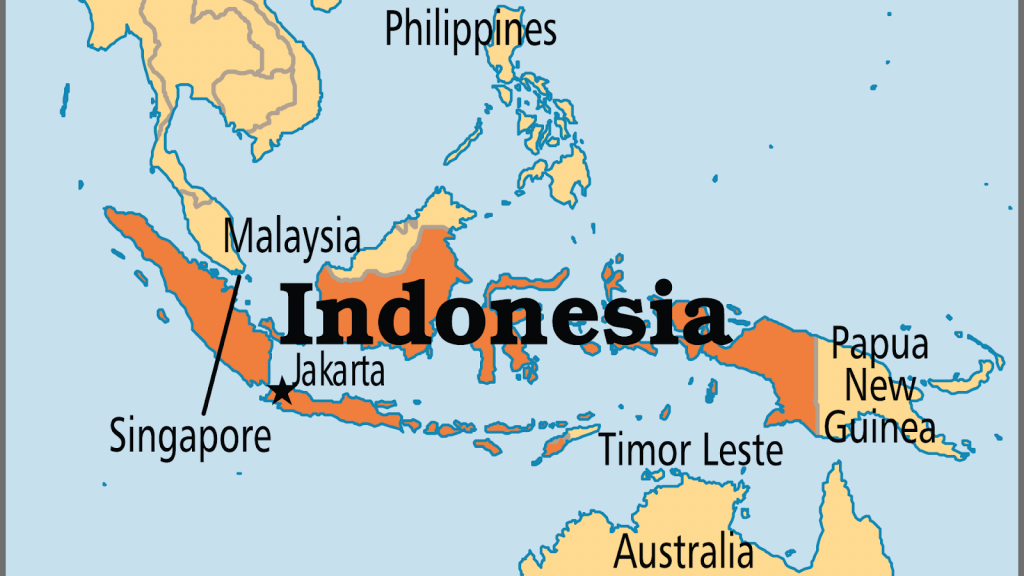
- World’s largest archipelagic state, located between the Indian and Pacific Oceans, off mainland Southeast Asia.
- Major islands: Sumatra, Java, Kalimantan (Borneo), Sulawesi, Papua.
- It shares land borders with East Timor (Timor-Leste), Papua New Guinea, and Malaysia.
- Capital: Jakarta (on the island of Java); new capital being developed — Nusantara in Kalimantan
- Largest Muslim-majority nation by population in the world.
- Tectonic Setting:
- Located on the Pacific Ring of Fire, the seismically active belt where ~90% of the world’s earthquakes occur.
- It hosts one of the world’s highest densities of active volcanoes, stretching from Sumatra through Java to the Lesser Sunda Islands.
- The Molucca Sea — where the recent earthquake originated — is a highly active tectonic zone in Indonesia’s northern region.
- Global and Regional Role:
- Founding member of the Non-Aligned Movement (NAM) along with India.
- Founding member of ASEAN (1967) — ASEAN Secretariat is headquartered in Jakarta.
- Indonesia became a full member of BRICS at the 16th Summit held under Russia’s chairship in Kazan.
- Member of G20 and hosted the G20 Summit in Bali in 2022.
- Member of IONS (Indian Ocean Naval Symposium) — a maritime cooperation platform conceptualised by India in 2008.
Source: TH
NCERT Granted Deemed University Tag
Syllabus: GS2/ Government Initiatives
In News
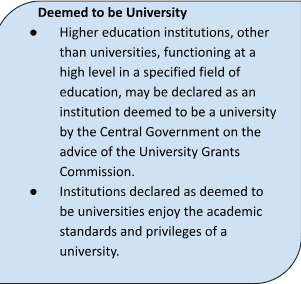
- The Ministry of Education has declared the National Council of Educational Research and Training (NCERT) an Institution Deemed to be a University.
About the Decision
- The deemed university status has been granted not only to NCERT headquarters, but also to its six Regional Institutes of Education (RIEs), subject to certain conditions.
Impact of the Decision
- NCERT can now start courses and academic programmes and also award degrees.
- It has also been asked to begin research programmes, doctoral programmes, and innovative academic programmes.
- NCERT should also gradually expand into other academic domains in line with UGC norms and regulations, and the National Education Policy (NEP) 2020.
- NCERT has been clearly prohibited from engaging in commercial or profit-making activities.
- NCERT can start new academic programmes, off-campus centres, or offshore campuses only in accordance with the guidelines issued by the UGC from time to time.
- NCERT has been directed to take steps for accreditation of its academic programmes by the National Board of Accreditation (NBA), and institutional accreditation by the National Assessment and Accreditation Council (NAAC).
- The government has also directed NCERT to participate in the National Institutional Ranking Framework (NIRF).
- It must also compulsorily create Academic Bank of Credits (ABC) IDs for students, and upload their credit records to digital lockers so that they can be reflected on the ABC portal.
Source: TH
Yuva Sangam
Syllabus: GS2/Government Initiatives
Context
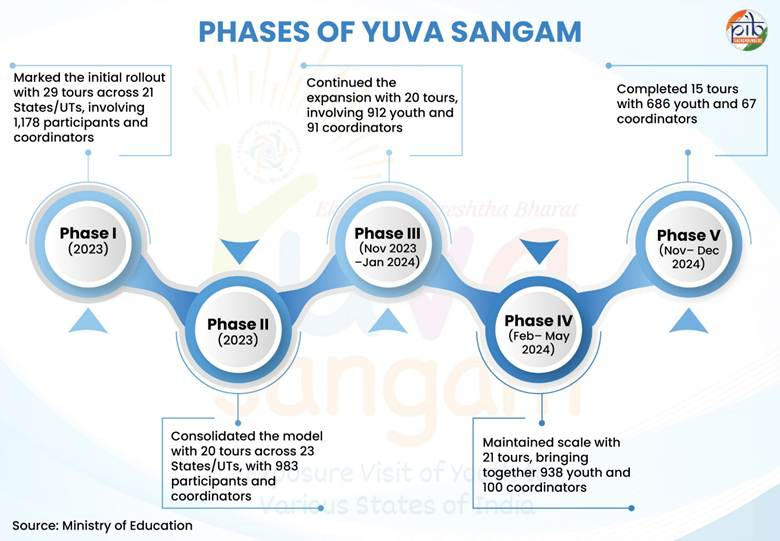
- Registrations for institution-led exposure tours under Yuva Sangam Phase-VI were held, covering 22 States and Union Territories.
About the Yuva Sangam
- It is an initiative by the Government of India to strengthen people-to-people connect between youth belonging to different States/UTs of India.
- It was conceptualised by the Ministry of Education in collaboration with various other ministries and departments, and was launched under the banner of Ek Bharat Shreshtha Bharat (EBSB).
- Ek Bharat Shreshtha Bharat (EBSB) launched on 31st October 2015 to strengthen national unity by deepening connections between States and Union Territories.
- It was conceptualised by the Ministry of Education in collaboration with various other ministries and departments, and was launched under the banner of Ek Bharat Shreshtha Bharat (EBSB).
- It has been organised collaboratively on the model of Kashi Tamil Sangamam (KTS).
The programme is guided by the Five P’s framework:
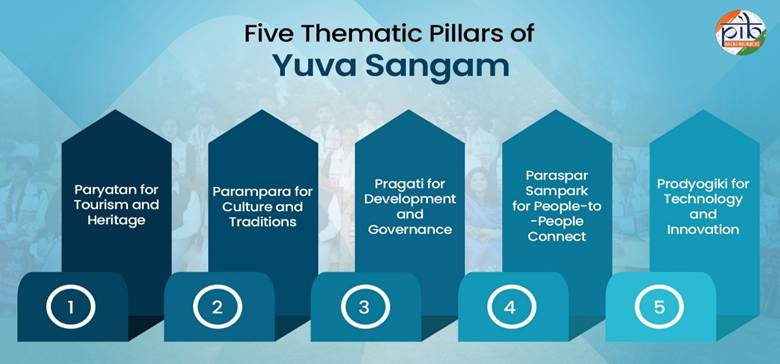
- Programme Journey:
Source: PIB
Cabinet Committee on Security (CCS)
Syllabus: GS2/ Governance
Context
- PM Modi chaired a special meeting of the Cabinet Committee on Security to review the situation and mitigating measures in the context of the ongoing West Asia Conflict.
About Cabinet Committee on Security (CCS)
- It is the apex decision-making body in India responsible for matters related to national security and defence expenditure, and strategic affairs.
- It handles crisis situations, defence issues, and high-stakes strategic decisions.
- It is chaired by the Prime Minister and includes the Ministers of Defence, Home Affairs, Finance, and External Affairs, with the National Security Advisor acting as a coordinator.
- It is an extra-constitutional body created under the Transaction of Business Rules, 1961 of the Government of India.
Source: AIR
Purchasing Manager’s Index (PMI)
Syllabus: GS3/ Economy
Context
- The West Asia crisis has led to India’s Manufacturing PMI falling from 56.9 in February 2026 compared to 53.9 in March 2026.
About Purchasing Managers’ Index (PMI)
- PMI is a survey-based economic indicator that captures changes in business conditions compared to the previous month.
- It provides insights into both current and near-term economic trends.
- It is prepared separately for manufacturing, services, and also as a composite index.
- PMI is measured on a scale of 0 to 100. A reading above 50 indicates expansion, below 50 indicates contraction, and 50 indicates no change.
- PMI is compiled globally for many economies by IHS Markit, which is now part of S&P Global.
Source: TH
Ad Valorem Duty
Syllabus: GS3/ Economy
In Context
- The United States has announced a 100% ad valorem duty on imports of patented pharmaceuticals and associated active pharmaceutical ingredients (APIs).
India’s Stake
- The US is India’s single largest pharmaceutical export destination, absorbing nearly 40% of India’s total pharma exports.
- India dominates the American generics market supplying approximately 47% of all generic medicines consumed in the US.
What is Ad Valorem Duty?
- Ad valorem duty is a customs tariff calculated as a fixed percentage of the declared value of imported goods — as opposed to specific tariffs, which are levied on the basis of weight, volume, or quantity regardless of price.
- As the value of the imported product rises, the absolute duty burden rises proportionally.
- A 100% ad valorem duty effectively doubles the landed cost of the imported product for the buyer, making domestically produced alternatives significantly more competitive on price.
Source: IE
Coal Gasification Incentive Scheme
Syllabus: GS3/ Economy
In Context
- The Union Minister has unveiled India’s roadmap to address this through domestic coal utilisation, with the Coal Gasification Incentive Scheme as a central instrument.
About Coal Gasification
- Coal gasification is the process of converting coal into syngas (synthesis gas) — a mixture primarily of hydrogen (H₂) and carbon monoxide (CO) — through a reaction with steam and oxygen at high temperatures. Syngas serves as a feedstock for producing:
- Ammonia → used in fertiliser manufacturing
- Methanol → used as fuel and chemical feedstock
- Hydrogen → clean energy carrier
- Synthetic natural gas → substitute for imported LNG.
Source: ET
Aditya-L1 Mission
Syllabus: GS3/ S&T, Space
In News
- ISRO invites proposals from the Indian solar physics community to analyse data from the Aditya-L1 mission.
Aditya-L1 Mission
- Launched in 2023, Aditya-L1 is India’s first dedicated space-based solar mission. It has been designed to study the Sun and its outer atmosphere.
- The mission’s lifespan is 5 years.
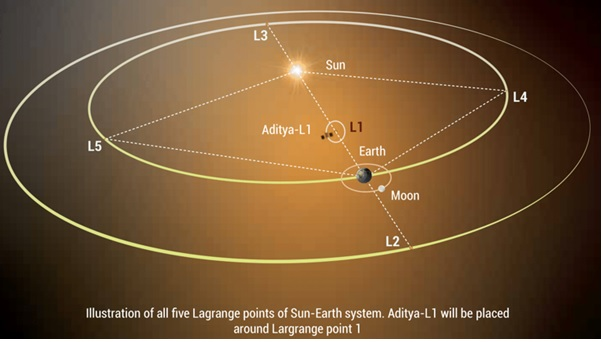
- The spacecraft is positioned at the Sun-Earth Lagrange Point 1 (L1), which allows it to continuously observe the Sun without frequent interruptions such as eclipses or occultation.
- The L1 (Lagrange Point 1) lies between the Earth and the Sun, where the gravitational pull of the two bodies balances the orbital motion of the spacecraft.
- This makes it an ideal location for continuous solar observation.
- Key Instruments:
- Visible Emission Line Coronagraph (VELC): VELC is designed to observe the solar corona, which is the outermost layer of the Sun’s atmosphere. It helps in studying coronal heating, coronal mass ejections (CMEs), and other dynamic solar events.
- Solar Ultra-violet Imaging Telescope (SUIT): SUIT is used to observe the Sun in the ultraviolet wavelength. It helps in studying the solar photosphere and chromosphere, and in understanding solar radiation and variability.
Source: TH
INS Taragiri
Syllabus: GS3/ Defence
Context
- INS Taragiri, a Nilgiri-class stealth guided missile frigate, has been commissioned into the Indian Navy.
About
- INS Taragiri is the 4th of the 7 Project 17A multi-mission stealth guided missile frigates.
- It was built by Mazagon Dock Shipbuilders Limited (MDL).
- It is named after the Taragiri hill ranges of Uttarakhand.
- About 75% of the ship is indigenously built.
Key Features
- It is designed for multi-role operations across air, surface and sub-surface warfare.
- It can act as a screen for Carrier Battle Groups and can also undertake independent or small-group missions.
- It is equipped with MF-STAR radar, MRSAM, Barak air defence missiles, and BrahMos missiles.
- For anti-submarine warfare, it carries HUMSA sonar, triple torpedo launchers, and Extended Range Anti-Submarine Rockets (ERASR).
- It uses a Combined Diesel or Gas (CODOG) propulsion system.
- It can achieve speeds of around 30 knots.
- It can carry at least one helicopter, including Kamov or MH-60R.
Source: PIB
INS Aridhaman
Syllabus: GS3/ Defence
In News
- INS Aridaman, part of India’s Arihant-class ballistic missile submarine (SSBN) fleet, has been commissioned as a more advanced platform than its predecessors — INS Arihant (commissioned 2016) and INS Arighaat (commissioned 2024).
Key Features
- It is larger than INS Arihant and INS Arighaat, with a displacement of about 7,000 tonnes.
- It can carry up to 24 K-15 Sagarika missiles, or 8 K-4 / K-5 missiles.
- The K-4 missile has a range of about 3,500 km.
- These are nuclear-capable submarine-launched ballistic missiles (SLBMs).
India’s Nuclear Submarine Programme
- India’s nuclear submarine effort is rooted in the Advanced Technology Vessel (ATV) Programme initiated over three decades ago as one of India’s most classified strategic defence projects.
- It was developed through collaboration between DRDO, the Department of Atomic Energy (DAE), the Navy, and private defence firms, with technical assistance from Russia in the early phases.
- The programme’s primary output is the SSBN (Ship Submersible Ballistic Nuclear), a nuclear-propelled submarine capable of carrying Submarine-Launched Ballistic Missiles (SLBMs) armed with single or multiple nuclear warheads.
Source: TH
Previous article
Nuclear Fusion Cost Models Too Optimistic to be Viable: Experts Warn
Next article
Challenges to Trade Multilateralism amid WTO Crisis
