


Syllabus: GS3/ Internal Security
Context
- The Ministry of Home Affairs has revised the classification of districts affected by Left-Wing Extremism (LWE), replacing the earlier category of “most affected districts” with a new three-tier categorization.
New Classification of LWE-Affected Districts
- LWE Affected Districts: Bijapur in Chhattisgarh and West Singhbhum in Jharkhand.
- Districts of Concern: Kanker district in Chhattisgarh
- Legacy & Thrust (L&T) Districts: These 35 districts are either no longer significantly affected but require continued support to prevent relapse (Legacy) or are vulnerable to potential Naxal expansion (Thrust).
What is the Naxalite Movement?
- Left Wing Extremism (LWE), often referred to as Naxalism, is one of India’s most serious internal security challenges.
- Origin: The Naxalite movement began in 1967 in Naxalbari, West Bengal, as a radical leftist uprising championing the rights of tribal and landless communities.
- It was led by Charu Majumdar, Kanu Sanyal and Jagan Santhal.
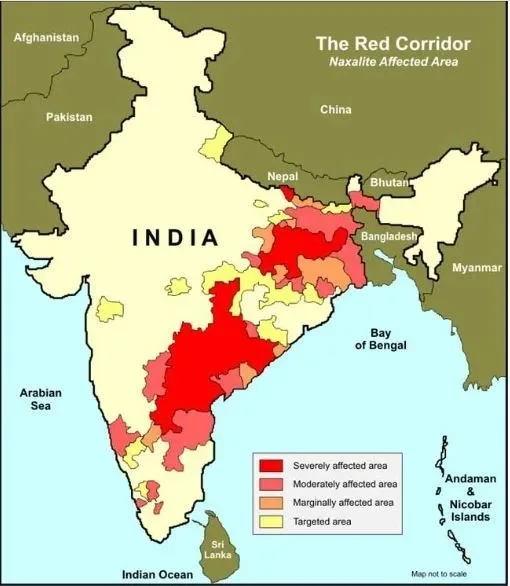
- Geographic Spread: The insurgency spread across the Red Corridor, covering parts of Chhattisgarh, Jharkhand, Odisha, Maharashtra, West Bengal, Andhra Pradesh, Telangana, Madhya Pradesh, and Kerala.
- Approach adopted: Naxalites employ guerrilla warfare, target state institutions, extort local populations, and often recruit children.
- They claim to fight for marginalized communities but resort to violent methods.
Consequences of Naxalism
- Political Consequences: It undermines state authority and weakens democratic institutions in affected areas. It also creates governance vacuums, making administration and law enforcement extremely difficult.
- Economic Consequences: Naxalism disrupts economic activities like mining, agriculture, and infrastructure development.
- The increased government spending on security reduces funds available for development and hampers private investment.
- Social Consequences: It fosters fear, mistrust, and a sense of alienation among marginalized communities.
- The disruption of education and health services, especially in remote areas, leads to significant human development losses.
Government Initiatives
- Security Related Expenditure (SRE) Scheme: This Scheme is being implemented as a sub-scheme of the umbrella scheme ‘Modernization of Police Forces’.
- The Central Government reimburses security related expenditure for LWE affected districts and districts earmarked for monitoring.
- SAMADHAN Strategy: A comprehensive approach involving Smart Leadership, Aggressive Strategy, Motivation and Training, Actionable Intelligence, Dashboard-Based KPIs and KRAs, Harnessing Technology, Action Plans for each Theatre, and No Access to Financing.
- Surrender and Rehabilitation Scheme: The policy has accelerated the collapse of Naxal cadres by offering attractive incentives and assured livelihood.
- High-rank LWE cadres receive ₹5 lakh, middle/lower-rank cadres ₹2.5 lakh, and all surrenderers get a ₹10,000 monthly stipend for professional training lasting 36 months.
- The National Policy and Action Plan to address LWE was approved in 2015. It envisages a multi-pronged strategy involving security related measures, development interventions, ensuring rights and entitlements of local communities etc.
- Educational Empowerment: The Government has launched skill development initiatives in 48 LWE-affected districts by sanctioning 48 Industrial Training Institutes (ITIs) with an investment of ₹495 crore and approving 61 Skill Development Centres (SDCs).
- Operation Black Forest: It was a massive 21-day counter-insurgency operation launched in April 2025, by Indian security forces to dismantle Naxalite-Maoist networks.
- The mission targeted the Karreguttalu Hills (also known as the Black Hills), a strategic stronghold spanning approximately 1,200 sq km along the Chhattisgarh–Telangana border.
Way Ahead
- Development interventions must prioritise last-mile delivery in tribal and remote regions, particularly in infrastructure, healthcare, education, and digital connectivity.
- Community participation and trust-building measures, including effective local governance and grievance redressal, must be enhanced.
- Continuous monitoring of Legacy and Thrust Districts is essential to prevent relapse into violence and ensure long-term stability.
Source: TH
Previous article
India and Azerbaijan Reset Ties After Diplomatic Strain
