
Quantum Computing

Syllabus: GS3/ Science and Technology

Context

  • At the Raisina Dialogue 2026, the need for early collaboration between scientists and diplomats was emphasized to design governance frameworks for emerging technologies such as quantum computing.

What is Quantum Computing?

  • Quantum computing refers to a new class of computers that use the principles of quantum mechanics rather than classical binary logic.
  • Classical computers process information using bits (0 or 1), while quantum computers use qubits, which can exist in multiple states simultaneously.
  • This capability allows quantum computers to perform certain calculations exponentially faster than conventional computers.
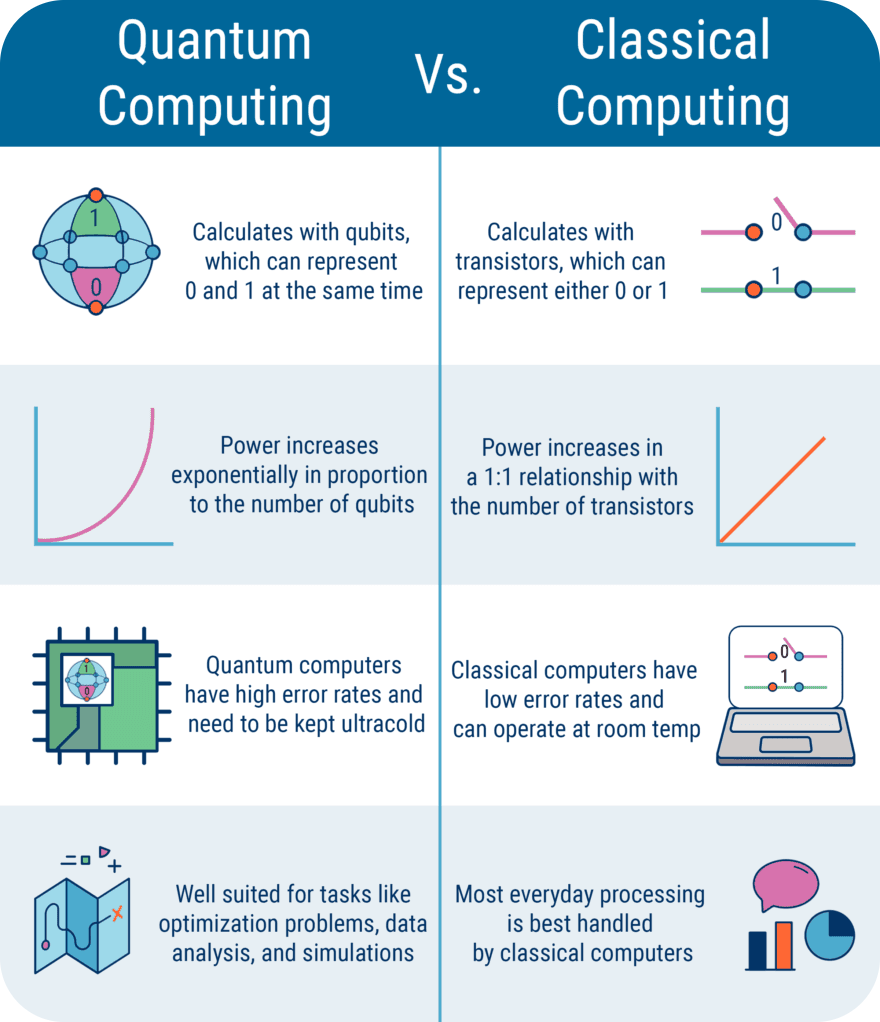
quantum computing

Principles of Quantum Computing

  • Superposition: It allows a qubit to exist in multiple states simultaneously, enabling quantum computers to perform many calculations in parallel.
  • Entanglement: It occurs when two or more qubits become strongly correlated, such that the state of one instantly determines the state of the other.
    • This property allows quantum computers to process and link information efficiently, helping solve complex problems faster.
  • Decoherence: Decoherence refers to the loss of a qubit’s quantum state due to interaction with the environment (such as radiation or heat).
    • Preventing or delaying decoherence is a major challenge in building stable quantum computers.

Applications of Quantum Computing

  • Cryptography & Cybersecurity: Enables ultra-secure communication through Quantum Key Distribution (QKD); for example, quantum communication networks being developed for secure government and military communication.
  • Drug Discovery & Material Science: Can simulate complex molecular interactions; for example, designing new drugs or advanced batteries by modelling chemical reactions that classical computers struggle to process.
  • Optimization Problems: Helps solve complex optimization tasks in logistics and finance; for example, optimizing airline routes, traffic flow in cities, or portfolio management in stock markets.
  • Artificial Intelligence & Big Data Analysis: Enhances processing of massive datasets; for example, improving pattern recognition in climate modelling, fraud detection in banking, or advanced machine learning systems.
applications of quantum computing

Source: TH


Other News of the Day

Syllabus: GS2/Governance Context Karnataka has announced a ban on social media use by children under 16 in its latest Budget, and Andhra Pradesh is moving to introduce a measure that would prohibit those under 13 to use such service. About It signals the growing momentum in India to protect children from the various harms that...
Read More

Syllabus: GS3/ Science and Technology Context The Indian Institute of Science (IISc) launched a moonshot project to develop brain co-processors that combine neuromorphic hardware and AI algorithms to enhance or restore brain function. What are Brain Co-Processors? Brain co-processors are advanced devices designed to interact directly with the human brain. They decode neural signals, process...
Read More

Syllabus: GS2/Polity Context The Lok Sabha is likely to take up the notice to move a resolution to remove Lok Sabha speaker from office for allegedly acting in a ‘blatantly partisan’ manner. Three Lok Sabha Speakers, G. V. Mavlankar (1954), Hukam Singh (1966), and Balram Jakhar (1987) faced such resolutions, though none of them passed....
Read More

Syllabus: GS3/ Economy Context Recent policy reforms centred on trust-based governance have significantly improved India’s business environment, reflected in a 27% rise in active registered companies, from 1.55 lakh in 2020–21 to 1.98 lakh in 2025–26. Key Transformational Policy Reforms Startup Ecosystem Development: The Startup India initiative enables eligible firms to obtain recognition from the...
Read More

Syllabus: GS3/Indian Economy Context Recently, the Union Ministry of Statistics and Programme Implementation (MoSPI) came out with new estimates of Gross Domestic Product, or GDP.  About Gross Domestic Product (GDP) It represents the total market value of all final goods and services produced within a country’s geographical boundaries during a given period. It is the...
Read More

Syllabus: GS3/Economy; Science and Technology  In Context India is transforming from a major user of digital systems to a builder of population-scale digital infrastructure, distinguished by its scale, openness, and integration.  Digital Public Infrastructure (DPI)  It refers to foundational digital systems that are accessible, secure, and interoperable, supporting essential public services.  India’s Digital Public Infrastructure...
Read More

U.S. Waiver Allows India to Purchase Russian Oil Amid West Asian Crisis Syllabus: GS2/ International Relations, GS3/ Economy Context India has received a 30-day waiver from the United States Department of the Treasury allowing Indian refiners to purchase crude oil from Russia. Why Was the Waiver Was Granted? Escalating hostilities involving the United States, Israel,...
Read More
scroll to top